
Your needs, this model
Does it fit your priorities?
Can the GENIUSPRO25 charge a 6 V LiFePO₄ battery?
Yes. NOCO’s North American manual documents a distinct 6 V lithium iron phosphate mode for a battery with a built-in BMS. The 6 V mode is rated at 25 A, and the manual lists the separate reduced-current 5 A setting for batteries up to 200 Ah. A 100 Ah battery is inside that stated reduced-current range, but the battery maker must still approve the voltage and selected rate. Do not treat Force mode as a substitute for confirming chemistry or battery condition.
Explore this need in the finder →Does GENIUSPRO25 have enough capacity for a 300 Ah 12 V AGM battery?
NOCO states a charging capacity up to 1,000 Ah for 6 V and 12 V batteries, so 300 Ah is inside the model’s stated rated-mode ceiling. Its 12 V AGM profile is rated at 25 A. The separate 5 A reduced-current setting is listed in the manual for batteries up to 200 Ah, so it does not apply to this 300 Ah scenario. This is not a promise of charge time or compatibility with every battery: confirm the AGM profile and allowed rate with the battery maker and follow the charger’s ventilation and supervision instructions.
Explore this need in the finder →Can GENIUSPRO25 power a 12 V accessory without charging a battery?
It has a separate 13.6 V Supply mode for compatible 12 V DC equipment; the manual lists 20 A continuous output with a 25 A maximum. This is not battery charging. NOCO directs users to select Supply with the clamps disconnected and warns that Supply disables safety features and leaves live output at the connectors, so verify the device's voltage/current needs and follow the manual before using it.
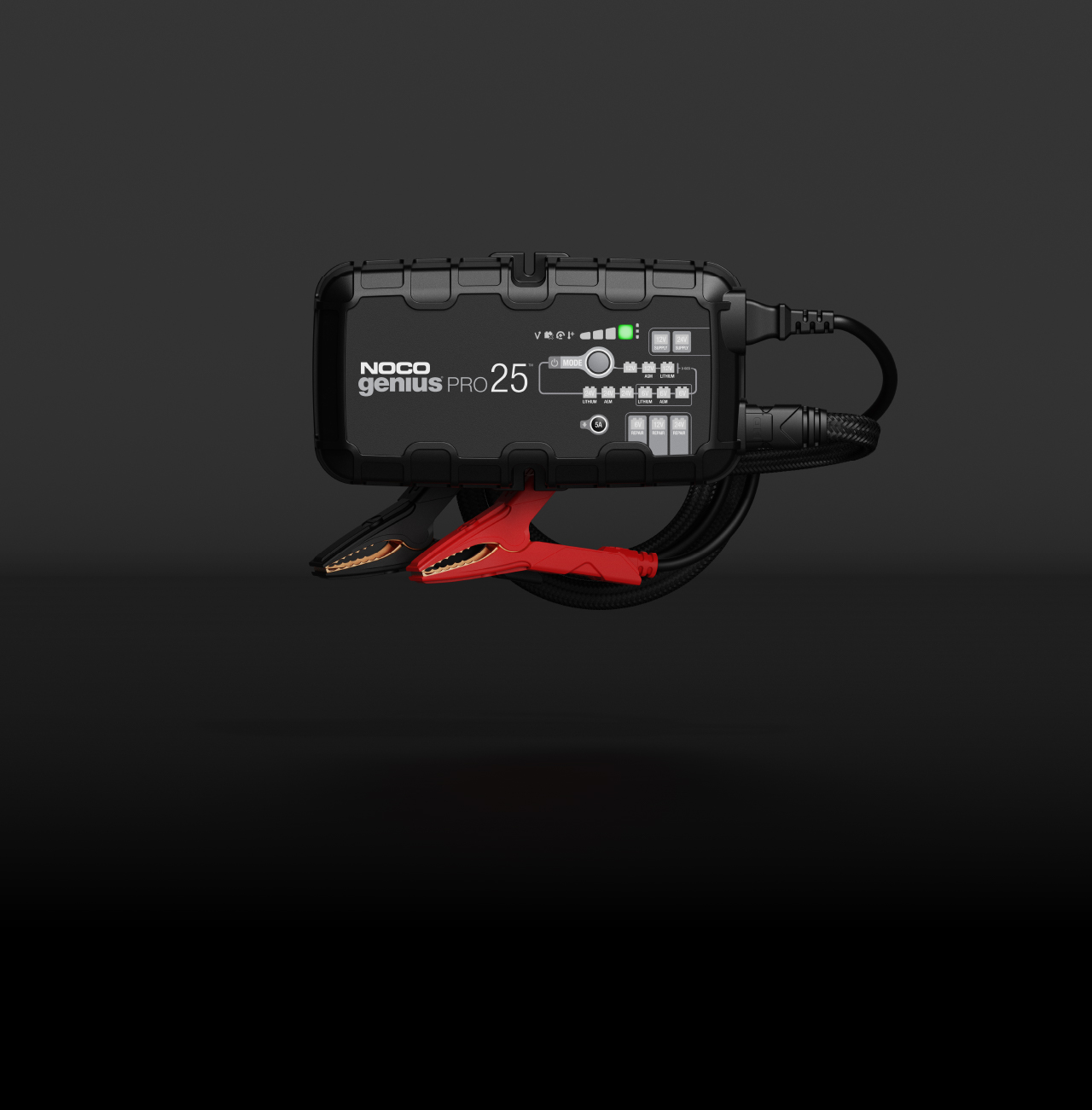
Explore this need in the finder →The NOCO GENIUSPRO25 is a portable, single-output AC charger built around a much higher charge rate and broader voltage coverage than the small plug-in maintainers in the same brand's GENIUS line. This research-based review compares NOCO's current North American model page, technical specifications, support material, user guide and data sheet; it is not a hands-on test. Its standout difference is that it has distinct battery modes for 6 V, 12 V and 24 V systems, while the 25 A label applies to 6 V and 12 V charging and falls to 12.5 A at 24 V.
A portable 25 A charger, not a multi-bank or permanent unit
NOCO places GENIUSPRO25 in its GeniusPRO professional charger family. It is a portable device with one battery connection, an AC input and removable connector arrangement. That makes it a different kind of purchase from the installed GENIUS2D or from the two- and four-output GENIUS2X2 and GENIUS2X4. A single high-current output does not charge several batteries independently; it serves one connected battery at a time. The exact model page explicitly lists automotive batteries, which places the model inside this site's car-charger scope even though NOCO also mentions marine, RV, powersports and deep-cycle use.
For 6 V and 12 V battery plans, the rated output is 25 A; for 24 V it is 12.5 A. The manual also documents a 5 A reduced-current mode for its charge profiles, and its mode table lists that setting for batteries up to 200 Ah. It is a lower selectable rate for smaller batteries—not a way to carry the 1,000 Ah (6/12 V) or 500 Ah (24 V) rated-mode ceiling down to 5 A. Check the battery maker's accepted charging current before choosing either setting. A charger should not be selected by maximum amperage alone.
Separate modes matter more than the broad chemistry label
The North American guide lists standard lead-acid profiles for wet/flooded, gel, enhanced flooded (EFB), maintenance-free and calcium batteries, with a separate AGM profile at 6 V, 12 V and 24 V. It also lists distinct LiFePO₄ lithium profiles for all three voltages. NOCO requires a built-in battery management system for those lithium modes. The model therefore fills a gap in the currently reviewed smaller GENIUS chargers: unlike those products, this guide explicitly supports 6 V LiFePO₄. Lithium compatibility is still conditional; verify the exact pack chemistry, BMS and battery maker's recommended voltage and rate rather than assuming that any product called “lithium” is suitable.
Use the voltage and chemistry printed on the battery or its instructions to choose a mode. The selected profile's nominal voltage must agree with the battery, and AGM is not a synonym for the standard lead-acid mode. NOCO's manual gives different charging voltages for standard and AGM settings. Its capacity guidance is also voltage-specific: up to 1,000 Ah for 6 V and 12 V batteries, and up to 500 Ah at 24 V. Those stated ceilings are about supported rated-profile charging capacity; the separate 5 A reduced-current table is limited to batteries up to 200 Ah, while the maintenance claim says “all battery sizes.” The maintenance wording is not a reason to charge a depleted battery beyond its stated capacity limit, and the higher rated-profile ceiling does not expand the 5 A setting’s limit. Neither claim promises a particular charge time or restores a damaged battery.
Supply, Force and Repair are distinct advanced functions
GENIUSPRO25 is not only a battery charger. Its separate Supply mode produces 13.6 V for compatible 12 V DC equipment and 27.2 V for compatible 24 V devices, including vehicle memory retention during battery work. The manual distinguishes continuous output from maximum output: 20 A continuous/25 A maximum for 12 V, and 10 A continuous/12.5 A maximum for 24 V. This mode is not an alternate battery-charging profile. NOCO directs the user to select it with the clamps disconnected and warns that safety features are disabled and the connectors remain live. A device's required voltage, current and polarity still need to be checked.
Force mode can begin a charge when the battery is below the normal detection threshold, but the manual warns that it also disables safety features and exposes live connectors. It should not be used to make an unknown or damaged battery an acceptable match. Repair mode applies a higher voltage to an existing lead-acid battery in an attempt to address sulfation or stratification; it can take hours, may affect vehicle electronics, and NOCO says not all batteries can be recovered. These functions reward a careful reader of the instructions rather than a buyer who wants a simple, unattended accessory.
Plan the outlet, ventilation and exact package
The charger accepts 100–240 V AC at 50–60 Hz and lists a maximum power draw of 375 W. It weighs 2.7 lb and measures about 9.21 × 2.95 × 5.16 inches on the current specifications page. Forced-air cooling, a single output and the manual's dry, well-ventilated placement requirements matter when deciding where it can sit. Although the product page discusses marine battery applications, the user guide says a boat battery must be removed and charged ashore unless the equipment is specifically designed for onboard marine charging. The case is marked IP20; NOCO says not to submerge or get the charger wet. “Portable” does not mean weatherproof or suitable for a permanent wet-space installation.
The current spec page lists interchangeable connectors, HD clamps with integrated eyelets, a 10-foot extension cord, an EVA case, mounting screws and several regional AC-cable types. Verify the current seller's exact contents, especially for an incomplete used package. NOCO's documents also disagree on details that affect installation: its specifications page gives a 64.8-inch DC lead-plus-clamp length while the manual estimates about 72 inches; the page says the upper operating temperature is 60°C while the manual and data sheet say 50°C; and the exact specifications/data sheet list a 30 A ANL fuse while overview copy says 35 A. This assessment uses the more conservative manual temperature limit and does not choose between conflicting cable or fuse values. Check the model-specific instructions and actual hardware rather than designing around a blended specification.
Who should compare it
GENIUSPRO25 is worth comparing when one compatible 6 V, 12 V or 24 V battery needs a selectable high-current charger, the battery maker permits the rate, or the documented lower-current mode is useful. It also offers unusual breadth for a portable model, including 6 V lithium and separate 12 V/24 V device-supply modes. If the job is an ordinary 12 V battery at modest current, the lighter and lower-output GENIUS10 or GENIUS5 may be a simpler comparison. If several batteries must remain connected on independent outputs, this single-output design is the wrong layout. Always confirm the exact battery label, charging-rate allowance, AC access, lead reach and manual cautions before choosing a mode.
Key specifications
Key details at a glance
| Output battery voltages | 6 / 12 / 24 V |
|---|---|
| Supported chemistries | Lead-acid / Lithium-ion |
| Rated DC charging current | 25 A |
| Published charge capacity limit | 1000 Ah |
| Maintenance claim | Yes |
| Independent battery outputs | 1 |
| Arrangement | Portable plug-in charger |
| Ingress rating | IP20 |
| Minimum operating temperature | -20 °C |
| Maximum operating temperature | 50 °C |
| Included connection | Interchangeable connector and one set of HD clamps with integrated eyelets; exact seller package contents should be checked. |
Use the exact model’s instructions for operating limits, supplied equipment and version differences.
Sources for this review
Sources for this assessment
Keep the next step evidence-led
Use the finder to combine voltage, battery chemistry, charging job and setup requirements; then check the exact model and its manual.