
Your needs, this model
Does it fit your priorities?
Can the GENIUS5 charge a 12 V AGM battery rated up to 120 Ah?
NOCO documents a separate 12 V AGM profile, 5 A output and charging up to 120 Ah. It is a one-output portable charger, not a multi-bank or jump-start device. Confirm that the battery maker permits the profile and rate; NOCO's approximate charge-time chart is not a measured guarantee.
Explore this need in the finder →Will the GENIUS5 charge a 12 V LiFePO4 battery?
NOCO lists a 12 V lithium mode, including LiFePO4, but the North American guide restricts it to a lithium battery with a built-in BMS. Confirm the battery maker's voltage and permitted charging current before using that mode; this is not a 6 V lithium charger.
Explore this need in the finder →Can the GENIUS5 charge a 6 V AGM battery?
Its exact North American mode list gives 6 V wet, gel, EFB, maintenance-free and calcium lead-acid profiles, but does not document 6 V AGM. Do not substitute the 12 V AGM setting; verify the battery maker's recommendation and choose a charger whose exact manual names the required voltage and subtype.
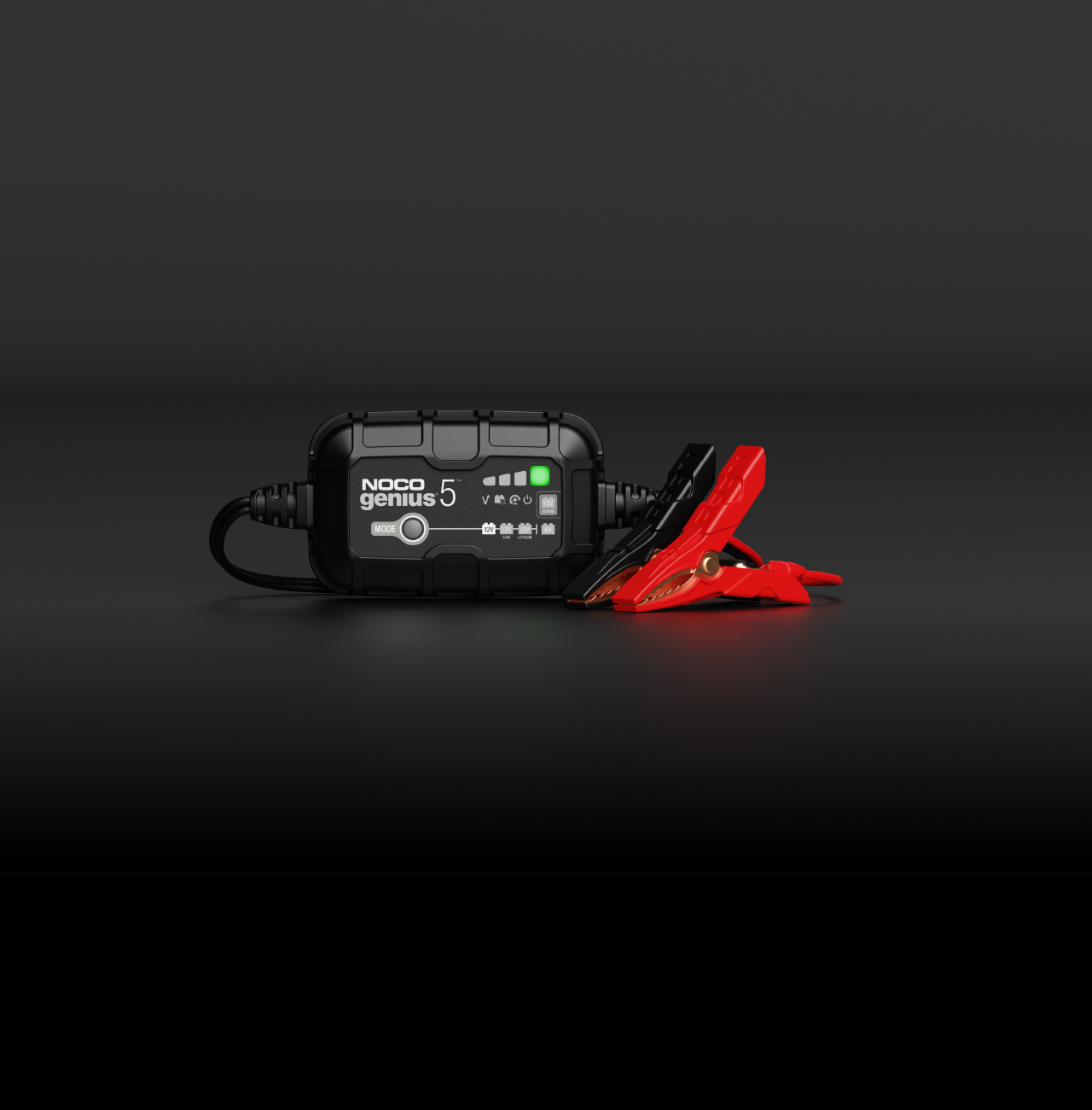
Explore this need in the finder →The NOCO GENIUS5 is a portable, single-output charger for shoppers who need more charging current than the GENIUS1 or GENIUS2 provides, but do not need an installed multi-bank unit. Its documented envelope is 5 A for one 6 V or 12 V battery, charging up to 120 Ah and maintaining batteries of all sizes. This is a source-based assessment of the North American GENIUS5, not a hands-on test.
What the 5 A rating changes
GENIUS5 sits between NOCO’s smaller Genius chargers and the larger GENIUS10 in both current and stated charging capacity. Compared with the reviewed GENIUS2, it raises the output from 2 A to 5 A and the published charge-capacity ceiling from 40 Ah to 120 Ah. The GENIUS1 is a still slower 1 A model with a 30 Ah stated charging ceiling. Those are meaningful differences if the charger will recover a partly discharged battery; none makes the unit an instant-start booster. NOCO’s manual estimates 15 hours for a 100 Ah battery at 50% depth of discharge and 18 hours for 120 Ah. Those are the manufacturer’s approximate chart figures, not measured results, and real time depends on battery condition, temperature, and charge acceptance. The device remains a one-battery portable charger, not a dual-bank system or an on-board installation. It needs an AC outlet and a safe route for the leads. NOCO lists a 77-inch DC lead-plus-clamp reach and a 71.7-inch AC cord, so check the whole outlet-to-battery path rather than assuming either cord can reach by itself. The specs list a compact 4.61 × 1.93 × 2.91-inch body at 1.5 lb, an IP65 enclosure, and a three-year limited warranty. A mounting bracket, strap, screws, interchangeable connector and clamps with integrated M6 eyelets are listed in the manufacturer’s package details; verify the exact package on any seller offer, especially for an open-box unit.Match the mode to the exact battery
The documented 12 V profiles include ordinary lead-acid, a distinct AGM mode, and a lithium-ion mode. The lithium setting includes LiFePO₄, but NOCO restricts it to 12 V lithium batteries with a built-in battery management system (BMS). The battery maker’s voltage and current instructions still control. The GENIUS5 also has a 6 V lead-acid mode for wet/flooded, gel, EFB, maintenance-free and calcium batteries. The manual does not list a 6 V AGM mode, so a 6 V AGM owner should not treat the 12 V AGM setting as interchangeable; the GENIUS10 is the Genius model in this reviewed library whose exact manual documents 6 V AGM. Force Mode is a separate, manual start for a battery below the charger’s 1 V detection threshold. NOCO warns that Force Mode disables safety features and leaves live power at the connectors. It is not a routine mode or a way to establish that a battery is healthy. The 12 V Repair mode is also specialized: the guide limits it to 12 V lead-acid batteries, says not all batteries can be recovered, and warns that its high voltage can affect vehicle electronics. Follow the guide’s disconnection and safety instructions before considering it.Charging and maintenance are different jobs
The stated 120 Ah limit is the manufacturer’s charging-capacity range. “Maintains all battery sizes” is a separate claim about keeping a compatible, already charged battery up; it does not enlarge that recovery-charging ceiling. NOCO describes automatic maintenance, yet the general safety section of the North American manual also says not to leave the product unattended while in use. The useful conclusion is not to infer blanket permission for an unsupervised garage or storage setup. Read the full current charger and battery instructions and plan supervision, ventilation, cable routing and protection from damage. The IP65 specification should likewise be read alongside the safety manual, which says not to submerge the product or get it wet and to keep it dry. Do not turn a housing rating into permission to charge in a wet location. The documented operating range is -4°F to 104°F (-20°C to 40°C); the manual also says not to charge a frozen battery.Who should compare the GENIUS10
The GENIUS5 is the more compact, lighter choice of these two when 5 A and a 120 Ah charge limit are enough. The GENIUS10 doubles the stated output to 10 A, covers charging up to 230 Ah, and adds a separately documented 6 V AGM profile and a 13.6 V DC supply mode. In exchange it is larger and weighs 3.33 lb. That supply function is not battery charging; it is a separate high-attention mode. If either capability is essential, read the GENIUS10’s guide and compare its package rather than stretching the GENIUS5’s specifications. NOCO’s GENIUS5 current specs and data sheet list 120–240 V AC input, while its North American guide lists 100–240 V. The 120 V US supply is common to those statements, but the public documents do not agree on the lower limit; verify the current label and guide before assuming use on another supply. The charging decision is more straightforward: check battery voltage, chemistry, subtype, capacity and permitted current, then select the model’s matching mode. If any of those are uncertain, confirm them with the battery maker instead of relying on the charger’s broad family claims.Key specifications
Key details at a glance
| Output battery voltages | 6 / 12 V |
|---|---|
| Supported chemistries | Lead-acid / Lithium-ion |
| Rated DC charging current | 5 A |
| Published charge capacity limit | 120 Ah |
| Maintenance claim | Yes |
| Independent battery outputs | 1 |
| Arrangement | Portable plug-in charger |
| Ingress rating | IP65 |
| Minimum operating temperature | -20 °C |
| Maximum operating temperature | 40 °C |
| Included connection | Interchangeable charger connector; clamps with integrated M6 eyelets |
Use the exact model’s instructions for operating limits, supplied equipment and version differences.
Sources for this review
Sources for this assessment
Keep the next step evidence-led
Use the finder to combine voltage, battery chemistry, charging job and setup requirements; then check the exact model and its manual.