
Your needs, this model
Does it fit your priorities?
Can the GENIUS10 charge a 6 V AGM battery?
NOCO's exact North American guide lists a distinct 6 V AGM mode at a higher-than-normal charging voltage. Check the battery maker's recommended voltage/current and capacity before using it; the 6 V AGM mode is not listed for the GENIUS5 and should not be substituted with a 12 V AGM profile.
Explore this need in the finder →Does the GENIUS10 have a 12 V power-supply mode?
Yes. The separate 13.6 V Supply mode is specified at 10 A with overload protection at 12 A maximum. It powers compatible 12 V DC devices or can retain vehicle settings during battery work; it is not a battery-charging mode. The guide says to select Supply with clamps disconnected and warns that live power is present and safety features are disabled.
Explore this need in the finder →Will the GENIUS10 charge a 12 V LiFePO4 battery?
NOCO documents a 12 V lithium mode including LiFePO4, but restricts it to batteries with a built-in BMS. The rated output is 10 A and the stated charging capacity is up to 230 Ah; confirm the battery maker's acceptable current and voltage before selecting the mode.
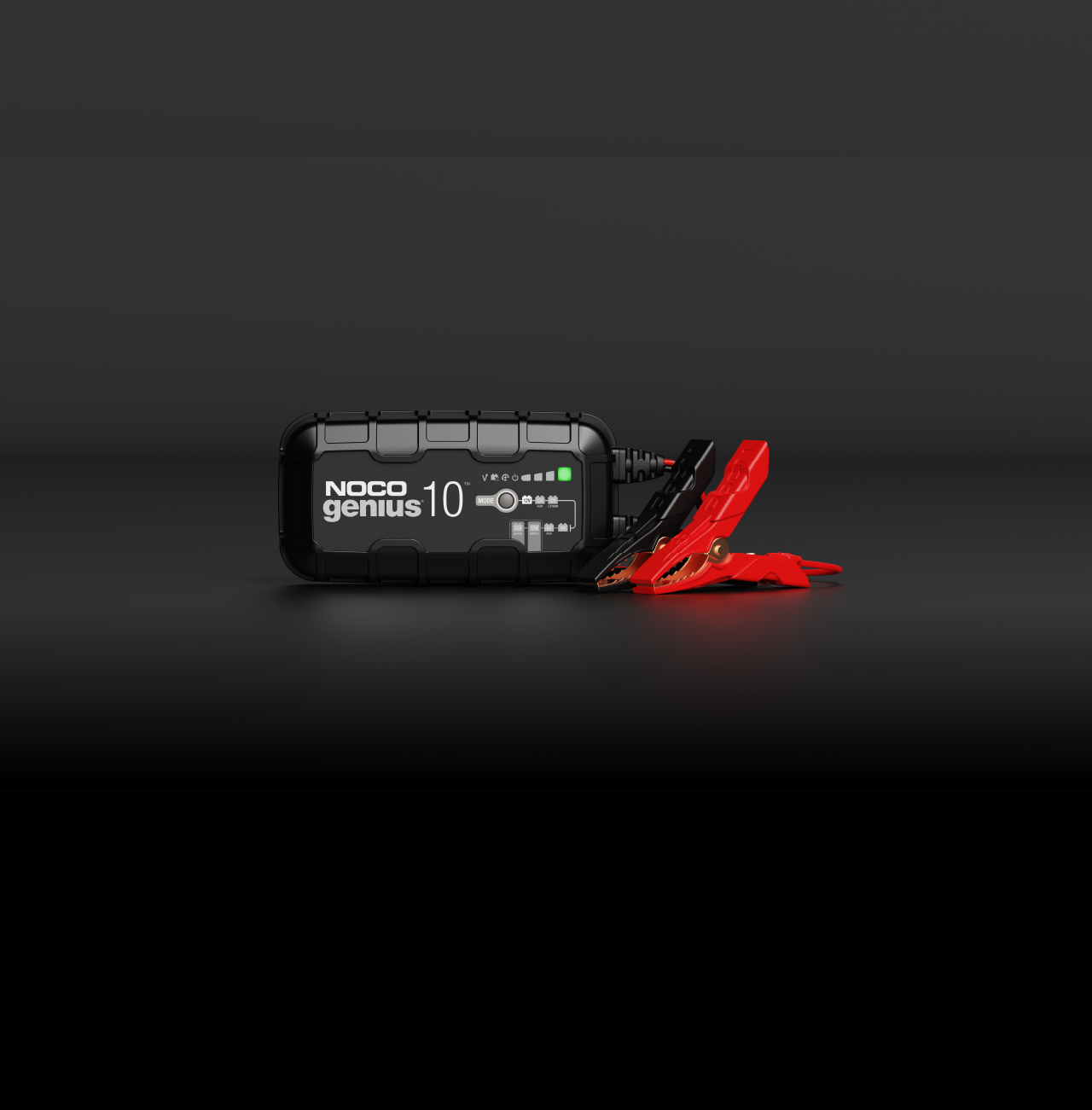
Explore this need in the finder →The NOCO GENIUS10 is the higher-output portable member of this reviewed Genius group: a single-output charger rated at 10 A for supported 6 V and 12 V batteries, with a stated charging range up to 230 Ah. Its distinction is not just the larger current. NOCO’s exact North American guide also documents a 6 V AGM mode and a separate 13.6 V supply mode, neither of which should be confused with ordinary battery charging. This is a source-based assessment, not a hands-on test.
More charging headroom, with a larger unit
The GENIUS10 doubles the GENIUS5’s listed output from 5 A to 10 A and raises the stated charging-capacity ceiling from 120 Ah to 230 Ah. That is relevant for larger batteries when the battery manufacturer permits the rate and the user wants a portable AC-powered charger. It remains one output for one battery arrangement, not a multi-bank charger or an on-board device. NOCO’s manual gives approximate charging estimates at 50% discharge, but those figures are manufacturer estimates rather than measured performance; battery condition, temperature, and its permitted acceptance rate change the outcome. The current specs page describes a 7.2 × 2.32 × 3.7-inch body at 3.33 lb, IP65 housing, 77 inches of DC cable plus clamps, and a 71.7-inch AC lead. Its listed package includes an interchangeable charger connector, clamps with integrated M10 eyelets, bracket, strap and two mounting screws. The retail data sheet lists UPC 0-46221-19005-2; that is a UPC, not a separately published retailer SKU. Check the listing’s exact model label, connector package, cable route and return terms rather than assuming a seller’s photos show what is included. For comparison, the GENIUS5 is smaller and lighter (1.5 lb) with 5 A and a 120 Ah stated charge limit. It handles the listed 6 V lead-acid profiles and 12 V AGM/lithium options, but its manual does not list 6 V AGM or a 12 V DC supply mode. The GENIUS10 documents both. It may justify the extra size for those needs; it is not a reason to select the faster profile without checking the battery’s instructions.Separate profiles matter
The GENIUS10 manual lists 6 V and 12 V lead-acid modes, dedicated 12 V and 6 V AGM modes, and a 12 V lithium mode. The lithium profile includes LiFePO₄ but is restricted to a battery with a built-in BMS. NOCO’s guide says the 6 V AGM setting uses a higher-than-normal charging voltage, so “6 V” alone is not enough to choose a mode. Confirm chemistry and recommended charging voltage at the battery itself. The charger is not documented here as a 6 V lithium charger. For deeply discharged batteries below its 1 V detection threshold, Force Mode requires deliberate manual selection. The guide warns that it disables safety features and presents live power at the connectors. Treat it as a safety-sensitive recovery function, not a diagnostic result or a shortcut around checking the battery. Similarly, the 12 V Repair mode is for 12 V lead-acid batteries only, can drive voltage up to 16.5 V, may take up to four hours, and cannot recover every battery. NOCO warns that the voltage can affect vehicle electronics and advises disconnecting the battery before using the mode.The 12 V supply mode is a different task
GENIUS10’s 13.6 V Supply mode powers compatible 12 V DC devices or can retain vehicle computer settings during battery repair or replacement. The guide specifies 13.6 V at 10 A, overload protection at 12 A maximum, and says to enter this mode with the clamps not connected. It also warns that Supply mode disables safety features and leaves live power at the connectors. This mode is not for charging a car battery; it is a separate application that calls for the exact manual and device instructions.Limitations to weigh
The portable format still requires an AC outlet and a safe cable path; it is not an installed charger, jump starter, or multi-bank system. The IP65 listing does not override NOCO’s safety instruction not to submerge the charger or get it wet; keep it dry and within the documented -4°F to 104°F operating range. The general safety section also says not to leave the product unattended while in use, even though the product is intended to provide maintenance after a full charge. Do not read a maintenance claim as unconditional approval of an unsupervised location. There is also a document mismatch worth checking: the current exact-model specs page lists 120–240 V AC input, while the North American guide and January 2026 data sheet list 100–240 V. All reviewed documents include 120 V, but the lower limit is inconsistent. Verify the exact charger label and current official instructions before relying on the broader range. The practical fit question is whether the battery’s chemistry, voltage, subtype, capacity and recommended charge rate align with a single 10 A output, and whether the separate 6 V AGM or DC-supply capability is genuinely needed.Key specifications
Key details at a glance
| Output battery voltages | 6 / 12 V |
|---|---|
| Supported chemistries | Lead-acid / Lithium-ion |
| Rated DC charging current | 10 A |
| Published charge capacity limit | 230 Ah |
| Maintenance claim | Yes |
| Independent battery outputs | 1 |
| Arrangement | Portable plug-in charger |
| Ingress rating | IP65 |
| Minimum operating temperature | -20 °C |
| Maximum operating temperature | 40 °C |
| Included connection | Interchangeable charger connector; clamps with integrated M10 eyelets |
Use the exact model’s instructions for operating limits, supplied equipment and version differences.
Sources for this review
Sources for this assessment
Keep the next step evidence-led
Use the finder to combine voltage, battery chemistry, charging job and setup requirements; then check the exact model and its manual.