
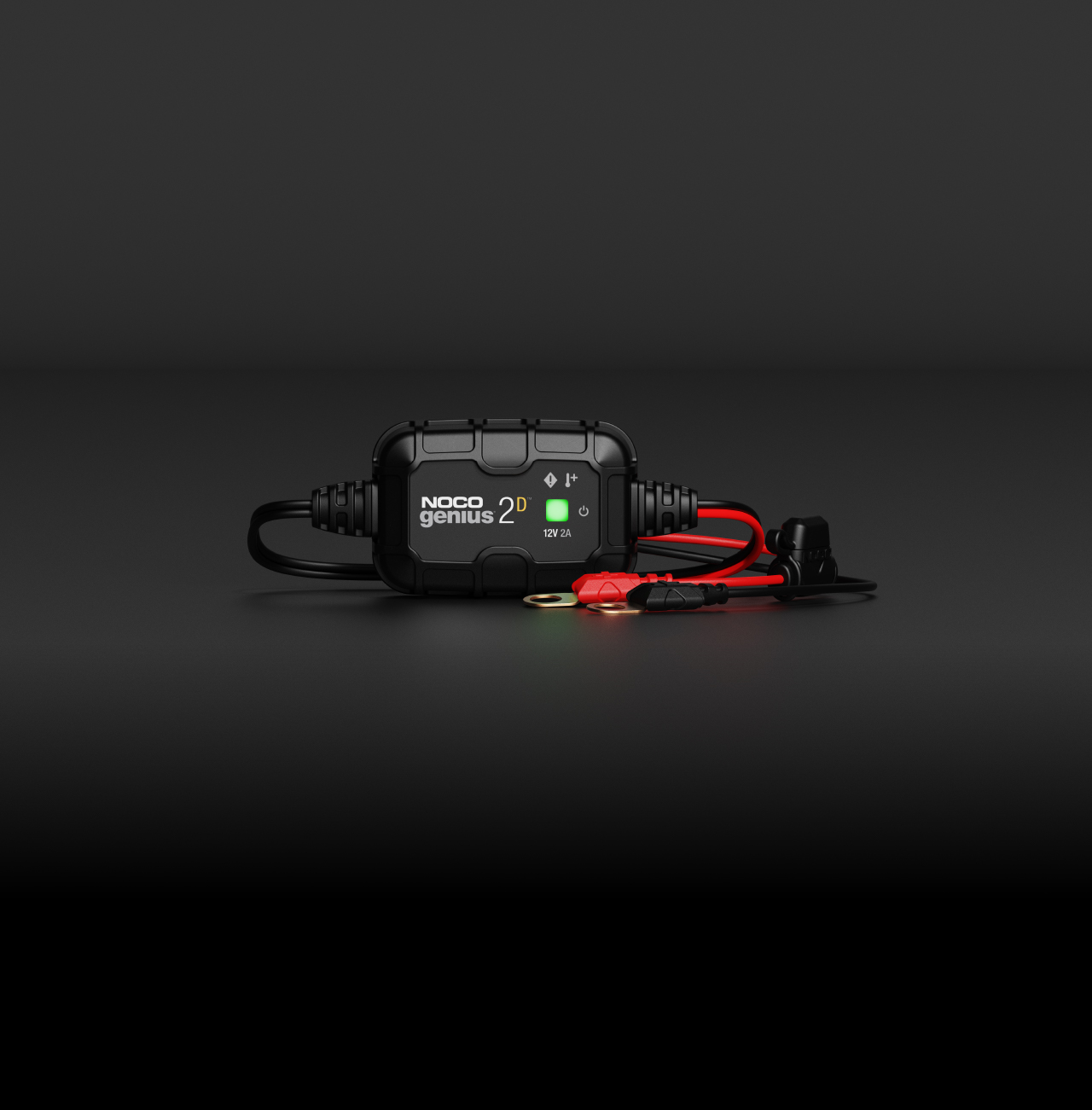
Your needs, this model
Does it fit your priorities?
Can the GENIUS2D stay mounted for storage maintenance on a 12 V car battery?
NOCO describes the GENIUS2D as a direct-mount charger and maintainer designed to remain connected, and says it can maintain all battery sizes after charging. It is only for 12 V lead-acid batteries and its stated charging limit is 40 Ah. Mount it near, never directly on, the battery; keep it ventilated, dry and clear of moving parts, and follow the battery and charger manuals. The manual warns against unattended use even though the product page discusses continuous operation, so do not treat that claim as a blanket safety permission.
Explore this need in the finder →Will the GENIUS2D charge a 12 V AGM battery?
Yes, NOCO lists AGM among the supported 12 V lead-acid types. Its only charging mode is 12 V NORM at 2 A, with a published charge-capacity ceiling of 40 Ah; there is no separate AGM-only mode. Confirm that the battery manufacturer approves that charging profile and rate. The model is an on-board/direct-mount unit, not a portable clamp charger.
Explore this need in the finder →Can the GENIUS2D revive a battery below one volt with Force Mode?
No. NOCO's support FAQ says the GENIUS2D does not include Force Mode, and its North American guide lists low-voltage detection at 1 V. Do not confuse automatic maintenance or a 40 Ah charge limit with a zero-volt recovery capability. A deeply discharged, damaged or frozen battery needs the battery maker's guidance or professional evaluation rather than an improvised mode.
Explore this need in the finder →A charger meant to stay near the battery
NOCO presents the GENIUS2D as a 2 A direct-mount charger and maintainer for installation near a battery. It suits someone planning a fixed charging point with protected cable routing, suitable mounting space and AC power. Its one output serves one battery connection; “2D” does not mean two banks.
The North American guide describes a 12 V lead-acid charger, and the current specification and support FAQ list 12 V only. NOCO names flooded or wet, gel, AGM, EFB, calcium and maintenance-free batteries. The guide describes one automatic 12 V NORM mode, not a separate AGM or lithium profile. In the manual that mode is shown at 14.5 V and 2,000 mA. Check the battery's label and instructions, then confirm that its maker permits this voltage profile and current. This model is not documented for 6 V batteries, lithium-ion or LiFePO4; do not treat a familiar brand name or a 12 V connector as chemistry compatibility.
Charging a depleted battery versus maintaining one
NOCO's exact-model sources put a boundary around recovery charging: the stated capacity is up to 40 Ah. They also say the unit can maintain all battery sizes once a compatible battery is charged. Those claims address different jobs. A healthy battery that is already full may fit the maker's maintenance claim even when its capacity is above 40 Ah; a depleted battery larger than 40 Ah does not become an approved charging match because maintenance is listed for all sizes.
The manufacturer gives illustrative times for 8, 12, 24 and 40 Ah batteries at an assumed 50% depth of discharge, with the 40 Ah example at about ten hours. Those are planning examples, not a guarantee for a particular battery. Starting charge, temperature, battery condition and charging acceptance all matter. The 2 A output is intentionally modest; it may make sense for periodic upkeep or smaller batteries, but someone who needs faster recovery should compare the required rate with the battery maker's limits and consider a model whose documented output is higher.
There is an important supervision caveat. Product copy describes continuous maintenance and the guide says the charger may remain connected to provide maintenance charging; elsewhere the guide warns not to leave the product unattended while in use. I would not flatten those into blanket permission for an unmonitored installation. Use the battery and vehicle instructions, maintain safe access to the setup, and stop if a battery is damaged, frozen, unexpectedly hot or otherwise suspect.
Installation is part of the decision
The intended setup is more involved than clipping on a portable charger when needed. NOCO's instructions say to secure the supplied bracket to the vehicle chassis with two self-tapping screws, loop the strap through it and clip the charger into place. The charger belongs near, but not directly on, the battery; the manual also warns against restricted ventilation, acid contact and placing the battery on top of the unit. Cables must be secured away from fan blades, belts, pulleys, hood or door pinch points and other moving parts. The AC lead and battery connections are each listed at roughly 24 inches, so measure the physical route before choosing a mounting location.
NOCO's data sheet describes the DC lead as ending in eyelets, which makes the fixed-mount arrangement relevant: confirm the battery connection and installation procedure rather than assuming the pictured clamps are included. The current technical-specification box list names the charger, bracket with strap, screws and safety information; the data sheet additionally depicts a 24-inch eyelet lead. Check the exact current retail package and connector before purchase. The data sheet gives UPC 0-46221-18013-8; that is not a separate retail SKU or proof that a seller has this exact package in stock.
Environment and limitations
The current specifications and North American guide give an operating range from -20 to 60 °C, with storage from -40 to 100 °C in the guide. An IP65 rating is listed, but the manual still directs users to operate and store the product in dry locations, not to submerge it or use it when wet. The product page's broad language about rugged use or all-weather charging should not replace those exact instructions. The built-in thermal sensor adjusts charging as ambient temperature changes; that is useful context, not permission to mount it where heat, vibration or liquid exposure exceeds the documented conditions.
For very low batteries, the support FAQ specifically says the GENIUS2D lacks Force Mode. The guide lists a 1 V detection threshold, so this is not a documented zero-volt recovery tool. It also has no power-supply mode for running a separate DC device. The reported body dimensions differ between the current specs page and the user guide's dimensions table; measure the exact unit and bracket rather than relying on a blended estimate.
Who should compare another format?
Choose this arrangement only if the benefit of a small, fixed, near-battery charger outweighs the installation work and short leads. For occasional charging from a wall outlet, the portable GENIUS2 is a different choice: it supports both 6 V and 12 V modes and uses portable connections, while the GENIUS2D is limited to 12 V lead-acid and has a direct-mount purpose. For higher current, a larger portable or professional model may be a better starting point. For multiple batteries, compare actual bank counts; the GENIUS2D is a one-bank unit. In every case, inspect the exact model suffix, voltage, chemistry, connection and manual rather than choosing from the GENIUS family name alone.
This assessment is based on manufacturer documentation, not a hands-on test. It does not establish charging time for an individual battery, the condition of a battery or vehicle, nor the contents or availability of a particular seller's package.
Primary sources checked: NOCO's GENIUS2D overview, technical specifications, support and mode information, North American user guide and manufacturer data sheet.
Key specifications
Key details at a glance
| Output battery voltages | 12 V |
|---|---|
| Supported chemistries | Lead-acid |
| Rated DC charging current | 2 A |
| Published charge capacity limit | 40 Ah |
| Maintenance claim | Yes |
| Independent battery outputs | 1 |
| Arrangement | On-board charger |
| Ingress rating | IP65 |
| Minimum operating temperature | -20 °C |
| Maximum operating temperature | 60 °C |
| Included connection | 24-inch DC cable with eyelet terminals per the manufacturer data sheet |
Use the exact model’s instructions for operating limits, supplied equipment and version differences.
Sources for this review
Sources for this assessment
Keep the next step evidence-led
Use the finder to combine voltage, battery chemistry, charging job and setup requirements; then check the exact model and its manual.