
Your needs, this model
Does it fit your priorities?
Can the SC1324 maintain a 12 V AGM battery during storage?
Its page-linked manual documents a 12 V AGM lead-acid plan and automatic transition from its 6/2 A charge setting to maintain. It still calls for occasional monitoring, and the manual says to investigate excessive draw or an aborted charge rather than treat maintenance as unattended diagnosis.
Explore this need in the finder →Is the SC1324 a reasonable 12 V gel-battery charger?
The linked manual explicitly names GEL along with STD and AGM lead-acid batteries. The ordinary selection is 6/2 A, not 40 A; follow the battery maker's charging instructions and do not treat the example time chart as a universal battery-capacity range.
Explore this need in the finder →Does the SC1324 give me a stand-alone jump start without the vehicle battery?
No. It is a corded charger with a separate page-rated 200 A engine-start mode. Its manual says to use that mode only with a battery installed, limits individual cranking to seven seconds and requires a three-minute cooling interval; it is not a battery-free jump pack.
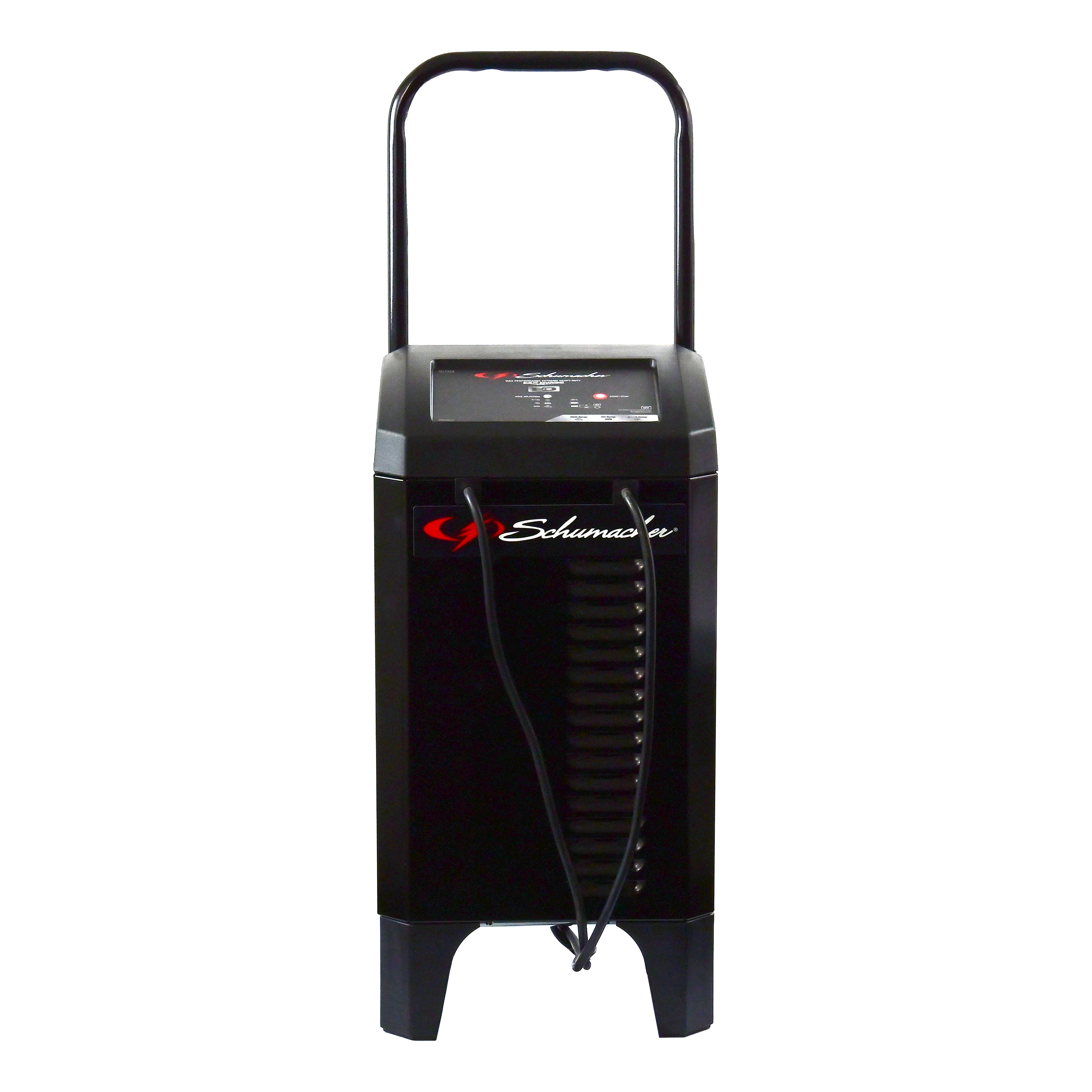
Explore this need in the finder →The SC1324 is the rolling-shop version of a car battery charger: a tall wheeled cabinet, a 120-volt cord and a conventional clamp connection, with a basic automatic charge-and-maintain path plus separate boost and engine-start settings. It is a plausible fit when a garage needs a floor-standing 12-volt charger that is easier to move than to lift and the extra starting function is useful. It is a poor fit for someone who needs a compact maintainer, a 6-volt or lithium mode, a fixed on-board charger, or ordinary charging above the documented 6-amp setting.
What the SC1324 actually offers
Schumacher's current U.S. product page names the SC1324 and describes a wheeled automatic 12-volt charger with a 6-amp / 2-amp charge-and-maintain path, a separate 40-amp boost mode and a 200-amp engine-start mode. The linked owner's manual (0099002167-03) is more useful for operating boundaries than the headline numbers: select the 6/2-amp charge-maintain setting for charging, and treat Boost and Engine Start as distinct modes, not ordinary charger-current ratings. The manual says charge mode can briefly use Boost during its first ten minutes if needed, then return to the selected charge rate. That automatic sequence is not a reason to size the unit as a 40-amp everyday charger.
The current product page also advertises desulfation. The linked manual names a desulfation mode and says it can take eight to ten hours; it also says a failed desulfation attempt ends in an aborted charge and a warning light. Neither document establishes a guaranteed recovery or repair. A charger cannot certify that a worn or damaged battery is serviceable.
Battery fit, maintenance and environment
The current product page says 12 volts. The page-linked manual specifies rechargeable 12-volt lead-acid batteries, including STD, AGM and GEL modes. AGM and gel are explicit subtype matches; the manual's general “STD” label does not settle every narrower battery subtype a shopper may see, so check the battery maker's instructions rather than treating the charger as a universal fit for EFB, calcium or every flooded design. Lithium charging is not documented for this model.
After charging, the green Charged/Maintaining indicator means the unit has entered float-style maintenance. The manual describes a small current delivered when needed, but warns that sustained excessive maintenance current can trigger an abort and that battery, vehicle or load problems can affect the result. It calls for occasional monitoring even during extended maintenance. This is useful for keeping a healthy 12-volt lead-acid battery charged; it is not a promise that a failed battery can be revived or safely ignored.
SC1324 is a wheeled, portable-to-the-battery arrangement, not an on-board charger. It requires a properly grounded 120-volt AC outlet and a dry, ventilated work area; the manual says not to expose the charger to rain or snow. For a boat battery, the manual specifically says to remove it and charge it ashore. The product page lists 27.35 lb and a 12-by-23.5-by-11-inch envelope, so plan floor space and the path over thresholds rather than assuming “wheeled” means small or effortless to move. The picture is the exact page-associated SC1324 image, but its framing does not document every item in a retail box.
Starting power is a separate, supervised job
The 200-amp Engine Start label can be attractive in a home garage, but this is a corded charger, not a stand-alone battery jump pack. Schumacher's manual says to use Engine Start only with a battery installed in the vehicle. It calls for a connected, grounded setup; cranking is limited to seven seconds at a time, followed by a three-minute cooling period before another attempt. In very cold weather or with a battery below two volts, it directs the user to charge first. If the engine turns over but will not run, the manual says to stop cranking and investigate the vehicle rather than keep repeating the procedure.
Boost has a different purpose: the manual describes it as a short pre-start energy addition for a severely discharged or large-capacity battery. Do not add its 40-amp page rating to the ordinary 6-amp charge rating or assume it supplies a steady 40 amps for a routine recharge. A dead starter battery can also point to a fault, a parasitic load or a battery at end of life; the SC1324 is not a diagnostic conclusion.
Where it sits among wheeled chargers
Against Schumacher's SC1632, the meaningful distinction is voltage range: the SC1632 is a wheeled automatic 6/12-volt model, while the SC1324 page identifies this one as 12-volt only and gives it the 200-amp start label. The SC1633 is also wheeled, but its normal charge control is manual and its 10-amp 12-volt charging path is a different proposition; its boost and start figures must likewise be kept separate from routine charge current. A smaller plug-in maintainer such as the SC1357 gives up the cart and high-current start role in exchange for a simpler carry-and-store format. These are category comparisons from published configurations, not performance tests.
What to verify before choosing it
Confirm the exact SC1324 code, the 12-volt chemistry and subtype, a grounded outlet within reach, and enough clear indoor floor area. Do not interpret the ordinary charge path as a published amp-hour capacity range: the manual's chart gives example battery sizes and estimated times under stated assumptions, not a universal charging-capacity limit. Confirm the seller's exact package and return terms; the manufacturer page currently lists a one-year limited warranty, while the linked manual ends with a two-year warranty statement. That discrepancy needs confirmation for the exact unit and purchase channel rather than an assumption that either term automatically governs. The central buying assessment records those checks alongside the exact model and full review.
Key specifications
Key details at a glance
| Output battery voltages | 12 V |
|---|---|
| Supported chemistries | Lead-acid |
| Rated DC charging current | 6 A |
Use the exact model’s instructions for operating limits, supplied equipment and version differences.
Sources for this review
Sources for this assessment

Keep the next step evidence-led
Use the finder to combine voltage, battery chemistry, charging job and setup requirements; then check the exact model and its manual.