
Your needs, this model
Does it fit your priorities?
Can the SC1357 charge a 6 V AGM battery?
The exact page lists 6 V / 2 A output, and the exact manual supports 6 V operation and AGM lead-acid batteries. The manual says current automatically adjusts with battery size and does not publish an Ah range; check the battery maker's charging instructions before relying on this charger rating.
Explore this need in the finder →Can the SC1357 charge a 12 V AGM battery and maintain it afterward?
Schumacher's exact page lists 12 V / 6 A output and AGM compatibility. The manual says automatic charging enters maintenance after full charge and supports 12 V batteries, but it requires occasional monitoring and aborts if maximum maintenance current continues for 12 hours. The 6 A figure is not a safe-rate recommendation for a particular battery.
Explore this need in the finder →Does the SC1357 support a 12 V AGM maintenance task after storage?
The exact page names AGM batteries, and the linked manual says the charger maintains 12 V batteries after charge. It also requires occasional monitoring, forbids rain or snow exposure, and calls for grounded nominal 120 V AC. This is a portable charger, not an on-board marine unit.
Explore this need in the finder →The Schumacher SC1357 is a portable, single-output charger/maintainer for lead-acid batteries. Its exact product page lists automatic 6 V and 12 V detection, with output-current figures of 2 A at 6 V and 6 A at 12 V. The linked manual confirms standard lead-acid and AGM use, charging followed by maintenance, and a requirement for occasional monitoring. This is a source-based assessment, not a hands-on test.
Two battery voltages, but not two selectable rate dials
The SC1357's practical distinction is its automatic voltage detection. Schumacher says the unit detects 6 V or 12 V instead of asking the user to choose a voltage. The exact page's description states 2 A at 6 V and 6 A at 12 V. Those are charger-output capabilities, not a recommendation that every battery should be charged at the listed current. The manual says the charging current adjusts automatically with battery size and instructs owners to follow the battery maker's rate guidance.
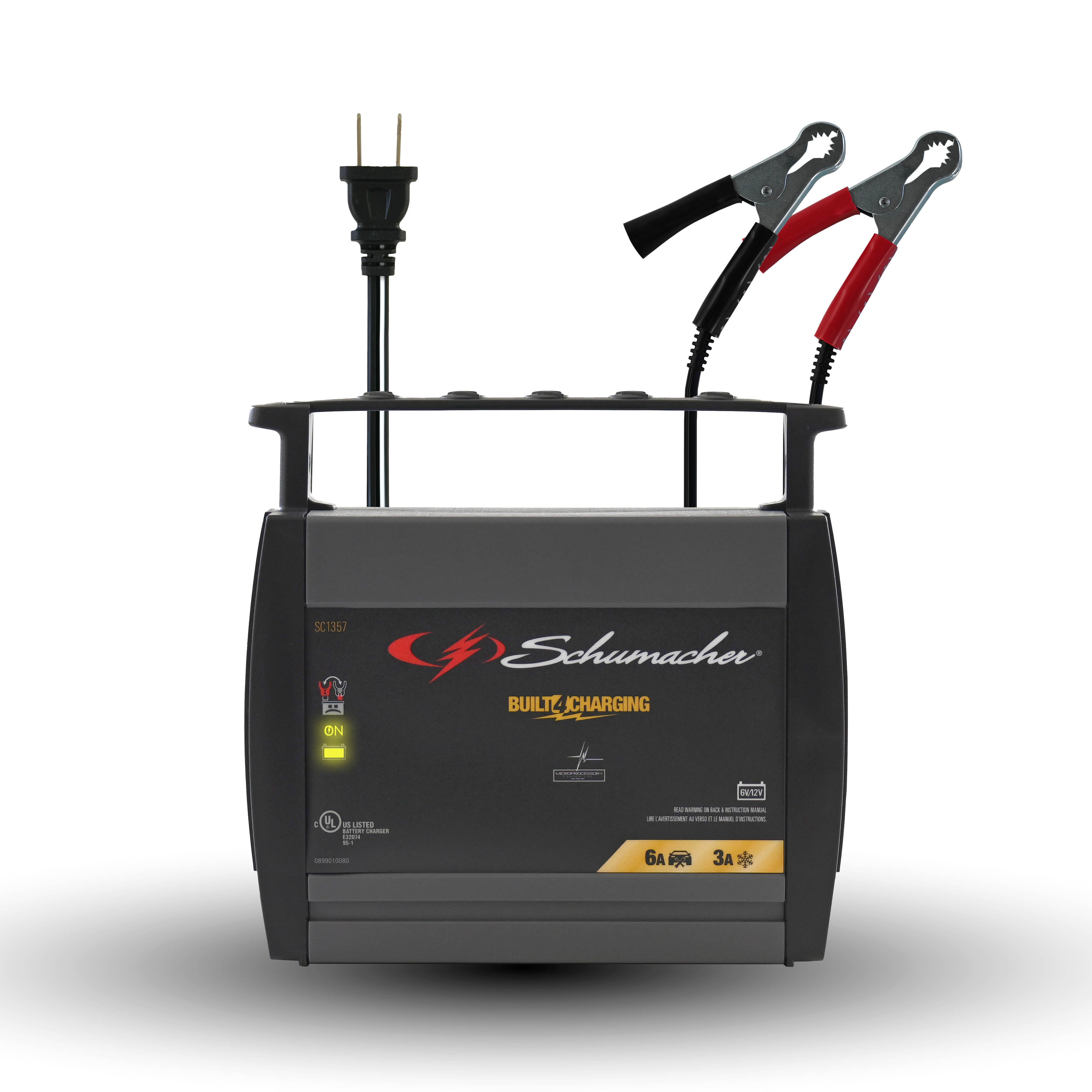
There is one rate detail that deserves caution. The official product page also describes a “3 A charge and maintain mode,” and the product photograph marks 3 A beside a snowflake symbol. The linked manual explains automatic charging and float-style maintenance but does not identify when that 3 A marking applies, which voltage it belongs to, or how it relates to the page's 2 A 6 V and 6 A 12 V output specification. I therefore do not treat 3 A as a separate, voltage-mapped charging plan. If the 3 A mode matters to your purchase, ask Schumacher for the current mode conditions and follow the supplied manual rather than inferring them from the image.
Lead-acid only, with AGM support stated
Schumacher's exact page lists standard and AGM batteries, and its manual restricts use to rechargeable standard or AGM lead-acid batteries. That supports a broad lead-acid fit and an explicit AGM match. It does not document a lithium mode. The manual's word “standard” is not a detailed list of flooded, EFB, gel, maintenance-free or calcium subtypes, so those more specific questionnaire labels should not be inferred from it. Confirm the battery label and the manufacturer's instructions before connecting the charger.
Because SC1357 detects the battery voltage automatically, the user is not choosing between a 6 V and 12 V selector position. That is convenient when the correct battery is clear, but it makes verifying the battery's nominal voltage before use especially important. The manual includes voltage troubleshooting thresholds and cautions; it does not turn a failed or deeply discharged battery into a routine recovery case. Desulfation and bad-battery indications are described as charger functions, not proof that a battery can be restored.
Charging ends in maintenance, but supervision still matters
The linked owner’s manual says automatic charging switches to maintenance after the battery is full and that the charger maintains both 6 V and 12 V batteries. It describes the maintenance output as a small current supplied when needed, rather than stating a universal maintenance-current value. It also says the charger should be checked occasionally during extended use. If it has to supply its maximum maintenance current for 12 continuous hours, it aborts; the instructions point to battery condition or an electrical drain as possible causes. This is useful for maintaining a healthy battery, but it is not a reason to treat the unit as an unattended, ignore-it-for-months installation.
The page's three-amp wording and snowflake-marked image do not override that manual language. In particular, no source reviewed here says that maintenance current is continuously 3 A. Capacity is another limit to keep visible: the manual presents charge-time examples for different kinds of batteries, but the product page and manual do not publish one universal amp-hour charging range. A current rating or example chart is not an Ah ceiling.
Portable indoor equipment, not an on-board marine charger
The manual calls for a properly grounded nominal 120 V AC circuit, a dry, non-flammable operating surface and no exposure to rain or snow. It also recommends ventilating the battery area and routing the AC and DC leads clear of moving engine parts. The exact page describes six-foot power and battery cables, but the manual gives no cable-length specification; the page figure is not a measurement of your route. Check the exact seller package and measure the distance to the battery and grounded outlet before purchase. No IP rating is stated.
“Marine battery” on the product page should not be read as permission to leave SC1357 installed aboard a boat. Its manual says to remove a marine battery and charge it ashore; charging on board requires equipment specifically designed for marine use. A weather-resistant or permanent on-board installation is a different requirement from taking a portable charger to a battery on shore.
Where it fits among small garage chargers
For a household that needs both 6 V and 12 V lead-acid support and values automatic voltage detection, SC1357 provides a straightforward 2 A/6 A output profile, with the qualification above about the separate 3 A claim. A CHARGE IT! 4506 is a useful contrast: its reviewed manual describes explicit voltage and rate selection, including 2 A and 6 A settings, so a buyer who wants to choose a low rate has a different control scheme to consider. Schumacher's SP1297 is another distinct alternative, but the current page/manual cover 12 V only and add a LiFePO₄ mode whose BMS requirement is not stated. These are configuration differences, not test results or a ranking.
The SC1357 is a reasonable candidate only when the battery is a compatible 6 V or 12 V lead-acid model, the battery maker permits the charger profile, and a dry, grounded, supervised setup is practical. Buyers should verify exact model SC1357, check the latest instructions, confirm the seller's included leads and measure cable reach. The manufacturer sources reviewed here leave a universal Ah limit, lithium use, wet-weather use, on-board marine charging and the 3 A mode's exact condition unestablished. None should be assumed from the product name or faceplate alone.
Key specifications
Key details at a glance
| Output battery voltages | 6 / 12 V |
|---|---|
| Supported chemistries | Lead-acid |
| Rated DC charging current | 6 A |
| Independent battery outputs | 1 |
| Arrangement | Portable plug-in charger |
| Included connection | The exact product page describes battery cables with color-coded clamps; the manual explains use of the output clips. Confirm the exact seller package and reach before purchase. |
Use the exact model’s instructions for operating limits, supplied equipment and version differences.
Sources for this review
Sources for this assessment


Keep the next step evidence-led
Use the finder to combine voltage, battery chemistry, charging job and setup requirements; then check the exact model and its manual.