
Your needs, this model
Does it fit your priorities?
Does the SC1632 support a 12 V AGM battery for routine charging?
The exact product page identifies a 6 A/2 A charge-and-maintain path, and its linked 101-17 manual names AGM as a supported lead-acid mode and covers 12 V batteries. This supports a 12 V AGM charging assessment, not a universal amp-hour limit; check the battery maker’s rate and the SC1632 label because the page’s specifications table conflicts with its own mode description.
Explore this need in the finder →Can it maintain a charged 6 V gel lead-acid battery after charging?
The linked model 101-17 manual covers 6 V batteries, names GEL mode, and says Charge/Maintain mode switches to a maintenance stage after full charge. It recommends occasional monitoring; the maintenance current and a universal battery-size ceiling are not specified.
Explore this need in the finder →Is the SC1632 documented for LiFePO₄ or unattended on-board marine use?
No. Its linked manual documents STD, AGM and GEL lead-acid modes, not lithium, and says a boat battery must be removed and charged ashore unless purpose-designed marine equipment is used. The wheeled 120 V unit is not an on-board charger, and the review explains why its product page’s generic marine wording does not change that limit.
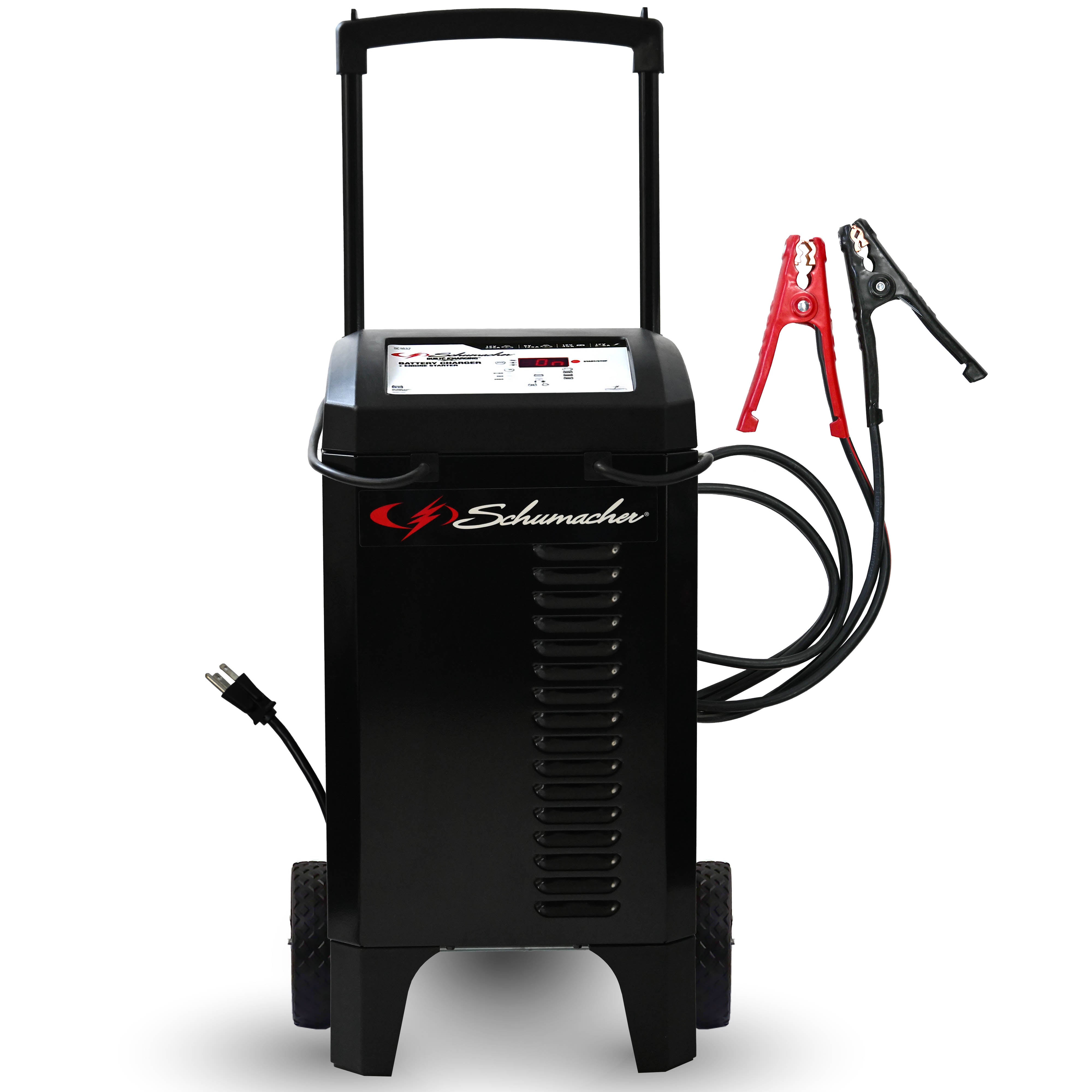
Explore this need in the finder →The Schumacher SC1632 is a large, wheeled, AC-powered charger with a separate engine-start function. Its current product page identifies a 6 V/12 V automatic unit, with a 6 A and 2 A charge/maintain description, a 40 A boost claim and engine-start figures of 225 A at 12 V and 125 A at 6 V. Those figures describe different jobs: a peak boost or crank rating is not the routine charging current. The charger belongs in a garage with room for a cart and a grounded outlet, not beside a battery for casual, weather-exposed use.
Read the model-specific output claims cautiously
Schumacher’s exact page is internally inconsistent. Its title and descriptive copy identify the SC1632 as a 6 A model and describe “6A<>2A” charge/maintain; the same page’s specifications field lists 10/25/50/200 A. The page-linked 101-17 owner’s manual has a charging-time chart with 2, 6, 8 and 10 A columns, while Schumacher’s patents page summarizes SC1632 as 2/6/40/225 A. These primary materials do not provide one clean, consistent set of ordinary charging rates. Our conservative comparison uses only the page’s clearly model-named 6 A/2 A charge-and-maintain claim; it does not count the conflicting 8/10 A table columns or the page’s unmatched 10/25/50/200 A field as higher ordinary output. If an exact purchase package or label differs, resolve the model and instructions before connecting a battery.
The 40 A boost is described as a way to add charge before starting; the product page does not clearly assign that current to each battery voltage. Likewise, 225 A at 12 V and 125 A at 6 V are engine-start ratings, not ordinary charging rates. The manual describes a timed crank sequence and required cooldown periods, so this feature is best treated as a distinct shop task rather than evidence that the charger can replenish a battery at hundreds of amps.
Supported batteries and the automatic maintenance stage
The page and exact linked manual identify 6 V and 12 V lead-acid use. The manual names STD, AGM and GEL selections. AGM and gel are explicit supported choices; its STD label is not translated here into every narrower subtype in our finder, because “standard” is not an exact confirmation of flooded, EFB, maintenance-free or calcium support. Neither the product page nor manual documents lithium charging or a lithium BMS requirement.
In Charge/Maintain mode, the manual says charging completes automatically and the unit then enters maintain mode, supplying a small current when needed. It also recommends occasional monitoring because battery faults, parasitic loads, bad connections or other conditions can cause abnormal draw or an abort. That is a more concrete storage function than a timer alone, but it is not permission to forget the battery indefinitely. Choose the battery type and rate deliberately and follow the battery maker’s instructions.
The manual includes charging-time examples for a few powersport, automotive and marine sizes, some given in amp-hours and others in cold-cranking amps. These examples depend on an assumed partial discharge and battery condition; they are not a single universal charging-capacity range. We do not infer an Ah maximum from the charger’s amperage or treat a CCA value as Ah. If a precise battery capacity limit is essential, the available SC1632 documentation does not establish it cleanly.
Plan for a shop-size footprint and a specific setup
The manufacturer lists the unit at 31 lb and about 34.74 inches high, 15.46 inches wide and 10.82 inches deep. It has a retractable handle and wheels, but the manual says to assemble the feet and wheels with supplied screws; a flat-head screwdriver is not included. This is portable in the sense that it can be rolled around a shop, not a light pocket-sized maintainer. Its product page lists a six-foot battery-lead reach and a 6.5-foot AC cord, so check that both routes reach safely without stretching or crossing moving parts.
Use requires nominal grounded 120 V AC, a dry nonflammable surface and an open, ventilated work area. The manual says not to expose the charger to rain or snow, not to charge a frozen battery, and to keep the unit away from battery gases and acid. A marine application label does not make this an on-board charger: the manual directs that a boat battery be removed and charged ashore unless equipment designed for marine installation is used.
One startup detail changes the supervision question
The manual describes a power-up auto-start: if the start control is not pressed within 30 seconds and the unit detects a correctly connected battery, it can select Boost and AGM and begin charging. That behavior makes it especially important to read the instructions, set the intended battery type and stay present during connection and initial operation. The manual’s engine-start instructions add their own safeguards: keep a battery installed in the vehicle, limit cranking attempts, observe the cooldown, and stop if the engine turns but does not start rather than repeatedly forcing the charger.
Bottom line
The SC1632 is a sensible candidate only when the job calls for a wheeled 6 V/12 V lead-acid charger, a 2 A/6 A ordinary charge-and-maintain path, and occasional shop use of separate boost or start functions. It has more physical bulk and setup steps than a compact maintainer, and the official page’s output table conflicts with the model description, manual rate chart and maker patent summary. The reviewed facts therefore keep its ordinary matching current conservative and leave its Ah ceiling unknown. Do not choose it for lithium, on-board marine installation, wet exposure, a confirmed high-current normal-charge requirement or an exact capacity limit without resolving those uncertainties against the label and instructions for the specific unit.
Use the exact model’s instructions for operating limits, supplied equipment and version differences.Key specifications
Key details at a glance
Output battery voltages 6 / 12 V Supported chemistries Lead-acid Rated DC charging current 6 A Independent battery outputs 1 Arrangement Portable plug-in charger Included connection The product page lists 6-foot booster cables/clamps and a 6.5-foot AC cord; its package line names the charger and owner’s manual. The exact manual also lists wheel/foot assembly screws, while the flat-head screwdriver is not included. Verify the exact package and cable arrangement before purchase. Sources for this review
Sources for this assessment

Keep the next step evidence-led
Use the finder to combine voltage, battery chemistry, charging job and setup requirements; then check the exact model and its manual.