
Your needs, this model
Does it fit your priorities?
Can I use the SC1633 for a 12 V AGM charge session?
The exact page lists a 10 A 12 V charge/maintain mode, and the page-linked manual permits AGM lead-acid batteries. That 10 A output is not a safe-rate instruction for a particular battery; use the battery maker's approved rate and supervise the SC1633's manual timer.
Explore this need in the finder →Does the SC1633 offer a regular 24 V charging plan?
The page states 25 A at 24 V in boost mode before engine starting, but its ordinary 10 A charge/maintain statement is for 12 V only. Treat the 24 V figure as a limited boost capability, not a general 24 V recharge or maintenance rating; the generic manual rate table is not reconciled with the current model-page rate presentation.
Explore this need in the finder →Can the SC1633 maintain a 12 V battery while I leave it unattended?
The product page uses 'charge/maintain' for its 10 A 12 V mode, but the linked manual describes manual timer operation and says the charger must be monitored. It stops when the timer expires and does not document automatic float charging, so it is not supported here as an unattended long-term storage maintainer.
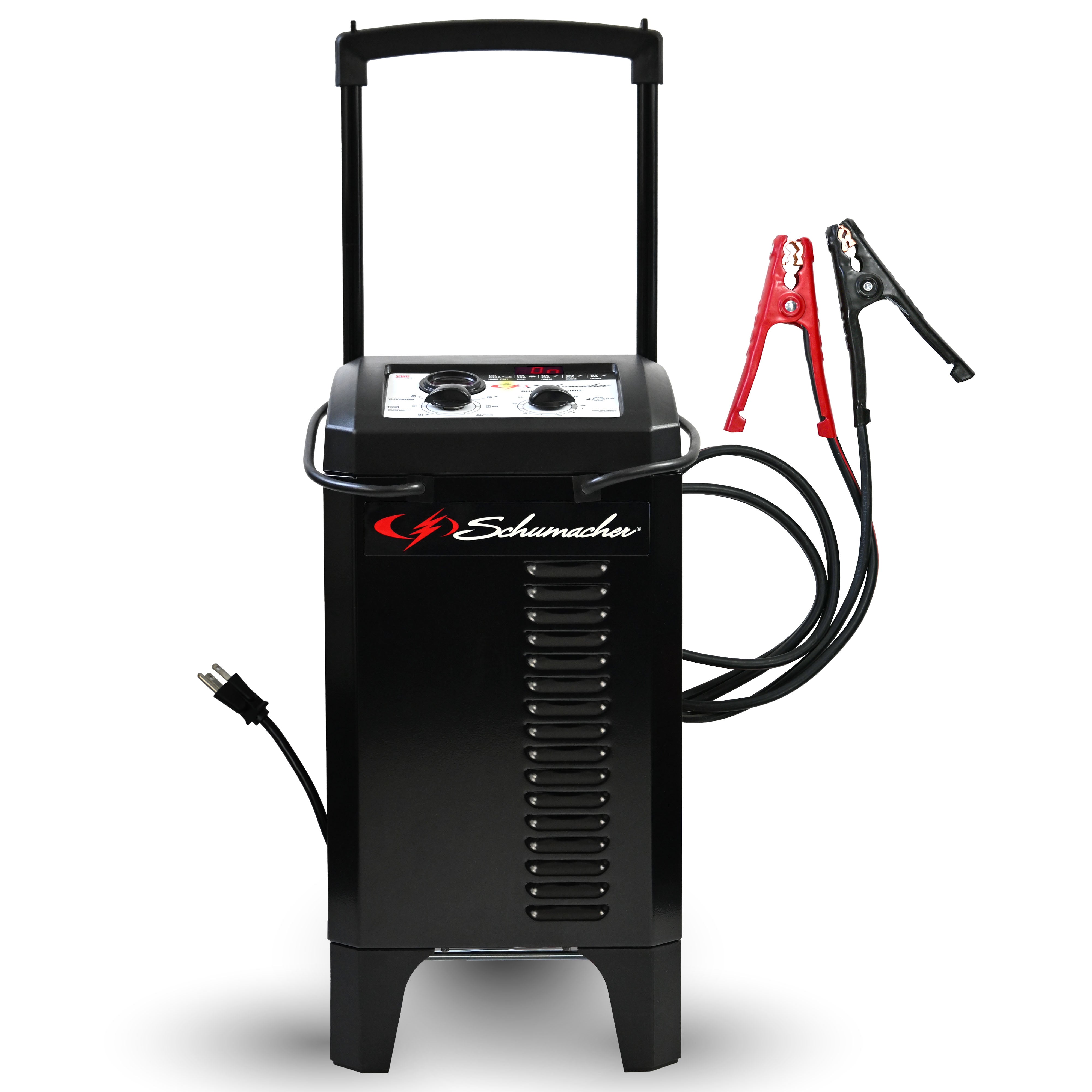
Explore this need in the finder →The SC1633 is a wheeled, manually controlled shop charger rather than a compact automatic maintainer. Schumacher’s current U.S. page identifies the exact model and presents three jobs separately: a 10 A, 12 V charge/maintain mode; 12 V and 24 V boost ratings; and a 200 A, 12 V engine-start rating. The page also lists 50 A at 12 V and 25 A at 12 V or 24 V for boost. Those numbers describe different modes, not four charging rates a buyer can combine or treat as continuous output.
Where the SC1633 fits
This model makes the most sense when a garage needs a movable, single-battery charger with a manual timer, a visible analog ammeter and a separate engine-start function. Its product page lists 35.6 lb, a retractable handle, wheels, a steel case and 6-foot power and battery leads. That is a floor-standing tool, not something to tuck beside a battery for months of automatic float maintenance. The page gives nominal 120 V AC input; the linked manual requires a properly grounded 120 V circuit.
The official page describes a 135-minute timer and manual rate selection. The linked owner's manual labels the charger “manual operation – must be monitored.” It says the timer stops charging when the selected time expires, and tells the user to monitor both charger and battery during charge and boost. A timer can help limit a session, but it is not proof of automatic charge termination, a float transition or safe unattended operation. For a car left in seasonal storage, a documented automatic maintainer is a more direct fit.
Separate the 12 V charge claim from boost and start
For ordinary charging, the clearest current-page statement is 10 A at 12 V, described as a charge/maintain mode. The maker separately lists 25 A and 50 A at 12 V boost, plus 25 A at 24 V boost. Its page says boost is for adding charge to a severely discharged or large-capacity battery before engine starting. The 200 A figure is a 12 V engine-start rating, not a battery-charging current. Do not select a charger because the largest number looks like a faster normal charge, and do not assume that a 24 V boost listing establishes a full 24 V charge or maintenance program.
There is a source limitation worth noticing. The exact SC1633 page links a manual whose cover identifies Schumacher model 105-8, and the page also lists UL model 105-8. That manual provides useful controls and safety instructions, but its generic rate table lists a different set of current figures than the current product page. This assessment therefore uses the current page for the model-specific 10 A charge/maintain and boost/start claims, and does not transfer the manual's unrelated table values into SC1633 output plans. If a seller's package, label or instructions differ, stop and resolve the exact model/version before charging.
Battery chemistry and limits
The page-linked manual permits rechargeable standard, AGM or gel lead-acid batteries. Schumacher's product page additionally names deep-cycle applications, which describe a use class rather than a separate chemistry. The exact materials do not establish a lithium mode, a LiFePO₄ BMS requirement, or support for every lead-acid subtype such as EFB or calcium. Check the battery label and battery maker's approved charging rate before connecting it.
Neither the current product page nor the page-linked manual establishes a universal amp-hour charging range for this model. The manual's time table uses mixed measures and current bands that do not align cleanly with the exact page's mode list, so those examples are not a general SC1633 Ah ceiling. Likewise, the nominal 10 A charge mode is an equipment capability, not a recommendation for every battery size or condition. If you cannot establish the battery's capacity and the manufacturer's safe rate, do not infer them from the charger's amperage.
Setup is part of the decision
Expect a grounded household 120 V outlet, room for a wheeled unit, a dry ventilated work area and hands-on supervision. The manual says not to expose the charger to rain or snow, not to charge a frozen battery, and to keep ventilation open around the battery. It also warns of explosive gases, requires appropriate eye and clothing protection, and says to make DC connections with the charger switched off and unplugged. Follow the model manual's vehicle-grounding sequence, keep leads clear of fans and belts, and disconnect in the stated order.
Although the product page lists marine applications, the manual says to remove a boat battery and charge it on shore; charging aboard requires equipment designed for marine installation. A marine use label does not establish that this wheeled charger is safe to mount or operate on a boat. Its page gives a 6-foot cable reach, but route and actual seller package still need checking.
Bottom line
The SC1633 offers a useful mix for a supervised workshop that wants manual 12 V charging, wheeled portability and distinct pre-start boost/start functions. Its limitations are equally important: one output, no published universal Ah range, no documented lithium support, no ordinary 24 V charging plan, no rain/snow permission, and no established automatic float-maintenance routine. Read the exact manual before use, verify the seller's model and package, and select it only if its manual workflow—not just its peak start number—matches the job.
Key specifications
Key details at a glance
| Output battery voltages | 12 / 24 V |
|---|---|
| Supported chemistries | Lead-acid |
| Rated DC charging current | 10 A |
| Independent battery outputs | 1 |
| Arrangement | Portable plug-in charger |
| Included connection | The exact page describes included booster cables/clamps and a 6-foot AC power cord. The page package description names the SC1633 unit and owner's manual; verify exact seller stock and supplied pieces. |
Use the exact model’s instructions for operating limits, supplied equipment and version differences.
Sources for this review
Sources for this assessment

Keep the next step evidence-led
Use the finder to combine voltage, battery chemistry, charging job and setup requirements; then check the exact model and its manual.