
Your needs, this model
Does it fit your priorities?
Does the 40 A rating charge one battery at 40 A?
No. This model has four independent 10 A output ports. The 40 A figure totals four banks; it does not raise the per-battery output above 10 A.
Explore this need in the finder →How does the Pro 4-Bank compare with the standard WaveCharge 4-Bank?
They are not the same current or voltage configuration. The Pro model has 10 A per 12 V bank; the standard WaveCharge 4-Bank uses 3 A per bank and selectable 6/12 V modes. Confirm the exact 022-1009 Pro suffix rather than relying on “4-Bank” alone.
Explore this need in the finder →What does the manual establish about mounting in rain?
It says not to expose the WaveCharge Pro charger family to rain or snow. The page's IP68/IP67+ marketing language conflicts with that operating instruction, so this assessment does not call an exposed mounting location suitable.
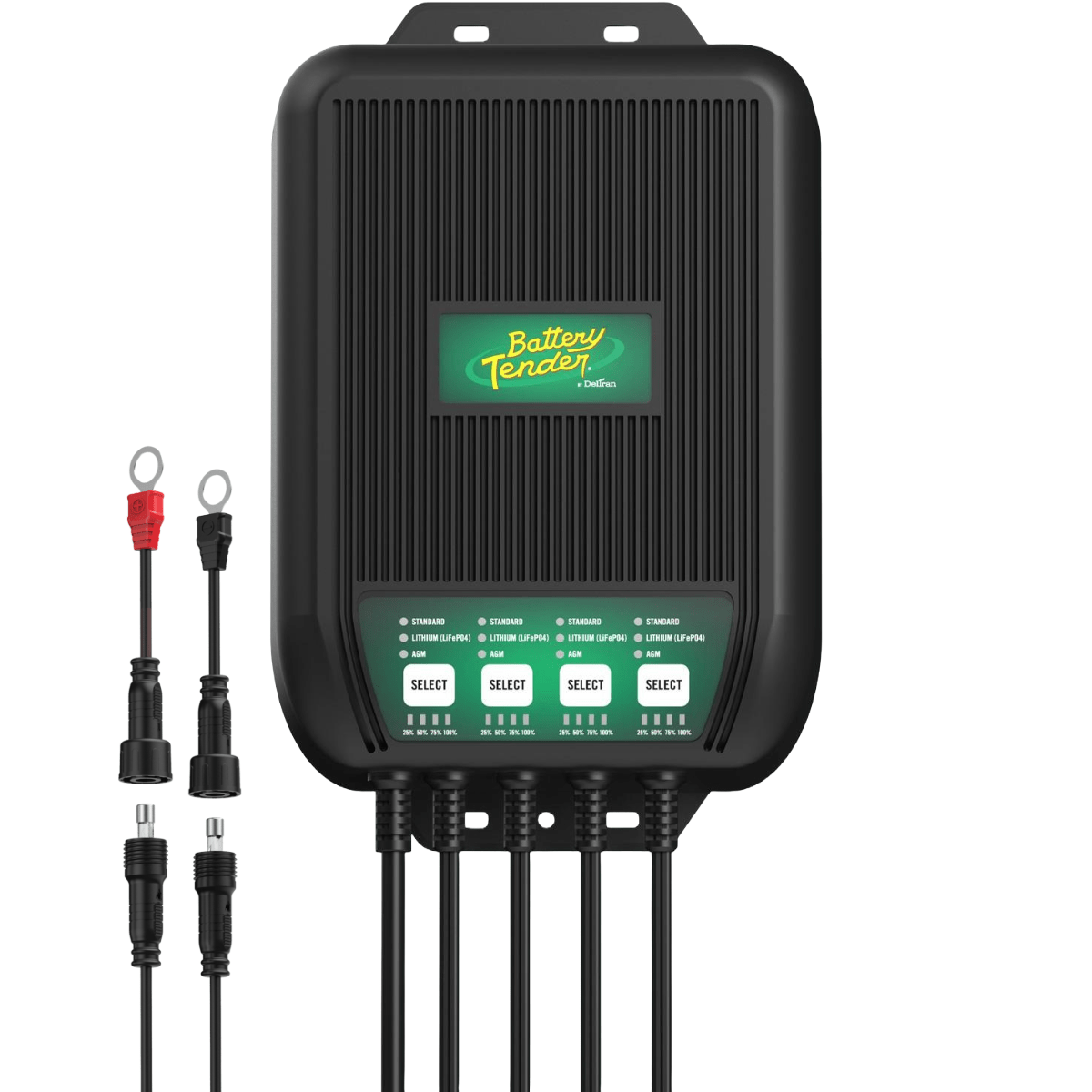
Explore this need in the finder →The WaveCharge Pro 4-Bank is the largest channel-count configuration in the Pro group: four independent 12 V outputs, each at 10 A, for 40 A total across the unit. Battery Tender identifies it as SKU 022-1009-DL-WH; the shared manual P/N 392-0445-R0 also names that number. The number of banks is the meaningful distinction from the 2-Bank and 3-Bank models. It does not mean one battery can use all 40 A, and it is not a tested performance claim.
Four separate batteries, four separate outputs
The maker's manual says its 2-, 3- or 4-port charger has fully independent ports. On this model, that supports four different battery connections, with no reason to add the individual outputs together when considering one battery. The product page's 40 A total corresponds to four 10 A banks. If only two batteries are installed, the unused pair does not double the current available to the two connected batteries. The maximum per-bank figure remains 10 A and must be checked against each battery's own charging guidance. For a boat or vehicle installation that genuinely has four 12 V batteries, a single on-board body can reduce the number of charger units and separate AC connections compared with four unrelated single-output devices. But more outputs also mean a more involved installation: the site needs four safe DC paths, appropriate fusing and a place to mount the charger under the exact instructions. If your arrangement has two or three batteries, the 2-Bank or 3-Bank version may be the closer configuration. The 4-Bank does not improve a single battery's documented output.12 V, with channel-specific chemistry selection
The exact model is a 12 V-only Pro configuration. Its SKU-matched manual documents Standard, AGM and 12 V four-cell LiFePO4 settings with a selector for each channel. The product is not the regular WaveCharge 4-Bank: that sibling has lower 3 A outputs and selectable 6 V/12 V settings. Do not transfer those 6 V options to the Pro because their names and bank counts look similar. Each output's mode is selected to match the connected battery. The manual describes an automatic charging process and storage/float maintenance, so the unit serves both recovery charging and maintaining a compatible charged battery. It explicitly says this model is not intended as a power supply for a low-voltage electrical system. The factual match list uses only flooded/standard and AGM lead-acid modes plus LiFePO4; the page's broader compatibility summary is not sufficient to extend the manual's supported chemistry list to gel, EFB, calcium or an unspecified lithium type. One important lithium question remains open: the manual supports LiFePO4 but does not state whether the battery must include a built-in BMS. That matters because the name “lithium” alone does not establish the pack's protection or charging rules. Verify the battery maker's instructions and BMS requirements. This review does not treat the 4-Bank as satisfying either a BMS-required or a no-BMS-required selection.Two important source conflicts
The exact product page claims 20–200 Ah per bank, but the manual opening describes the 2/3/4-bank charger as designed for 150 Ah Standard/AGM batteries. It does not call 150 Ah a maximum, but the current page does not reconcile those figures. Rather than present 150 or 200 Ah as a definitive boundary, this assessment leaves the finder's capacity range unverified. Ask the manufacturer for current model-specific limits and confirm that the battery's maker permits the 10 A profile before buying for an unusually small or large battery. Likewise, the page uses IP68/IP67+ and weatherproof language, but the manual says not to expose the charger to rain or snow. Its commercial text gives inconsistent ingress-rating wording, so the matcher does not assert an IP rating. Follow the explicit manual restriction and do not assume an uncovered bilge or outdoor position is acceptable. The page also advertises marine ignition protection, but the reviewed instruction booklet gives no certification number or evidence to confirm that claim. That is not a safety clearance for a fuel-vapor location.Installation and who should consider it
The exact product page lists 120 V AC input, four fused ring-terminal leads, mounting hardware and a manual. Verify the current box and the length of every cable against the actual batteries and AC receptacle; a rendered product image cannot establish what a seller will ship. The manual's connection instructions and battery safety warnings matter in a permanent layout: keep the charging area ventilated, avoid damaged leads, observe polarity, and disconnect AC before removing DC connections. Never charge a frozen battery. This is a plausible research match for a buyer who needs four separate 12 V connections, an on-board installation, and no more than the documented 10 A per output. It is not a fit just because the system has a large aggregate Ah total, nor is 40 A a substitute for confirming each battery's accepted rate. If the intended installation is exposed to precipitation, requires a known capacity ceiling, relies on a verified fuel-vapor certification, or uses 6 V/24 V batteries, the inspected documents do not establish that the Pro 4-Bank satisfies that requirement. Compare the standard WaveCharge 4-Bank only when its lower per-channel current and 6/12 V settings meet the real job.Key specifications
Key details at a glance
| Output battery voltages | 12 V |
|---|---|
| Supported chemistries | Lead-acid / Lithium-ion |
| Rated DC charging current | 10 A |
| Independent battery outputs | 4 |
| Arrangement | On-board charger |
| Included connection | The exact product page lists fused 10 AWG ring-terminal output leads for each bank and mounting hardware. Confirm current contents and lead reach in the exact package; the manual says to follow its connection instructions and disconnect AC before removing DC leads. |
Use the exact model’s instructions for operating limits, supplied equipment and version differences.
Sources for this review
Sources for this assessment
Keep the next step evidence-led
Use the finder to combine voltage, battery chemistry, charging job and setup requirements; then check the exact model and its manual.