
Your needs, this model
Does it fit your priorities?
Is the 022-1004 a 12 A charger for one large battery?
No. Twelve amps is the aggregate of four independent 3 A channels. The manual confirms each output is a separate charge/maintenance port. Do not combine the channel ratings or parallel outputs to infer a 12 A single-battery charge; use the battery maker's current limit and an appropriate one-output charger if that is the job.
Explore this need in the finder →What does four-bank capacity mean in practice?
It is four separate battery connections, each with an independent 3 A setting and charge stage. That is useful only if four batteries need separate charging; it does not describe a single battery's Ah capacity. Confirm four battery locations, lead reach, selector access and a safe AC-powered mount before choosing the four-bank enclosure.
Explore this need in the finder →Can the WaveCharge 4-Bank maintain a 12 V LiFePO4 battery?
The exact manual documents 12 V four-cell LiFePO4 charging and automatic maintenance on an independently selected channel. It does not document a 6 V lithium mode or state whether the battery needs a built-in BMS. Verify the exact battery's chemistry, BMS instructions and accepted charge current before use.
Explore this need in the finder →Four independently managed batteries, three amps at a time
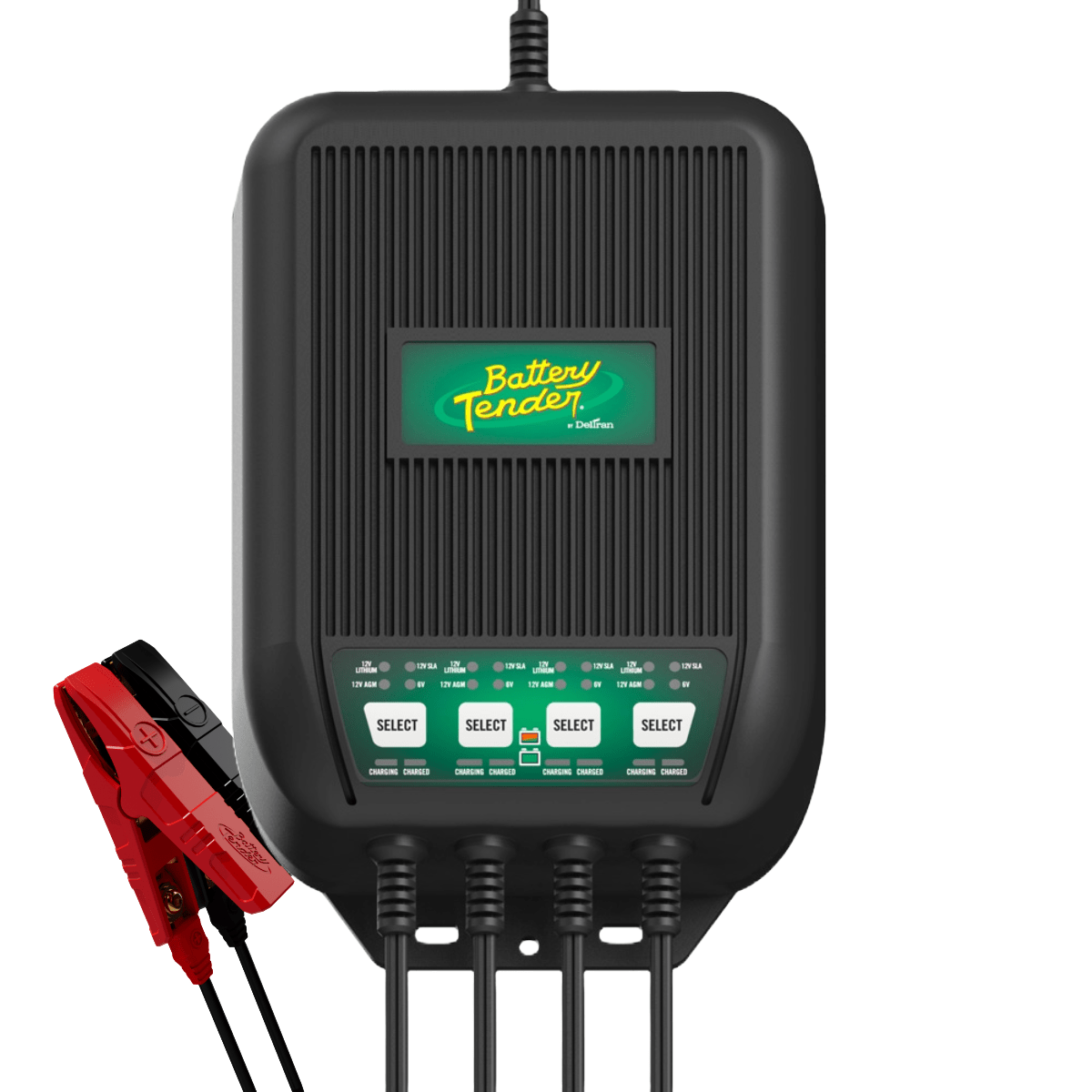
The WaveCharge 4-Bank is Battery Tender SKU 022-1004-DL-WH, a fixed-mount charger for a system with four separate battery connections. The exact manual groups it with the 2- and 3-bank models as a 6 V/12 V, 3 A-per-port family and says each port operates independently. That makes the advertised 12 A total four channels of 3 A each—not a 12 A output for one battery. The fourth connection is the substantive difference from the 2-Bank 022-1002 and 3-Bank 022-1003, both separate reviewed configurations.
This model is only a sensible shortlist candidate when a four-battery layout exists. It could serve separate starting, house, auxiliary and another onboard battery, with each port responding to its own charge state. Adding more banks does not raise the individual current, remove the need to match voltage and chemistry, or prove that the charger can recover a battery outside the maker's stated range. If only one or two batteries need maintenance, fewer independent outputs or a portable single-channel unit may better match the installation.
Which battery profiles it documents
The manual that names P/N 022-1004 lists six-cell and three-cell lead-acid batteries and 12 V four-cell lithium iron phosphate batteries. It describes 6 V standard/AGM lead-acid, 12 V lead-acid/AGM, and 12 V LiFePO4 settings selected separately at each channel. The product page lists compatibility with flooded, AGM, gel, sealed maintenance-free and lithium batteries and says each bank has a voltage/chemistry selector. Because the page's list of lead-acid subtypes is broader than the manual's selector wording, check a battery's exact label and manufacturer's instructions, especially for an uncommon subtype. The sources do not establish a required or optional BMS condition for a LiFePO4 battery; this assessment leaves that point open.
Battery Tender states a 14–100 Ah range per bank for 12 V. The manual includes a 15 Ah/3 A example but does not set a universal minimum or maximum size. The page range is consequently retained as a 12 V matching boundary, not extended to 6 V by assumption. An Ah range also does not say that 3 A is safe for every battery at the range's upper edge: the battery maker's permitted rate controls. The product page's general “3–5 A” output-range field conflicts with the exact 3 A per-bank output statement and manual. The review uses the manual-supported 3 A rate.
Check space, power and cable route before installation
Four banks mean four battery connections, four lead routes and a larger physical unit than the two-bank model. The exact page gives a 7.2 by 11.1 by 3.3 inch enclosure and 5.2-pound charger weight. It lists four combined ring-terminal/alligator-clip lead sets and mounting hardware; check the seller's exact kit rather than assuming every pictured accessory is supplied. The page lists five-foot output cables, while the manual says six-foot DC output cords. Before mounting, check distances to all four battery banks and to a 120 V AC source (50/60 Hz), plus room to see and reach each channel selector. Avoid running leads where vehicle movement, heat or abrasion can damage them.
The case's water claims require caution. The exact product page advertises IP67/water resistance for marine use, but the SKU-matched manual says not to expose the charger to rain or snow. It also prohibits below-waterline mounting and calls for ventilation and separation from acid drips. I would not treat the IP claim as permission for an exposed outdoor or submerged position; follow the actual manual location instructions and get clarification from the manufacturer if the planned installation could be wet. Spark-free circuitry, reverse-polarity protection and automatic mode indication do not replace safe battery handling.
When four ports are worth the added hardware
The four-bank model fits a multi-battery system whose individual batteries can each use a 3 A charging and float-maintenance channel. Unlike a splitter or a shared output, it can run a separate charge stage for each battery. This is useful when one battery is replenishing while others are already full, but it does not make a four-battery bank into one larger battery for matching purposes. The manual warns that a frozen battery must not be charged, calls for ventilation and correct connection order, and states the charger is not meant to power a low-voltage electrical system.
Compared with the similarly named WaveCharge Pro 4-Bank, the 022-1004 is the lower-current 3 A-per-channel configuration; the maker's family page describes Pro at 10 A per channel. Do not choose the Pro just because the number is higher—confirm each battery's allowable charge current. For this model, verify the exact 022-1004 label, four independent battery needs, the 6 V/12 V profile at each bank, 12 V capacity range, LiFePO4/BMS compatibility, safe dry location, supplied leads and real cable reach. The captured manufacturer page showed a sold-out notice; it is not a report of current third-party availability or price.
Assessment basis
This is an original desk review of Battery Tender's exact 022-1004 product page and shared 392-0440-RA manual, which names P/N 022-1004. The official image shows four selectors and four output leads, not an installed product or a seller's complete box. No hands-on test, ownership, measured charging result, customer experience or live-stock check is claimed.
Key specifications
Key details at a glance
| Output battery voltages | 6 / 12 V |
|---|---|
| Supported chemistries | Lead-acid / Lithium-ion |
| Rated DC charging current | 3 A |
| Published charge capacity limit | 100 Ah |
| Independent battery outputs | 4 |
| Arrangement | On-board charger |
| Ingress rating | IP67 |
| Included connection | Product page lists four sets of combined alligator-clip/ring-terminal leads and mounting hardware. The manual says DC output cords are six feet; the exact page lists five feet. Check exact seller package and installed reach. |
Use the exact model’s instructions for operating limits, supplied equipment and version differences.
Sources for this review
Sources for this assessment
Keep the next step evidence-led
Use the finder to combine voltage, battery chemistry, charging job and setup requirements; then check the exact model and its manual.