
Your needs, this model
Does it fit your priorities?
Does the 20 A model charge one battery at 20 A?
No. The SKU-matched manual identifies 10 A on each of the two independent 12 V output channels. The product title totals both channels; it does not make a single battery connection a 20 A output.
Explore this need in the finder →Can the two channels use different documented chemistries?
The manual gives each port its own selection button for 12 V Standard, AGM or LiFePO4. It supports per-channel choices, but does not state the built-in-BMS requirement for lithium. Check each battery manual before selecting the LiFePO4 mode.
Explore this need in the finder →Can this Pro charger serve a 6 V battery?
No 6 V mode is documented in the 022-1007 manual; it identifies 12 V Standard/AGM and 12 V LiFePO4. The regular WaveCharge product is a different model family with selectable 6/12 V modes.
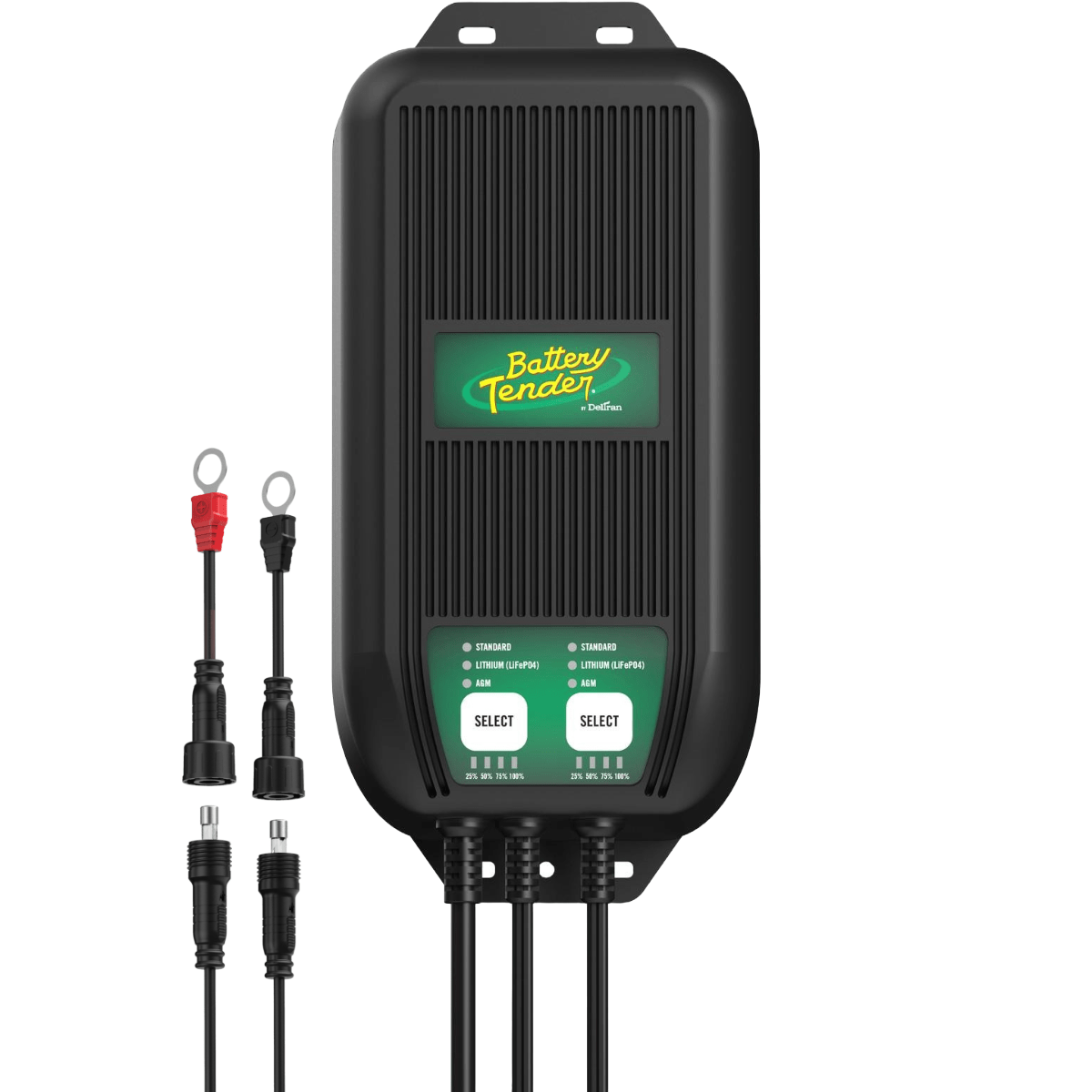
Explore this need in the finder →The WaveCharge Pro 2-Bank is a fixed-installation 12-volt charger with two separate battery outputs. Battery Tender identifies SKU 022-1007-DL-WH on its product page, and its shared manual P/N 392-0445-R0 names that part number alongside the 3- and 4-bank siblings. The useful distinction is not the “20 amp” total in the model name: the manual describes 10 amps on each independent channel, for two separate batteries. This is a researched assessment of manufacturer documentation, not a hands-on test.
Two independent 10 A outputs, not one 20 A connection
The two-bank layout is for two battery connections. The manual says each charging port is independent; a battery on one lead has its own charging process rather than taking a share of a single 20 A pool. The product page and WaveCharge family page describe the total as 20 A, while the manual calls the family a 12 V, 10 A, 2/3/4-bank charger. Read those figures together as 10 A per bank and 20 A across this two-bank configuration. If one battery needs more than 10 A, the unused second channel does not raise the first channel's rating. This can make sense where a compatible vehicle layout has two separate 12 V batteries, for example a starter battery and a house or auxiliary battery, and both require an installed charger. It is not automatically better than two smaller chargers: the key questions are whether the battery manufacturers permit the selected 10 A profile and whether both output leads can reach the intended batteries. A one-battery arrangement does not use the second output to charge faster.12 V chemistry choices are made per channel
Manual 392-0445-R0 specifies 12 V Standard, 12 V AGM and 12 V four-cell LiFePO4 selections. Each channel has a chemistry selector, so the documented choice is made for the connected battery rather than once for the whole chassis. The instruction booklet describes an automatic charge sequence that reaches storage/float maintenance; it also says not to use this charger as a low-voltage power supply. The product page likewise names both charging and maintaining automotive batteries. Do not generalize the settings to 6 V or 24 V. The standard WaveCharge 2-Bank is a different model with lower per-output current and selectable 6/12 V modes; the Pro version reviewed here is identified as 12 V. Likewise, the page's broader chemistry summary is wider than the manual's named selections. This assessment counts the manual's Standard/flooded and AGM lead-acid modes and 12 V LiFePO4, not unsupported gel, EFB, calcium or other chemistries. For LiFePO4, the manual establishes a 12 V lithium mode but does not say whether the battery must have a built-in battery-management system. That is a consequential unknown, not a reason to infer that every lithium pack is suitable. Confirm the pack voltage, chemistry, BMS arrangement and allowed charging current with its maker before using the lithium setting. The matcher therefore does not treat either a required-BMS or no-BMS condition as satisfied.Capacity and weather claims need a closer check
The maker's current product page gives a 20–200 Ah per-bank compatibility range, but the opening of the SKU-matched manual says the charger is designed for a 150 Ah Standard/AGM battery. The manual does not say that 150 Ah is a maximum, and the page does not explain how its broader range relates to that manual language. Rather than convert one number into an invented cutoff, the assessment leaves capacity bounds unresolved. If the battery is substantially different from the manual's stated design example, confirm the current recommendation with Battery Tender and the battery manufacturer. There is a second conflict worth taking seriously before a marine installation. The product page uses IP68/IP67+ and weatherproof language; different lines on that same page do not even state one consistent ingress rating. The manual for the exact 022-1007/1008/1009 family explicitly says not to expose the charger to rain or snow. Follow the direct instruction in the manual and do not treat the marketing language as permission for an exposed, wet or submerged mounting location. The page also advertises marine ignition protection, but the manual reviewed here does not provide a certification number or a supporting declaration. This assessment does not rely on that claim to approve a fuel-vapor location.Installation checks and the sibling comparison
This is an on-board design, not a small portable charger to move between cars. The exact page lists 120 V AC input, two fused ring-terminal output leads, mounting hardware and an instruction manual. Check the current offer for the actual parts and cable reach; the page's box list is not evidence of an individual seller's package. Follow the manual's polarity and connection sequence, provide the required ventilation around the batteries, and remove AC before disconnecting the DC leads. Do not charge a frozen battery. The adjacent Pro options keep the same 10 A per-channel concept but serve different counts: the 3-Bank has three outputs and 30 A aggregate, and the 4-Bank has four and 40 A aggregate. The standard WaveCharge 2-Bank is a different lower-current, 6/12 V sibling. For one battery, choose based on a documented compatible profile and actual per-bank current, not the largest family total. For two batteries, the Pro model earns consideration only when its permanent installation, 12 V modes and unresolved capacity instructions fit the real setup.Key specifications
Key details at a glance
| Output battery voltages | 12 V |
|---|---|
| Supported chemistries | Lead-acid / Lithium-ion |
| Rated DC charging current | 10 A |
| Independent battery outputs | 2 |
| Arrangement | On-board charger |
| Included connection | The exact product page lists fused 10 AWG ring-terminal output leads for each bank and mounting hardware. Confirm current contents and lead reach in the exact package; the manual says to follow its connection instructions and disconnect AC before removing DC leads. |
Use the exact model’s instructions for operating limits, supplied equipment and version differences.
Sources for this review
Sources for this assessment
Keep the next step evidence-led
Use the finder to combine voltage, battery chemistry, charging job and setup requirements; then check the exact model and its manual.