
Your needs, this model
Does it fit your priorities?
Does the 022-1002 divide 6 A between two connected batteries?
No. Its 6 A name is the two-bank total; the exact manual identifies a 3 A 2/3/4-bank family and says each output operates independently. A bank charging one battery does not draw current away from the other. If one battery alone needs more than 3 A, the second bank does not add to its available current.
Explore this need in the finder →Can one WaveCharge bank charge lithium while the other charges lead-acid?
The exact manual gives each channel a voltage/chemistry selector and documents 12 V LiFePO4 plus lead-acid modes, so the charger supports independently selected per-bank chemistry. It documents lithium only at 12 V; it does not state a required or optional built-in BMS condition. Check the exact battery manual before using that lithium setting.
Explore this need in the finder →Is the 022-1002 appropriate for an exposed outdoor mounting point?
Do not infer that from the product page's IP67 claim. The manual that names P/N 022-1002 says not to expose the charger to rain or snow. Treat the location as constrained by that instruction, provide a suitable dry and ventilated installation, and verify the exact mounting and lead route before choosing it.
Explore this need in the finder →Two independent outputs, not one six-amp outlet
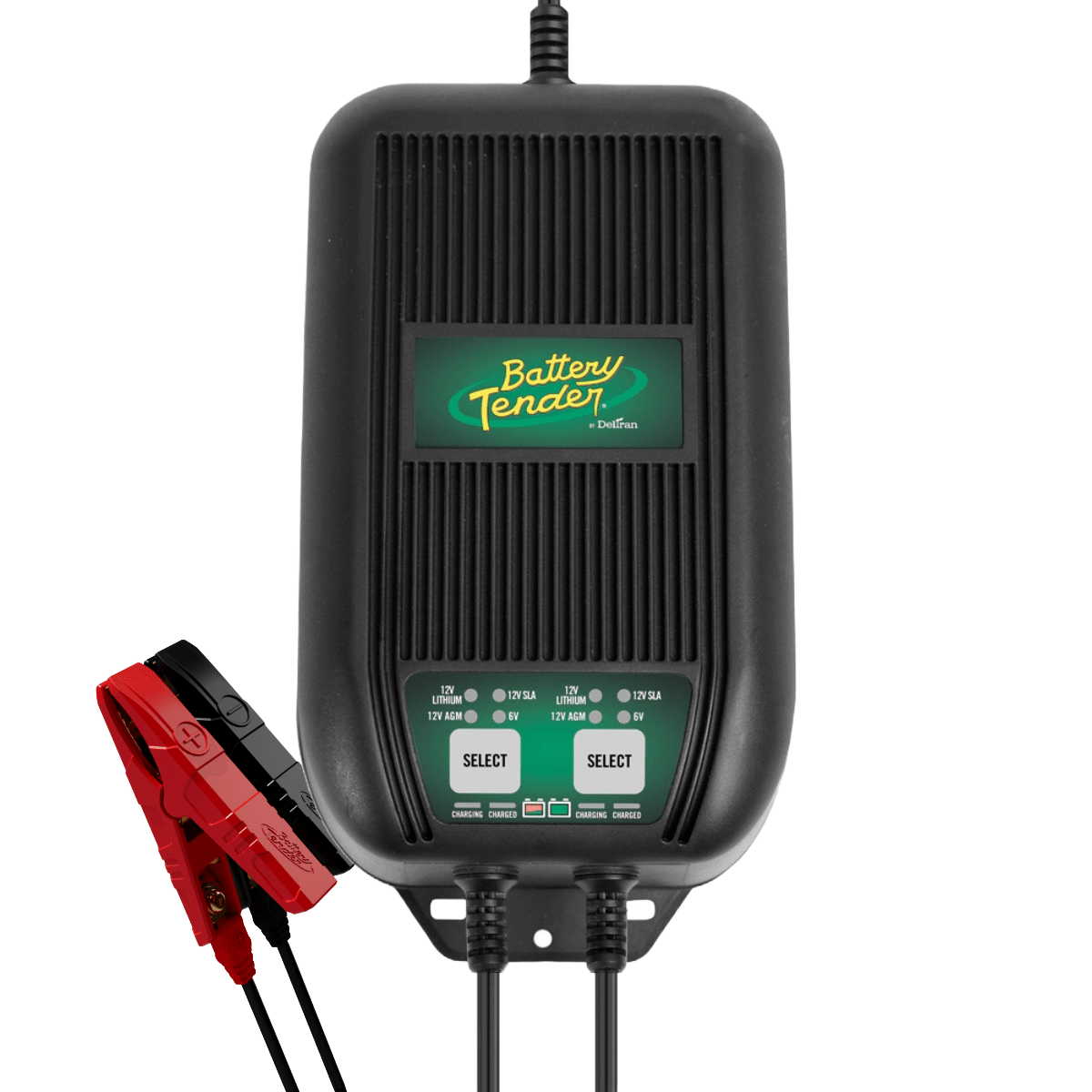
The Battery Tender WaveCharge 2-Bank is SKU 022-1002-DL-WH, a permanently installed charger with two battery outputs. Its headline six-amp total is easy to misread: the exact manual identifies this as a 6 V/12 V, 3 A 2/3/4-bank family and says each output port charges and maintains independently. For this two-bank model, each connected battery gets its own 3 A channel. A starting battery can be in float maintenance while a second bank is still charging, but the unit cannot send the other channel's current to one battery when only one is connected.
That makes the number of battery circuits the first selection question. A dual-battery truck or a boat with a starting and house battery is a more natural job than a single car battery that needs one portable charger. If the installation requires three or four outputs, the 3-Bank 022-1003 and 4-Bank 022-1004 are separate functional models, not bundle sizes or alternate names. Their added ports matter only when there are additional batteries to connect.
Voltage and chemistry are selected per channel
The matching manual names the 022-1002 and states that it charges six-cell or three-cell lead-acid batteries and 12 V four-cell LiFePO4 batteries. Its selector covers 12 V SLA/AGM lead-acid, 12 V LiFePO4 and 6 V standard/AGM lead-acid. The exact product page additionally lists flooded, AGM, gel, sealed maintenance-free and lithium profiles and says each bank can select 6 V or 12 V. The public page is broader about subtypes; where a particular battery's construction is unclear, use its own charge instructions rather than generalizing from the word “lead-acid.” Lithium is documented for 12 V only. The manual does not say whether a lithium battery must have a built-in BMS, so this assessment leaves that condition unknown.
Each port has its own selector and charge cycle. The manual says to choose the correct voltage and chemistry before connecting the battery, and that changing the mode during a charge requires disconnecting the battery first. The product page claims 14–100 Ah per bank at 12 V; the manual itself gives a 15 Ah/3 A charging example but does not establish an Ah range. The manufacturer's 12 V page range is useful as a screening boundary, not a substitute for checking the battery's maximum charge current. The page's separate “3–5 A” output-range field conflicts with its 3 A output statement and the manual's 3 A specification; the supported operating plan here uses 3 A per channel.
Installation and environmental claims need a closer read
Unlike a small plug-in maintainer, this is an onboard unit intended to be mounted and wired around a two-bank layout. It takes 120 V AC at 50/60 Hz, includes mounting hardware and two sets of combined ring-terminal/alligator-clip leads according to the exact product page. The manual calls each DC output cord six feet long while the page lists five feet; measure the real route from charger to battery and check the offer's package rather than assuming the page's “over 13 feet total reach” will suit a particular vehicle. The AC supply must also be reachable without routing the cord through a hazardous or wet area.
There is a meaningful conflict in the enclosure claims. The product page advertises IP67 and water resistance, but the manual naming P/N 022-1002 says, “Do not expose charger to rain or snow.” The manual's direction governs this assessment: do not treat the marketing rating as permission to mount the charger in an exposed or immersion-prone location. It also instructs users not to mount directly over a battery, to maintain ventilation, and not to put the charger below a boat's waterline or adjacent to fuel tanks. Its spark-free circuit and independent fault indicators do not remove ordinary battery ventilation, polarity and connection precautions.
When the two-bank format is useful—and when it is not
The WaveCharge 2-Bank is most relevant when two batteries have distinct states of charge or charging needs and an installed 3 A per-battery rate is sufficient. Independent profiles let each channel follow its own stage; they do not mean the batteries can be wired together or that one channel can deliver six amps. For a one-battery job, a portable charger such as the separately reviewed Battery Tender Power Tender 022-0234 has selectable 2/8/15 A charging rates, while the older 022-0165 supplies two 1.25 A channels in a different off-board format. Those are not interchangeable: compare the battery maker's permitted rate, installation, exact voltage and number of outputs.
The maker says the 022-1002 can be left connected for extended maintenance after charging, and the manual describes automatic float maintenance. That may suit seasonal storage where an appropriate AC source and safe mounting point are already available. But it is not a general low-voltage power supply, and it does not cure a defective or frozen battery. Before choosing it, count the batteries, confirm 6 V or 12 V for each bank, verify lead-acid subtype or 12 V LiFePO4 compatibility, check the stated current and Ah boundaries, and plan a dry, ventilated location with adequate cable reach.
Assessment basis
This is desk research based on Battery Tender's exact SKU page and the 392-0440-RA manual that names the 022-1002. The assessment preserves differences between the page's IP67/cable/current claims and the manual's dry-use, six-foot-lead and 3 A instructions. The product image is an official reference image, not a test photograph; no hands-on testing, battery ownership, measured charge time, current stock or current price is claimed.
Key specifications
Key details at a glance
| Output battery voltages | 6 / 12 V |
|---|---|
| Supported chemistries | Lead-acid / Lithium-ion |
| Rated DC charging current | 3 A |
| Published charge capacity limit | 100 Ah |
| Independent battery outputs | 2 |
| Arrangement | On-board charger |
| Ingress rating | IP67 |
| Included connection | The exact product page lists two sets of two-in-one alligator-clip/ring-terminal leads and mounting hardware; verify the precise offer's package. The manual says each DC output cord is six feet, while the product page lists a five-foot output cord. |
Use the exact model’s instructions for operating limits, supplied equipment and version differences.
Sources for this review
Sources for this assessment
Keep the next step evidence-led
Use the finder to combine voltage, battery chemistry, charging job and setup requirements; then check the exact model and its manual.