
Your needs, this model
Does it fit your priorities?
Is 30 A available on one of the three leads?
No. The maker page and shared manual support 10 A on each of three independent ports. The 30 A title is the sum of three separate outputs, not one lead that can charge a single battery at that rate.
Explore this need in the finder →Can I use the 3-Bank as a DC power supply?
No. The manual explicitly says the charger is not intended to supply a low-voltage electrical system. It supports charging/maintenance modes, not powering a 12 V accessory as a supply.
Explore this need in the finder →Is exposed wet installation cleared by the page rating?
Not by the reviewed instructions. The current page advertises IP68/IP67+ language, but manual P/N 392-0445-R0 says not to expose the charger to rain or snow. Use the manual's restriction and confirm installation guidance rather than treating page-level copy as weather permission.
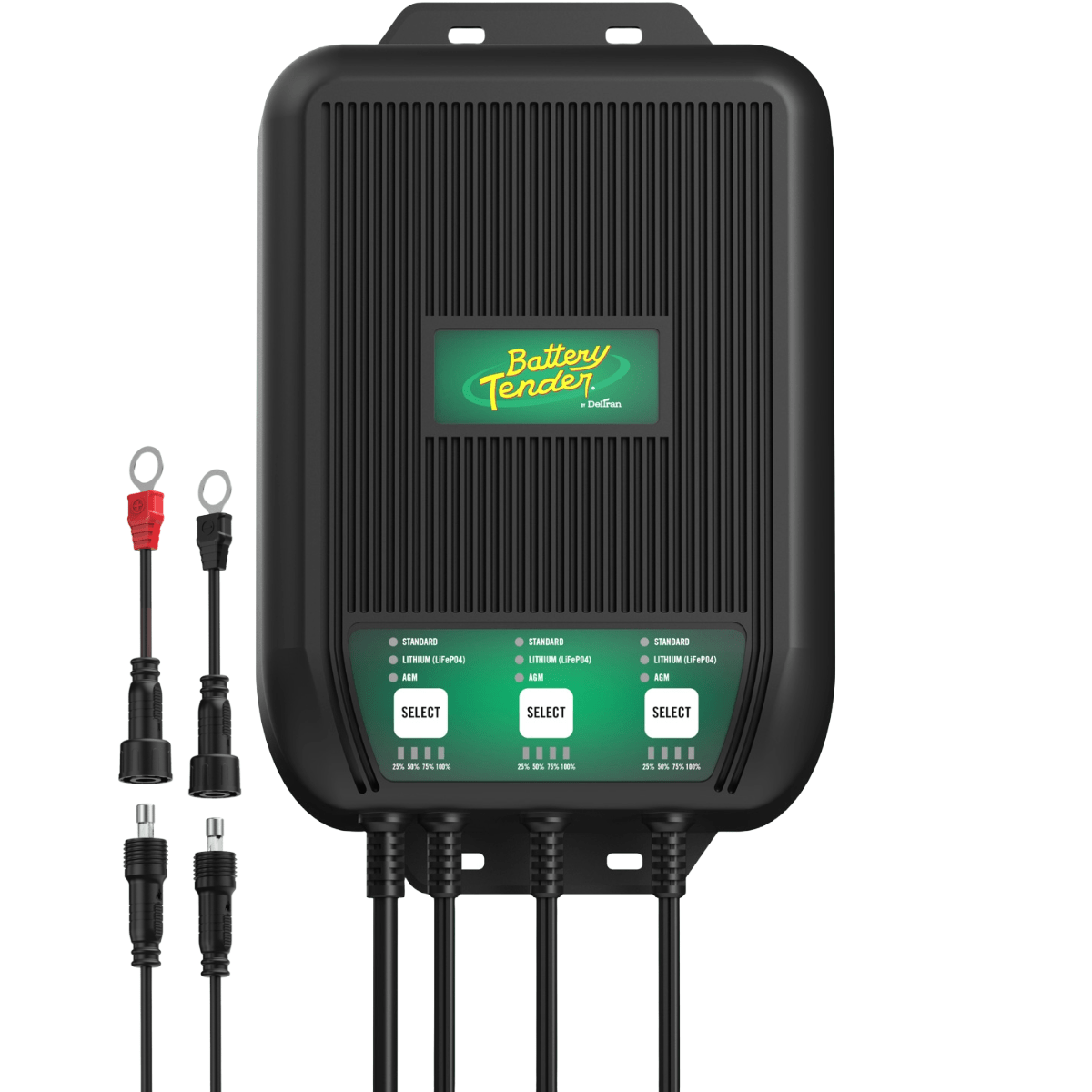
Explore this need in the finder →The WaveCharge Pro 3-Bank (022-1008-DL-WH) adds a third independent output to Battery Tender's 10 A-per-channel Pro format. Its “30 amp” title is the combined nameplate across three banks, not a 30 A lead for one battery. The exact product page and shared instruction manual identify the SKU and the 2/3/4-bank family; the manual describes each port as independent. This review compares those manufacturer documents and does not claim personal installation or testing.
Three battery connections with separate charge cycles
Each of the three outputs is rated at 10 A according to the product page and manual family specification. The 30 A aggregate is the sum of three separate circuits. It cannot be reassigned to one battery, and an idle bank does not turn the other channels into a 20 A or 30 A charger. That distinction matters for a three-battery layout: the charger offers three simultaneous connections, but the right current for each battery is still a separate battery-maker question. On a boat, the extra bank might be useful for separate starter, house and auxiliary batteries; in an automotive setting, it could fit a fixed 12 V arrangement with three batteries. The maker's exact product page names cars, trucks and SUVs as supported applications, which is why this marine-oriented on-board product is included in the car-battery charger category. A product page can describe a possible application; it cannot establish that every vehicle or battery should be charged with this setup. Check the vehicle and battery instructions and the mounting location before treating three outputs as a fit.What is documented about batteries
The SKU-matched manual 392-0445-R0 lists 12 V Standard, 12 V AGM and four-cell 12 V LiFePO4 modes. The separate selector for each port means the documented profile can be chosen per connected battery, rather than choosing one chemistry for all three. The manual describes the transition through charge stages into storage/float maintenance and says the charger is not designed to power a low-voltage electrical system. This is therefore a battery charger and maintainer, not a general 12 V bench supply or a jump starter. The reviewed documents do not support 6 V or 24 V operation. A standard WaveCharge can select 6 V/12 V and supplies 3 A per bank, but it is not the Pro model. The Pro page contains a broad compatibility summary, while its manual names Standard/AGM lead acid and LiFePO4. The facts here stay with that manual's modes: flooded/standard and AGM lead-acid plus LiFePO4. They do not convert the wider marketing list into proof for gel, EFB, calcium or another chemistry. The manual establishes a 12 V LiFePO4 mode but does not state whether a built-in BMS is required. A match cannot settle that condition for a particular pack. Check the battery maker's charge profile and BMS requirements; when that documentation is missing, this assessment treats the BMS condition as unknown instead of calling the battery compatible.Do not guess a capacity or weather boundary
Battery Tender's exact product page says 20–200 Ah per bank. The first page of manual 392-0445-R0, which explicitly names SKU 022-1008, describes the design as for 150 Ah Standard/AGM batteries. Those statements might refer to a product range and a design point, but the manufacturer documents do not explain the relationship. The manual supplies no stated minimum or maximum range. The finder therefore does not use either as a confirmed cutoff; if a specific battery's capacity is important, check the current manual and get the battery maker's approved rate before selecting a unit. The product page also advertises weatherproof IP68/IP67+ language and marine ignition protection. Its rating statements vary within the page, and the manual explicitly says not to expose the charger to rain or snow. The conservative choice is to respect that instruction and plan a dry, ventilated installation; an IP label in the commercial copy is not a substitute for current installation guidance. The manual inspected here does not include a certification number or support the page's ignition-protection assertion, so this assessment does not endorse an engine-room or fuel-vapor installation on that basis.Compare the count before choosing
The exact page lists 120 V AC input, mounting hardware, a manual and three fused ring-terminal leads. Confirm exact package contents and lead reach in the current offer. This is not a portable charger: it needs a permanent mount, a suitable AC supply and a safe route to three separate batteries. Follow the manual's connection order and keep the battery area ventilated; the manual warns against charging frozen batteries and requires the AC cord to be removed before disconnecting output leads. The 2-Bank Pro is the two-output, 20 A aggregate option; the 4-Bank Pro adds a fourth battery connection and reaches 40 A aggregate. All three share the 10 A-per-channel design, so the choice is principally the number of independent batteries that need charging or maintenance, not a different per-battery current. For a lower-current selectable-voltage alternative, compare the standard WaveCharge 3-Bank; its 3 A channels and 6/12 V profiles are materially different. A three-bank product is justified only when three compatible batteries and an installed mounting plan are actually present.Key specifications
Key details at a glance
| Output battery voltages | 12 V |
|---|---|
| Supported chemistries | Lead-acid / Lithium-ion |
| Rated DC charging current | 10 A |
| Independent battery outputs | 3 |
| Arrangement | On-board charger |
| Included connection | The exact product page lists fused 10 AWG ring-terminal output leads for each bank and mounting hardware. Confirm current contents and lead reach in the exact package; the manual says to follow its connection instructions and disconnect AC before removing DC leads. |
Use the exact model’s instructions for operating limits, supplied equipment and version differences.
Sources for this review
Sources for this assessment
Keep the next step evidence-led
Use the finder to combine voltage, battery chemistry, charging job and setup requirements; then check the exact model and its manual.