
Your needs, this model
Does it fit your priorities?
What does the third bank add over the 2-Bank WaveCharge?
It provides a third independent 3 A port, so a three-battery layout can be maintained without combining batteries on one shared output. It does not raise current per battery above 3 A. If the system only has two batteries, the 2-Bank 022-1002 is the closer configuration; if four independent batteries need charging, review the 4-Bank 022-1004.
Explore this need in the finder →Can the third channel be set to 6 V when the other channels are 12 V?
The manual provides a selector for each output and states the channels operate independently. It documents 6 V standard/AGM lead-acid and 12 V lead-acid or LiFePO4 profiles. Lithium is documented at 12 V only. Verify each battery's label and select its own correct profile before connecting it.
Explore this need in the finder →Does its three-bank layout make it safe for uncovered outdoor use?
No such permission follows from the layout or the page's IP67 claim. The exact manual naming 022-1003 says not to expose the charger to rain or snow and gives mounting and ventilation cautions. Plan a dry, ventilated installation and confirm actual cable reach and package contents.
Explore this need in the finder →The third independent channel is the reason to choose this version
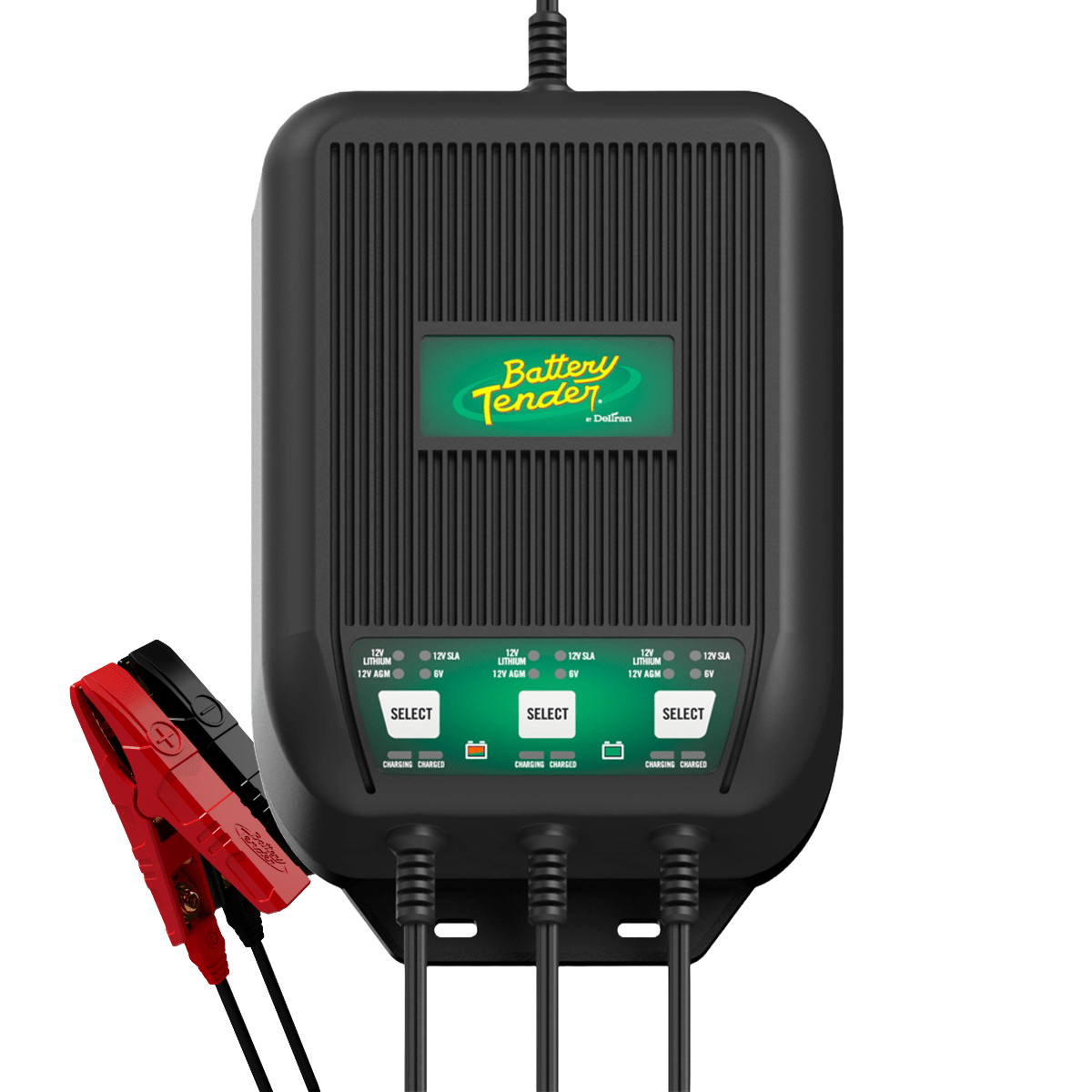
The WaveCharge 3-Bank (022-1003-DL-WH) is aimed at a system with three separate batteries, not simply a large battery that needs a nine-amp charge. The exact Battery Tender manual lists this SKU in a 6 V/12 V, 3 A 2/3/4-bank family and states that each port works independently. The product page describes three 3 A circuits, which add to a 9 A aggregate when all are used. One channel can be in bulk charging while another is in float maintenance; the third does not depend on either. That arrangement can suit a starting battery, a house bank, and one additional auxiliary circuit, provided each battery's instructions accept the 3 A channel rate.
The distinction from the 2-Bank model is the extra independently controlled connection, not a higher current per battery. If a vehicle only has two battery banks, the third channel may add cost and installation bulk without solving a new task. If four batteries need separate charge profiles, the 4-Bank 022-1004 is another functional configuration. Neither total current nor bank count says anything about combining the batteries: each output is intended for an individual battery connection, with its own selector and charge cycle.
Independent voltage and chemistry settings
The exact manual states support for 6 V standard/AGM lead-acid, 12 V SLA/AGM lead-acid, and 12 V four-cell LiFePO4 batteries. It says a selector is provided for each port and permits individual 6 V or 12 V lead-acid profiles alongside 12 V LiFePO4. The product page lists flooded, AGM, gel, sealed maintenance-free and lithium types and describes the voltage and chemistry selections as independent. Because the manual's mode wording is narrower than the page's subtypes, match a battery's exact construction to its own instructions instead of assuming one lead-acid profile covers every battery sold under that label. Lithium is documented at 12 V; the manual does not state a BMS requirement.
The page gives a 14–100 Ah compatibility range per bank at 12 V. The manual's 15 Ah/3 A example estimates the time to reach 80 percent charge but does not establish a capacity range. Here, 14–100 Ah is retained as the manufacturer page's 12 V screening range only; there is no corresponding 6 V Ah limit in the sources. The 3 A bank output is also not a charging-speed guarantee. A battery's own recommended current, condition, loads and wiring govern whether a particular bank is suitable.
Mounting, leads and disputed water protection
This model requires an onboard arrangement and a 120 V AC, 50/60 Hz source. It is not the convenient option to move among several cars or to use where no AC supply is available. The product page lists three sets of combined ring-terminal/alligator-clip leads and mounting hardware. Its page says five-foot output leads while the manual says six-foot DC output cords; measure cable paths to all three batteries and the outlet before choosing a location. The third lead and selector also need accessible, orderly routing, especially if battery banks are spread across a boat or vehicle.
The environmental story is inconsistent. The exact page advertises IP67 water resistance and marine use, but the manual that explicitly names P/N 022-1003 says not to expose the charger to rain or snow. It also cautions against installing below a boat's waterline, directly above a battery, or in an unventilated enclosure. The rating therefore should not be used as an authorization for exposed outdoor placement or submersion; the manual's actual installation instructions need to be followed. The product's spark-free circuitry and automatic fault detection are useful protection features but do not eliminate safe connection, ventilation or correct-polarity procedures.
How it compares with the related formats
For three separate 12 V AGM batteries, a useful comparison is between three WaveCharge channels at 3 A each and a multi-bank system with more current per channel. The 3-Bank 022-1003 emphasizes independent maintenance and has two sibling configurations at two or four banks. The larger-current WaveCharge Pro family is separate; Battery Tender's family page describes that range at 10 A per channel, not 3 A. A higher-current bank is not automatically better: confirm that the battery maker permits that rate and that charging time, installation and environmental limits fit the job. For one portable 12 V battery, a single-output charger with selectable current may make more sense than mounting a multi-bank device.
Before purchasing, confirm the exact 022-1003-DL-WH label, the number of actual batteries, individual voltage and chemistry settings, the battery maker's acceptable current, the 12 V Ah page range, and whether your installation stays within the manual's dry-location rule. Verify that each connection lead reaches without extension improvisation and that the package includes the leads and mounting hardware you need. Manufacturer listings have shown the model as sold out at the time captured; that observation is not current market stock or a promise about another retailer.
Assessment basis
This desk assessment uses Battery Tender's exact SKU page and its shared manual 392-0440-RA, which names 022-1003. It does not claim a hands-on trial, measured charge time, installed fit, user experience or live availability. The official image shows three controls and output leads but is not evidence of every seller's package contents.
Key specifications
Key details at a glance
| Output battery voltages | 6 / 12 V |
|---|---|
| Supported chemistries | Lead-acid / Lithium-ion |
| Rated DC charging current | 3 A |
| Published charge capacity limit | 100 Ah |
| Independent battery outputs | 3 |
| Arrangement | On-board charger |
| Ingress rating | IP67 |
| Included connection | The exact page lists three sets of combined alligator-clip/ring-terminal leads and mounting hardware. The manual specifies six-foot DC output cords; the page lists five-foot leads. Verify the actual offer and layout reach. |
Use the exact model’s instructions for operating limits, supplied equipment and version differences.
Sources for this review
Sources for this assessment
Keep the next step evidence-led
Use the finder to combine voltage, battery chemistry, charging job and setup requirements; then check the exact model and its manual.