
Your needs, this model
Does it fit your priorities?
Can it serve a 24 V AGM battery when I need at least 20 A?
The manual documents a 24 V AGM charging setting and 20 A as the highest selectable 24 V rate (with a 10 A lower setting). This is a single output. Choose the rate only if the battery maker permits it; the charger's 60 A figure belongs to its 12 V plan, not the 24 V plan.
Explore this need in the finder →Does the 250 A engine-start figure mean it charges a battery at 250 A?
No. The manual lists 250 A for a separate 12 V engine-start-assistance mode; battery charging is 60/40/10 A at 12 V or 20/10 A at 24 V. Engine-start assistance is not a battery-free jump start, and the manual calls for checking the vehicle instructions and charging first.
Explore this need in the finder →Can I treat it as a long-term indoor or outdoor storage maintainer?
Clore's exact-model page says the unit supports fleet charging and maintaining, but the reviewed manual does not state a long-term float voltage or an all-size unattended storage limit. It also requires a dry, well-ventilated spot and says not to expose it to rain or snow. Confirm the maker's intended storage routine before leaving a battery connected.
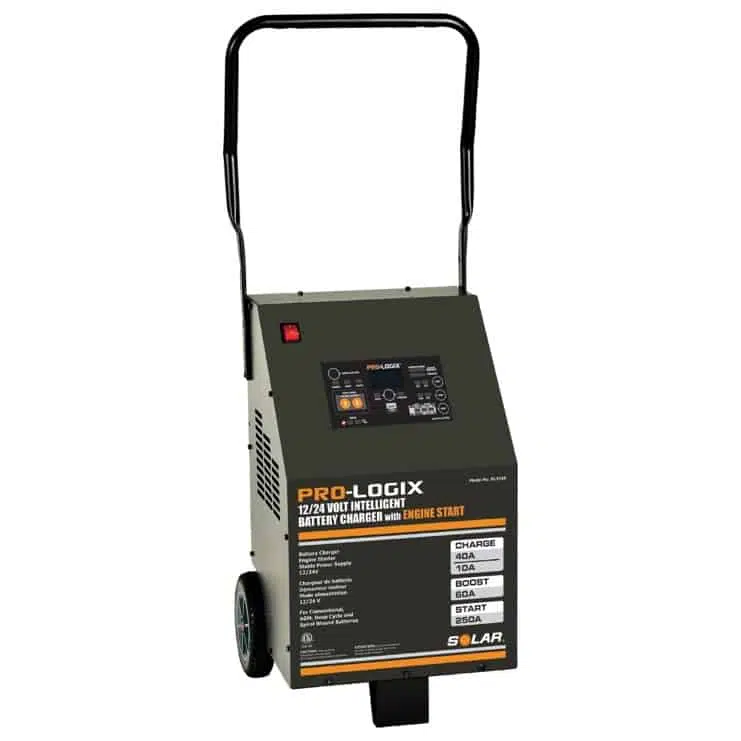
Explore this need in the finder →The PRO-LOGIX PL3760 is a wheeled fleet charger for one lead-acid battery at a time, with selectable 12 V and 24 V plans. Its modes include ordinary multi-stage charging, vehicle-system Stable Power and 12 V engine-start assistance. That mix is useful in a service bay, but the separate ratings are easy to confuse: the 250 A figure is not charging current, and the 60 A 12 V setting does not carry over to the 24 V plan.
Read the voltage and rate settings as separate plans
The model-specific manual lists 12 V charge settings of 60, 40 and 10 A, and 24 V settings of 20 and 10 A. Its control-panel illustration marks the top 12 V selection as BOOST 60 A. A shopper should therefore compare the rate for the actual battery voltage, not simply treat the largest number on the face as universal output. There is no 6 V setting, and Clore documents lead-acid chemistry rather than lithium charging.
The manual's battery-type selector supports flooded lead-acid and AGM, including spiral-wound batteries. Clore's product page also names marine and deep-cycle applications, but the manual says to determine whether those batteries are wet/flooded, AGM or spiral-wound before selecting a profile. It does not list a lithium profile. The intended setup is one selected battery and one output; the 12 V and 24 V positions are alternate plans, not two simultaneous banks.
Clore publishes no Ah charging range for this model. The manual says to use the battery manufacturer's instructions and not exceed its recommended maximum. It gives general rate guidance: 5 A or less for small motorcycle/powersport or lawn equipment (which it says is not applicable to this charger), 15 A or less for deep-cycle, 40 A or less for maintenance-free automotive or marine cranking, and 60 A or less for heavy commercial batteries. The 60 A setting is therefore not automatically appropriate for a normal passenger-car battery. A minimum-current filter tells you only that a setting exists; it cannot certify that rate as safe for a particular battery.
Stable Power is not battery charging
In Stable Power mode, the PL3760 can support a connected vehicle system at an operator-selected target. Clore lists 13.1–14.9 V at up to 60 A for a 12 V system and 26.2–29.8 V at up to 20 A for a 24 V system; the manual describes 0.1 V adjustments. This is a service function for vehicle electronics and repairs, not a second charging output or a general accessory power socket. The manual requires a good, fully charged vehicle battery and says Stable Power will not start if the vehicle battery is below 12.0 VDC; it does not specify a separate cutoff by system voltage.
Engine-start assistance is separate again. The manual's table shows 250 A at 12 V and no 24 V engine-start rating. It directs users to check the vehicle operator's manual, keep a battery connected, charge first and allow a cooling interval after a start attempt. Treating this as a stand-alone jump starter, or as a 250 A charger, would be a category error.
Installation, weight and use environment
At 57 lb, this is a shop machine that rolls rather than a compact charger to move between household vehicles. The manual lists a 72-inch, 6 AWG output cable and nominal grounded 120 V, 60 Hz AC. Its handle ships partly secured in a lowered position; the operator must raise and secure it before using the wheeled format. Plan floor space and cord reach, and confirm the exact package and lead condition when checking a retail listing.
Clore's manual calls for a clean, dry, stable and well-ventilated location, with air flow kept unobstructed. It says not to place the charger where rain, snow or other moisture can drip on it and not to permanently mount it on a boat or recreational vehicle. No IP rating is stated. The product page says the model charges and maintains fleet batteries, but the manual does not give a long-term float voltage, an all-size maintenance ceiling or an unattended storage schedule. If storage maintenance is the goal, confirm the intended routine with Clore instead of assuming a continuous float mode.
How it differs from the PL3740
The PL3740 review covers the 12 V-only alternative with analog knobs, 40/15/5 A rates and timed or HOLD charging. The PL3760 is the more capable voltage-format choice when 24 V charging is genuinely required, with a digital display and an adjustable stable-power target; it is not merely a faster PL3740. It is 10.4 lb heavier, its highest 12 V setting is labelled BOOST, and the 24 V rate stops at 20 A. Neither model has a published Ah range, and neither is documented for lithium batteries.
The exact-model page lists a two-year limited warranty, reverse-polarity and battery-fault protection, soft start, battery reconditioning and temperature compensation. Those are manufacturer-stated features, not independent test results. This assessment does not claim ownership or hands-on use. The important shopping checks are the exact PL3760 model, the battery's actual voltage and construction, the approved current for that battery, a grounded 120 V outlet and a dry, ventilated location.
Bottom line: The PL3760 makes sense where a shop needs one wheeled unit for documented 12 V and 24 V lead-acid charging and separate vehicle-system support. Its charge-rate selection must be matched to the battery maker's limit; the headline 60 A and 250 A figures describe different modes. Its weight, 120 V requirement, unknown Ah range and unreported long-term maintenance envelope are meaningful trade-offs.
Key specifications
Key details at a glance
| Output battery voltages | 12 / 24 V |
|---|---|
| Supported chemistries | Lead-acid |
| Rated DC charging current | 60 A |
| Independent battery outputs | 1 |
| Arrangement | Portable plug-in charger |
Use the exact model’s instructions for operating limits, supplied equipment and version differences.
Sources for this review
Sources for this assessment
Keep the next step evidence-led
Use the finder to combine voltage, battery chemistry, charging job and setup requirements; then check the exact model and its manual.