
Your needs, this model
Does it fit your priorities?
Can this charge a 12 V AGM battery at a 40 A minimum?
The exact page and manual document a 12 V AGM charging selection and a top battery-charge setting of 40 A, plus 15 A and 5 A settings. That only clears the charger's output threshold; use a rate the battery maker permits, and do not treat 40 A as suitable for every battery.
Explore this need in the finder →Can it serve a 24 V truck battery or a 6 V battery?
No. The exact PL3740 is a 12 V-only charger. Its 225 A start-assistance figure and three Stable Power voltage presets do not create a 24 V or 6 V battery-charging plan.
Explore this need in the finder →Is its stable-power mode the same as charging another battery?
No. Stable Power is a separate mode for maintaining a connected vehicle system at one of three documented targets (13.4, 13.7 or 14.1 V) with up to 40 A. The manual says the vehicle battery must be good and fully charged and Stable Power will not start below 12.0 V; this is not a second battery output or a general low-voltage accessory supply.
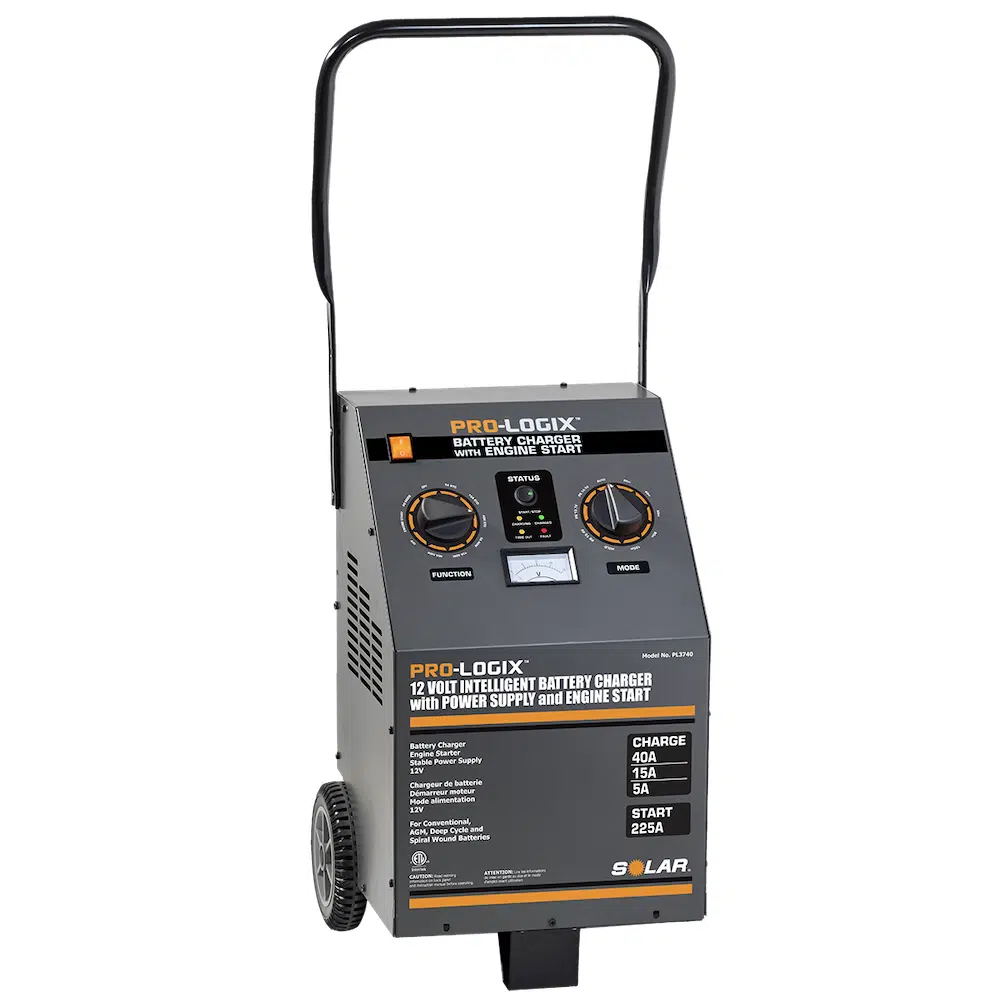
Explore this need in the finder →The PRO-LOGIX PL3740 is a wheeled, service-bay charger for one 12 V lead-acid battery at a time. Its defining feature is not the 225 A number in its product name: that figure belongs to a separate engine-start-assistance mode. For battery charging, the manual lists selectable 40, 15 and 5 A settings. The machine also has a distinct Stable Power mode for supporting a vehicle electrical system during service work. Those jobs should be evaluated separately rather than added together as if this were a multi-bank charger or a portable jump starter.
What its controls and modes actually offer
The PL3740 uses two rotary controls and status lights rather than a data-rich digital screen. Clore documents automatic charging, a HOLD routine, and timed charge choices of 20, 40, 60, 90 or 120 minutes. The manual warns that a timed cycle will often stop before the battery is full. That makes the timer a deliberate shop workflow choice, not a promised fast-charge duration. If you prefer the unit to finish its automatic process, use the correct battery-type setting and AUTO mode; HOLD is described as a routine similar to the automatic one.
Its second output mode is Stable Power. The exact-model page and manual text specify three system-voltage targets—13.4, 13.7 and 14.1 V—with up to 40 A available to the vehicle. Clore describes this for service and repair work where vehicle system voltage must be held at a chosen target. It is not a second battery connection or a general-purpose 12 V accessory supply. The manual says the vehicle battery must be in good condition and fully charged, and that Stable Power will not start if that battery is below 12.0 VDC. A 225 A engine-start-assistance rating is a third, separate function; it does not mean 225 A battery charging.
Match the battery before choosing the rate
The PL3740 is documented for 12 V only. Its manual identifies conventional and maintenance-free flooded lead-acid batteries for the STD setting, and AGM or spiral-wound lead-acid for AGM. Deep-cycle and marine descriptions still require checking the battery's actual construction: the manual says the correct type selection follows whether it is wet/flooded, AGM or spiral wound. There is no 6 V or 24 V battery plan, and no LiFePO₄ or other lithium mode is documented.
Clore publishes no minimum or maximum amp-hour range for this model. The highest selectable charge rate is 40 A, but that is not a universal recommendation. The manual directs the operator to follow the battery maker's maximum rate and gives its own broad guidelines: 5 A or less for small motorcycle/powersport and lawn equipment, 15 A or less for deep-cycle batteries, 40 A or less for maintenance-free automotive or marine cranking batteries, and 60 A or less for heavy commercial batteries. A battery's permitted rate and type matter more than a charger's headline maximum. The matcher therefore treats its Ah ceiling as unknown; an output-current number cannot fill that gap.
Power, setup and shop constraints
This is a 46.6 lb wheeled machine with a 72-inch, 6 AWG output cable. Clore says it ships fully assembled, but its manual still calls for careful connection and setup. The unit requires nominal 120 V, 60 Hz AC from a properly grounded receptacle. The manual calls for a clean, dry, stable, well-ventilated location; keep air vents clear and do not place it where rain, snow or other moisture can drip on it. It should be stored indoors and upright. There is no IP rating or exposed-wet-use approval in the reviewed material.
For engine-start assistance, use the vehicle maker's guidance and the PL3740 manual's exact connection sequence; Clore warns that auxiliary starting can affect some vehicle electronics. The manual also says not to attempt starting a vehicle without a battery and to allow the unit to cool between repeated attempts. These conditions are why the 225 A feature should not be read as a substitute for a dedicated jump starter or as an invitation to bypass the vehicle manual.
Where it sits beside the PL3760
The PL3740 is the simpler choice when the job is strictly 12 V and the operator values physical knobs and timed charging. Its lower 5 A setting gives it more rate flexibility than a machine with only higher shop rates, but even 5 A can exceed the limit for some small batteries. The PL3760 assessment covers the step up to 12/24 V, a digital display, 60/40/10 A 12 V settings and 20/10 A 24 V settings. It is also heavier at 57 lb and requires its handle to be raised and secured before use.
Clore's PL3740 page describes battery-maintenance use, and the manual includes HOLD. The documents reviewed here do not publish a long-term float voltage, an all-size storage limit or an unattended maintenance schedule. If the main need is to leave a vehicle connected for seasonal storage, verify that routine with Clore rather than inferring it from the maintenance wording. The two-year limited warranty and claimed protections are documented product features, not evidence of independent performance testing. No hands-on testing or ownership is claimed in this assessment.
Bottom line: The PL3740 is a substantial, one-battery 12 V lead-acid shop charger with rate choices, vehicle Stable Power and separate starting assistance. It fits a shop that can match its modes to the exact battery and provide grounded AC power in a dry, ventilated space. Its 12 V-only scope, 46.6 lb chassis, unpublished Ah range and unclear long-term storage-maintenance envelope are important limits—not details to guess around.
Key specifications
Key details at a glance
| Output battery voltages | 12 V |
|---|---|
| Supported chemistries | Lead-acid |
| Rated DC charging current | 40 A |
| Independent battery outputs | 1 |
| Arrangement | Portable plug-in charger |
Use the exact model’s instructions for operating limits, supplied equipment and version differences.
Sources for this review
Sources for this assessment
Keep the next step evidence-led
Use the finder to combine voltage, battery chemistry, charging job and setup requirements; then check the exact model and its manual.