
Your needs, this model
Does it fit your priorities?
Does the SC1437 document a 12 V AGM or GEL charge setting?
Yes, for a 12 V lead-acid AGM or GEL battery: the exact page identifies a 6 A Charge setting and names AGM/GEL compatibility, and the directly linked manual gives the 135-minute timer procedure. This is a documented capability, not advice that 6 A is right for every battery; follow the battery maker's charge-rate guidance and monitor the timed session.
Explore this need in the finder →Can the SC1437 maintain a charged battery unattended?
No documented maintenance mode is established. The exact product is a manual timer-controlled charger; its linked instructions say the timer stops charging when it expires and tell the operator to monitor the charger and battery. The SC1437 is not matched for a maintain-only task or unattended float storage.
Explore this need in the finder →Do the SC1437 Boost or Engine Start ratings establish its regular charging rate?
No. The exact page gives 6 A for regular Charge and a separate 150 A Engine Start. Manufacturer renderings conflict on the separate Boost setting (25 A versus 35 A), so verify the delivered label/manual if Boost matters. Neither Boost nor Engine Start is used as ordinary charge current.
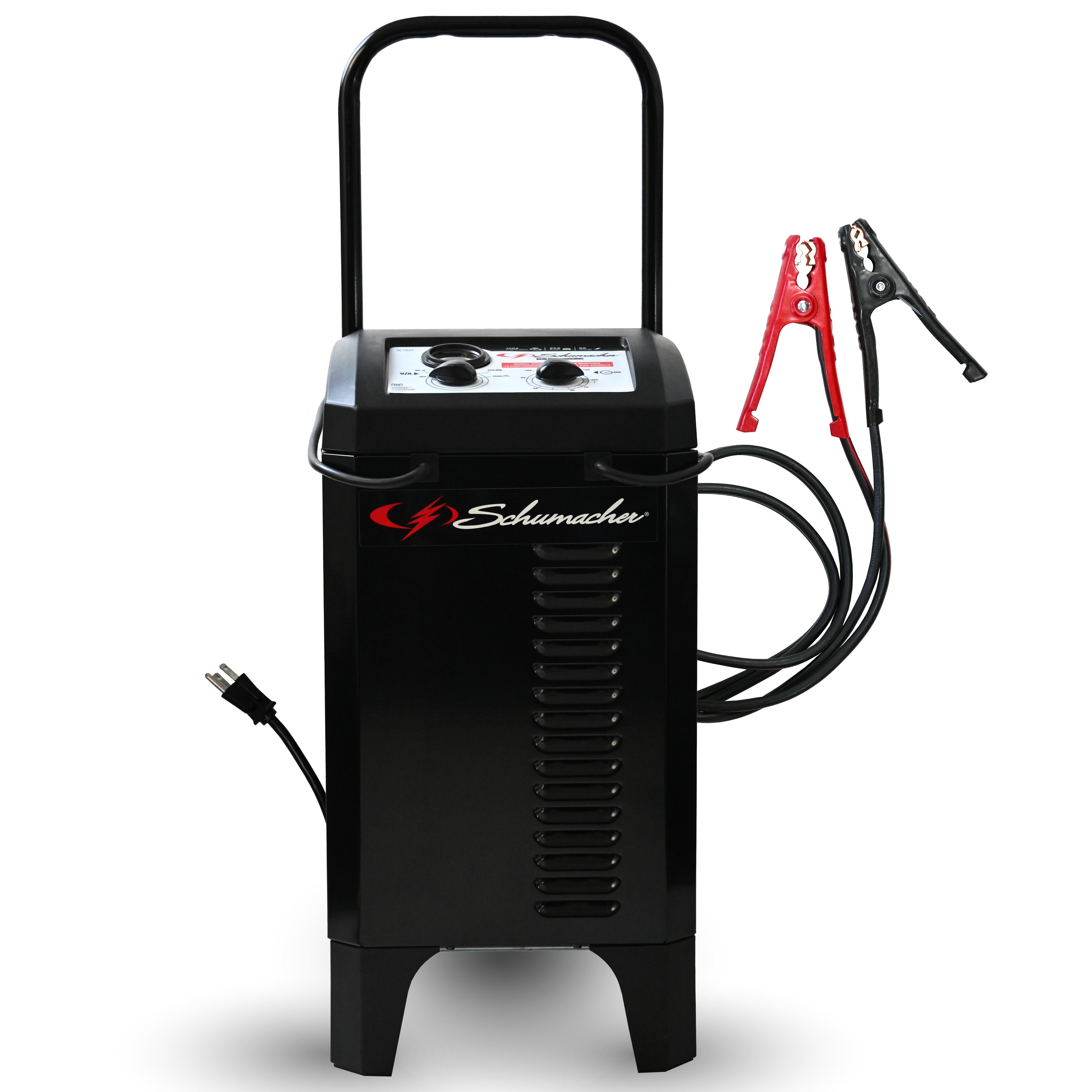
Explore this need in the finder →This is a source-based assessment of Schumacher Electric’s current U.S. SC1437 page, the owner’s manual linked from that page, and the associated official product image—not a hands-on test. SC1437 is a large, wheeled, 120 V AC charger with one clamp output, a manual timer and a distinct engine-start setting. Its appeal is direct control over a timed 12 V charging session in a garage; the same manual control is a drawback if you want an unattended maintainer.
The retail identity is clear; some page details are not
The exact manufacturer page names Schumacher Electric SC1437, with product-form SKU SC1437 and GTIN-8 00026666814379. The same page associates the official image used here. It links owner’s manual 0099002200-02, whose cover prints model family 105-15 rather than the retail SKU. I therefore treat the manual as page-associated operating guidance, not as independent proof of the SC1437 identity. The manual also uses a generic family charge-time chart; its higher current columns are not reassigned to this exact retail model.
A 6 A timed charge—not a maintenance cycle
The exact SC1437 page lists 6 A charging for a 12 V battery. The linked instructions describe a selector with Charge, Boost and Engine Start, and a timer that stops charging when its selected interval ends. They repeatedly tell the operator to monitor the battery and set time according to its capacity and state of charge. This makes the SC1437 a different kind of purchase from a small automatic maintainer: the operator chooses when to stop rather than leaving a float-maintenance cycle running. There is no published SC1437-specific universal amp-hour ceiling, and the manual’s generic table should not be used to invent one.
Keep the ratings for other modes out of a charging-rate comparison. Schumacher’s page lists a separate 150 A Engine Start setting; it is intended to crank an engine with a battery in the vehicle, not to recharge at 150 A. The Boost figure is not settled in the source record: a direct current HTML capture of the exact official page says 35 A, while another rendered view of that same route and the exact-model Amazon listing say 25 A. Neither number changes the documented 6 A Charge setting, and neither is used to recommend a battery charge rate. Check the label and supplied instructions if Boost capability is material to the decision.
Check the battery profile before choosing it
The maker names 12 V batteries and Standard, AGM and GEL compatibility; it also uses “deep-cycle,” which describes a battery use class rather than an independent chemistry. This review’s finder match is narrower: it includes only explicit AGM and GEL subtype plans. The maker does not explain whether its generic Standard label means flooded/wet, EFB, maintenance-free or calcium, so those categories are not silently treated as equivalents. Lithium support and a BMS requirement are not documented. Follow the battery maker’s recommended charge rate even though the charger’s 6 A mode is a known capability.
The page also discusses marine batteries, but the linked manual says a boat battery must be removed and charged ashore unless the equipment is designed for onboard marine use. A product suitable for a battery removed from a boat is not automatically an installation-rated onboard charger. The manual specifies nominal grounded 120 V AC input, says not to expose the charger to rain or snow, and says the unit is not a general low-voltage device power supply. There is no IP rating.
A rolling shop unit still needs space and an outlet
The page describes a steel wheeled case, retractable handle and analog ammeter. It publishes 30.3 lb and dimensions of 11.88 × 23.5 × 12.25 inches. Those are maker specifications, not independent measurements. The supplied image confirms the overall upright case, controls, clamp pair and AC cord, but it cannot verify ratings, wheel hardware, cable reach or carton contents. The exact product page says the package contains the charger and manual; check whether the seller’s delivery includes the parts needed for assembly.
There is a real reach discrepancy to resolve before ordering: the current specifications block says 6 ft of cable reach, while another official rendering says 12 ft total from a 6 ft power cord and 6 ft output leads. The actual output lead length is therefore not treated as confirmed. Plan the grounded outlet and battery position around the exact unit’s cord and clamp reach, rather than assuming the larger figure.
Where the manual tradeoff matters
SC1437 can make sense when a garage has a grounded outlet, one 12 V lead-acid AGM or GEL battery needs a measured-duration 6 A session, and the user will stay attentive to the timer. Its wheels and high-current engine-start function add bulk and shop utility, but not battery-powered jump-starting or a second output. For an automatic 6 V/12 V charger with a documented maintenance stage, compare the different operating plan in our SC1400 assessment; that larger charger has its own current and cable-reach uncertainties and is not a substitute for checking the battery maker’s limits.
Verify the exact setup
Before purchase, confirm the product label says SC1437 and the package is one wheeled charger with its manual—not a similar Schumacher model such as SC1445. Check the exact battery’s nominal voltage, lead-acid subtype and permitted charge current; reserve a grounded 120 V outlet; confirm the charger can reach the battery without unsafe extension-cord improvisation; and read the timed-charge procedure before connection. Do not plan on unattended maintenance, a lithium profile, onboard boat charging, rain exposure, a certain amp-hour ceiling or the disputed Boost figure. The manufacturer’s SC1437 product page and its linked manual are the primary checks for the delivered model and instructions.
Key specifications
Key details at a glance
| Output battery voltages | 12 V |
|---|---|
| Supported chemistries | Lead-acid |
| Rated DC charging current | 6 A |
| Maintenance claim | No |
| Independent battery outputs | 1 |
| Arrangement | Portable plug-in charger |
| Included connection | The page describes AC power cord and booster cables and gives unit/manual as package contents; verify exact seller package, handle/wheel parts and cable reach. |
Use the exact model’s instructions for operating limits, supplied equipment and version differences.
Sources for this review
Sources for this assessment

Keep the next step evidence-led
Use the finder to combine voltage, battery chemistry, charging job and setup requirements; then check the exact model and its manual.