
Your needs, this model
Does it fit your priorities?
Does the SC1400 document charging and maintaining both 6 V and 12 V AGM batteries?
Yes for the voltage/chemistry/service combination: the exact page-linked manual covers 6 V and 12 V lead-acid, AGM, charge completion to Maintain, and occasional monitoring. But its generic 2/6 A Charge/Maintain figures are not mapped to individual voltages, so a numeric minimum-current answer does not qualify it. Follow the battery maker’s charge-rate guidance and verify the instructions shipped with the exact unit.
Explore this need in the finder →Do the SC1400’s 60 A Boost or 300 A Engine Start ratings count toward ordinary charging current?
No. Schumacher lists 60 A as a separate intermittent Boost function and 200 A at 6 V / 300 A at 12 V as peak Engine Start output. These modes are not regular charge current and do not satisfy a numeric charge-current screen. The manual requires a connected vehicle battery for Engine Start and gives short start/cool-down directions.
Explore this need in the finder →Can the SC1400 charge an onboard boat battery or an outdoor battery?
The linked manual says a boat battery must be removed and charged ashore unless the equipment is specifically designed for onboard marine charging. It also says not to expose this charger to rain or snow; the product page gives no IP rating. Its wheeled format is portable garage equipment, not an onboard or wet-weather rating.
Explore this need in the finder →This is a source-based assessment of Schumacher Electric’s current U.S. SC1400 page, the manual linked from that page, and its associated product image—not a hands-on test or a claim about a particular seller’s carton. The SC1400 is a substantial wheeled, 120 V AC charger with separate charging, boost and engine-start functions. Its main practical appeal is garage-shop mobility and a combination of 6 V/12 V lead-acid charging with high-current assistance; it is not a compact maintainer, marine-installed charger, or battery-powered jump starter.
The current page identifies SC1400; its linked manual is generic
Schumacher’s battery-charger collection links to a product page titled for the SC1400. That page’s embedded product data lists SKU SC1400 and GTIN 00026666814003, establishing the retail model identity. It directly links manual 0099002031E-02, but the manual’s cover says “Automatic Battery Charger” and model family 101-14 rather than printing SC1400. I treat it as manufacturer-linked operating guidance, not as a document that independently proves the retail SKU. The exact-model page and manual should travel together when you check an offer.
Keep ordinary charging separate from Boost and Engine Start
The manufacturer page documents 6 V and 12 V output, lead-acid battery support, ordinary Charge/Maintain, a separate 60 A intermittent Boost rating, and Engine Start peaks of 200 A at 6 V and 300 A at 12 V. These are different jobs. The manual calls Boost a short way to add energy to a deeply discharged or large battery and instructs the user to crank only when the display indicates readiness. It warns that Engine Start is used with the vehicle battery installed; it is not an internal-battery jump box. The high Boost and starter figures are not ordinary charge current and should never be used to decide what rate a particular battery can safely accept.
The exact product page lists 2/6 A continuous output and describes a 6-to-2 A charge/maintain setting, but neither the page’s technical block nor the linked manual clearly assigns those ordinary current values to the individual 6 V and 12 V plans. The manual’s generic charging-time table even includes 8 A and 10 A columns despite the exact page’s 6 A maximum. I therefore do not use the table’s larger settings, the boost rating, or the 300 A start peak as evidence of a per-voltage charge-current threshold. The finder recognizes documented voltage and battery-type plans, but withholds the SC1400 when you require a numeric minimum charging current. Follow the exact battery maker’s rate guidance, and check the offered unit’s manual before connecting it.
A lead-acid choice, not a universal chemistry claim
The linked instructions cover 6 V and 12 V lead-acid batteries and name STD, AGM and GEL selections. AGM and gel are explicit subtype matches in this review. “STD” is not translated into flooded/wet, EFB, maintenance-free or calcium support: the manual’s description does not establish those questionnaire labels. The product page’s descriptive copy also mentions deep-cycle use, while its specification block names Standard, AGM and Gel; this does not establish a separate deep-cycle profile or a universal compatibility promise. Lithium is not documented, so there is no lithium or BMS match. Its charge-completion indicator moves the charger to maintenance, but the manual calls for occasional monitoring and states no fixed maintenance current or universal battery-capacity ceiling. Its example times are illustrations, not an Ah limit.
Plan for a wheeled cabinet and a grounded outlet
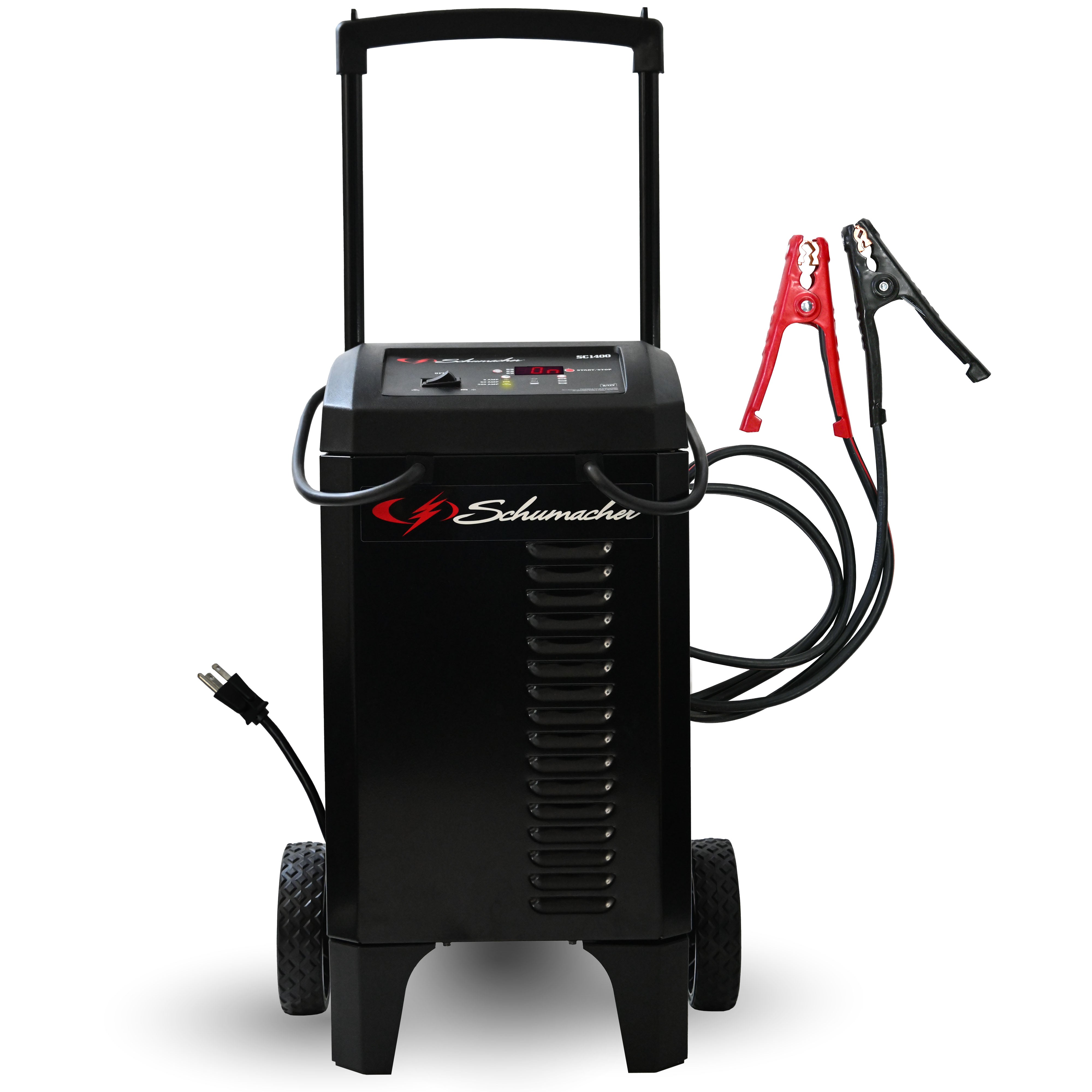
The official listing describes a wheeled steel cabinet with a retractable handle and a digital display. Its published figures are 41.5 lb and 12.63 × 15.33 × 19.75 in; these are manufacturer specifications, not my measurements. The unit uses nominal 120 V AC, so its wheels help move a garage tool but do not make it portable without an outlet. The page lists a six-foot AC cord. Its body copy says the output cables reach up to 12 feet, while its specifications say six-foot cable reach. Because the listing conflicts, verify actual cable length and placement for the seller’s package rather than relying on either figure.
The wheeled format does not mean outdoor or onboard use
The linked manual says not to expose the charger to rain or snow, requires a grounded 120 V circuit, and says a boat battery must be removed and charged ashore unless the equipment is specifically designed for onboard marine charging. This is a portable garage arrangement, not an installed onboard system. The manual also prohibits general low-voltage device-power use except for the starter-motor application, and says never to charge a frozen battery. For engine starting, it gives short crank-and-cool-down instructions; stop if the engine turns over but does not start and have the underlying problem diagnosed instead of repeatedly applying starter current. The product page lists no IP rating.
Who should consider the SC1400
It may suit someone who wants one shop cart for occasional 6 V/12 V lead-acid charge and maintenance work plus separate boost and engine-start assistance, and who has enough storage space and a grounded outlet nearby. It is a poor fit if you need a confirmed charge-current floor at a particular battery voltage, lithium support, more than one independent output, a compact unit to leave installed, an onboard marine charger, rain-exposed use, or jump-start power without mains electricity. For a lighter single-output alternative, compare the handheld SC1281L-titled unit; its linked manual documents a different chemistry mix, but its own 6/2 A selector also lacks a verified voltage-by-voltage current mapping.
Sources and scope
- Schumacher Electric’s current SC1400 product page (product-form SKU and GTIN, page-listed modes, specifications and page-linked manual).
- Manual 0099002031E-02 linked from that exact page (lead-acid voltage and subtype guidance, setup/safety instructions, maintenance behavior and mode limits).
Key specifications
Key details at a glance
| Output battery voltages | 6 / 12 V |
|---|---|
| Supported chemistries | Lead-acid |
| Rated DC charging current | 6 A |
| Independent battery outputs | 1 |
| Arrangement | Portable plug-in charger |
| Included connection | The official product image visibly shows one clamp pair and an AC lead. The product-page body describes wheels/feet/hardware/manual, while its specifications line mentions the unit and manual; verify assembly hardware and the exact retailer carton rather than assuming all page package text is consistent. |
Use the exact model’s instructions for operating limits, supplied equipment and version differences.
Sources for this review
Sources for this assessment

Keep the next step evidence-led
Use the finder to combine voltage, battery chemistry, charging job and setup requirements; then check the exact model and its manual.