
Your needs, this model
Does it fit your priorities?
Is the SC1323 a 6 V or a 12 V charger?
Schumacher's current exact-model page names both 6 V and 12 V output, with a page-stated 2 A at 6 V and 15 A at 12 V. The older SC1323 page linked a manual with 3 A and 15 A selections but does not reconcile the 6 V value. The finder treats the 6 V rate as unknown; confirm the actual label and delivered manual before relying on any 6 V current threshold.
Explore this need in the finder →Can the SC1323 maintain a charged 12 V AGM battery?
The exact page and older listed manual identify AGM compatibility, and the manual says automatic charging changes to maintenance after full charge. It also calls for occasional monitoring and says the 3 A selection can maintain fully charged larger batteries. This is not an unattended-care guarantee, and 3 A is not established as the continuous maintenance current.
Explore this need in the finder →Does the SC1323 have a published Ah charging limit or a lithium mode?
No universal Ah limit or lithium mode is documented in the inspected exact-model sources. The manual's charge-time chart gives examples under a 50%-discharged assumption but does not establish an Ah ceiling. It limits intended use to 6 V or 12 V lead-acid; do not infer lithium compatibility or battery capacity from those chart rows.
Explore this need in the finder →The Schumacher SC1323 is a portable, mains-powered charger/maintainer for 6 V and 12 V lead-acid batteries. It is most straightforward as a 12 V garage charger: the current manufacturer page lists 15 A charging, and the older manufacturer manual associated with the exact SC1323 describes a 15 A rate selection and automatic transition to maintenance. The 6 V story is less settled. The current page says 2 A at 6 V, while the older SC1323 manual describes 3 A and 15 A selections without explaining that specific current. This assessment is based on manufacturer documentation, not hands-on use.
Separate the charge setting from maintenance
The SC1323 is not a tiny overnight tender. Schumacher's current page markets 15 A rapid charging for 12 V, a separate 3 A maintain mode, digital voltage/charge display, and charge, maintain, test and restore functions. The manual describes a 3 A selection for small batteries and for maintaining a fully charged larger battery, and a 15 A selection for automotive, marine and light-truck batteries. Its automatic-charge procedure switches to maintain mode after charging finishes. These are operating roles, not one continuous 15 A float output: the manual describes maintenance as a small current when needed and does not establish 3 A as the continuous maintenance current.
The 15 A rating is not a recommendation for every battery; the manual says to follow the battery maker's charging-rate guidance. Its time chart assumes a 50%-discharged battery and mixes amp-hour with cold-cranking-amp examples. Those rows do not establish a universal Ah limit or guarantee charge time.
The 6 V rate needs a version check
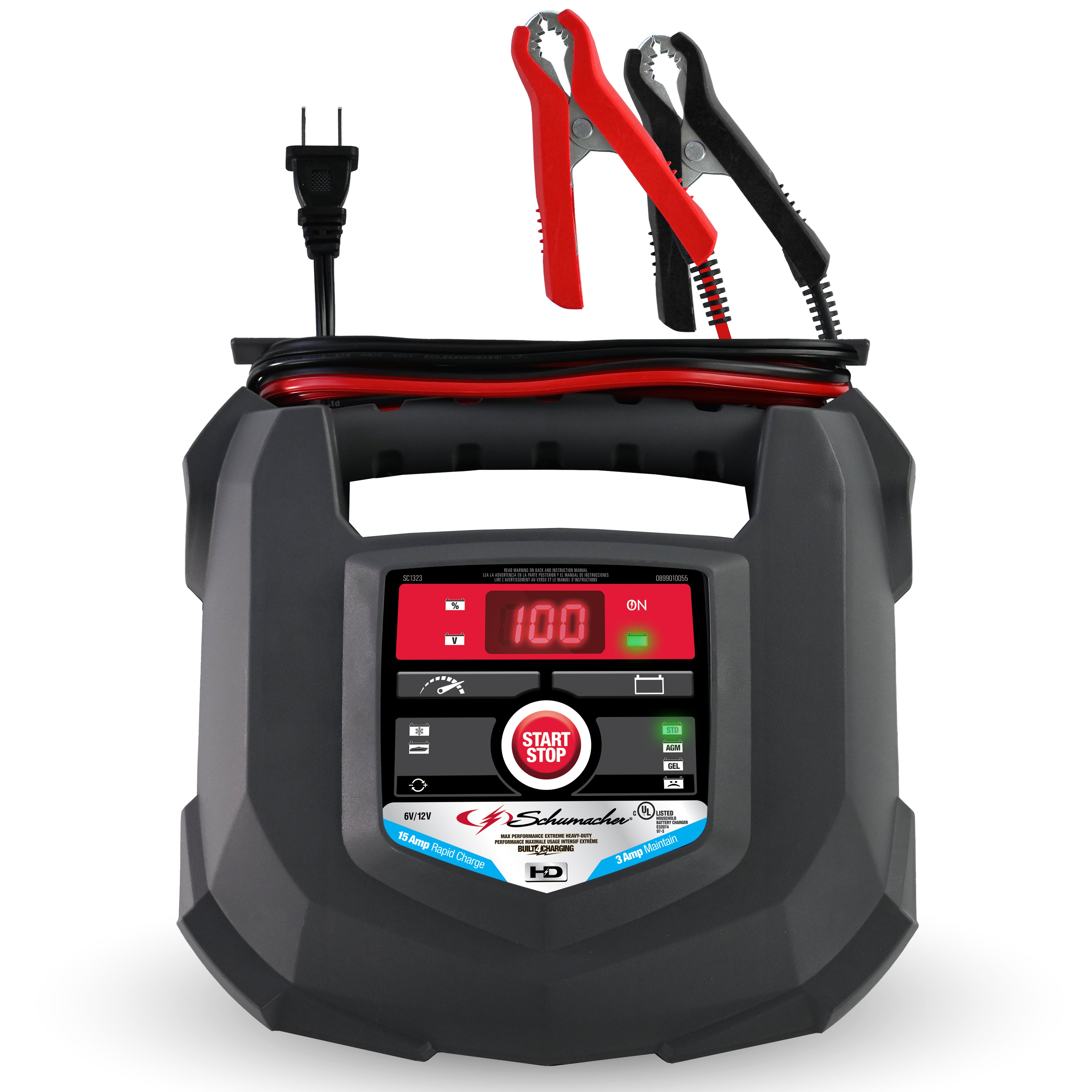
Schumacher's current exact-model page states 6 V / 2 A and 12 V / 15 A, then separately describes a 3 A maintain mode. The product-page photograph visibly identifies the SC1323 and labels 15 A rapid charge and 3 A maintain. An older official SC1323 product-page record lists manual 0099001990E-R4; that manual's charge-rate section describes 3 A and 15 A selections, but it does not explain how its values map onto the current page's 6 V / 2 A claim. The current and older product-page descriptions therefore cannot be silently reconciled into a single 6 V rate. We leave the 6 V numeric charge current unresolved in the finder. If six-volt charging matters, compare the actual charger's printed label and the manual supplied for that exact unit before purchase or use.
The same caution applies to fit. The current page's listed weight and body dimensions differ from the older exact-model page's figures. This review does not use either set to claim a shelf or storage footprint. The manufacturer pages list a six-foot AC cord and six-foot battery leads; those are useful planning references, not a measurement of reach around a vehicle or proof that every seller package is identical.
What the source record supports—and what it does not
The inspected manual limits the charger to rechargeable 6 V or 12 V lead-acid batteries and names Standard, AGM, Gel and deep-cycle use. That supports the common AGM and Gel paths in the assessment library. “Standard” is not treated as proof for every narrower battery subtype in the finder. No lithium charging mode or lithium BMS condition is documented, so the SC1323 should not be selected for LiFePO₄ on the strength of a generic “smart” or “multi-stage” claim.
The manual's digital tester reads battery voltage, not capacity, and warns that surface charge can mislead. It includes desulfation but says an unsuccessful attempt aborts; a restore feature is not a promise to recover a damaged battery.
Setup and ownership are conventional, not weatherproof
The manual calls for a properly grounded nominal 120 V outlet, a well-ventilated battery area, and a dry, nonflammable surface for the charger. It says not to expose it to rain or snow, warns against charging a frozen battery, and requires occasional monitoring during maintain mode. If the charger supplies maximum maintain current continuously for 12 hours, it aborts; the manual points toward a battery problem or electrical drain rather than inviting the owner to ignore the warning. There is no published IP rating or outdoor-use permission in the reviewed sources.
Although Schumacher's page mentions marine batteries, the manual says a boat battery must be removed and charged ashore unless the equipment is specifically designed for onboard marine service. The SC1323 is a portable household-outlet charger, not a permanently installed onboard marine unit. Keep the cords away from moving engine parts, observe the prescribed connection order, and follow the vehicle and battery instructions.
Who should consider it
The SC1323 makes sense for a garage owner who wants a conventional 12 V lead-acid charger with a clearly listed 15 A selection, automatic maintenance after a completed charge, and a display that reports voltage and estimated state of charge. Its additional test and desulfation functions may be convenient, provided they are understood as limited features rather than a diagnostic or repair guarantee. It is less suitable for someone who needs a verified 6 V current threshold, lithium support, outdoor exposure, several independent battery banks, a fixed marine installation, or a published Ah range.
Before buying, confirm that the offer is SC1323 and identify the manual revision and package supplied. Check return terms, grounded-outlet access, cord reach and the battery maker's allowed rate. A one-year limited warranty is listed, but verify the actual channel's terms. The 12 V use case is clear; verify the 6 V rate and dimensions rather than assuming the more favorable listing.
Key specifications
Key details at a glance
| Output battery voltages | 6 / 12 V |
|---|---|
| Supported chemistries | Lead-acid |
| Rated DC charging current | 15 A |
| Independent battery outputs | 1 |
| Arrangement | Portable plug-in charger |
Use the exact model’s instructions for operating limits, supplied equipment and version differences.
Sources for this review
Sources for this assessment
- Schumacher Electric dated current U.S. Battery Chargers collection snapshot
- Schumacher Electric current U.S. SC1323 product page
- Schumacher Electric indexed SC1323 15A product page (older exact-model route; now unavailable)
- Schumacher manual 0099001990E-04 / 0099001990E-R4, observed through the browser PDF view and older SC1323 page listing
- SC1323 official product-page gallery image

Keep the next step evidence-led
Use the finder to combine voltage, battery chemistry, charging job and setup requirements; then check the exact model and its manual.