
Your needs, this model
Does it fit your priorities?
Does the SC1280 meet a 12 V AGM charging-current screen?
The current exact-model page states a 15 A rapid-charge plan at 12 V and lists AGM support. That is a charger capability, not a recommendation for your battery: use its maker's permitted charge rate and check the delivered unit and instructions. The 3 A selection, maintenance stage and any start-related label should not be added to the ordinary 15 A charge plan.
Explore this need in the finder →What does its 6 V setting mean for current?
The current exact page states a 2 A 6 V battery-charge mode, which is the rate used by this assessment for its 6 V plan. The page-linked manual's 3 A and 15 A selections do not map those settings to each voltage, so verify the panel and manual supplied with the exact unit before relying on that number. It is not a safe-rate recommendation.
Explore this need in the finder →Can it maintain a charged 12 V Gel battery?
The exact page and its linked manual identify Gel lead-acid support; after an automatic charge, the manual says the charger changes to maintenance and calls for occasional monitoring. The page's separate 3 A Charge/Maintain wording is not evidence of a continuous 3 A float current. Check the Gel battery maker's instructions and monitor the battery as directed.
Explore this need in the finder →Does the SC1280 have a universal Ah limit or lithium mode?
The inspected manual gives example charge times but no universal SC1280 Ah ceiling, so a numeric Ah requirement is not treated as a confirmed fit. Its manual limits use to 6 V/12 V lead-acid batteries and documents no lithium profile or BMS condition; do not select it for LiFePO4 based on generic smart-charging language.
Explore this need in the finder →The Schumacher SC1280 is a portable, single-output charger/maintainer for 6 V and 12 V lead-acid batteries. The current U.S. manufacturer page identifies its model form as SC1280, lists a 15 A rapid-charge path at 12 V, and states a separate 2 A charging mode for 6 V. It also describes a 3 A Charge/Maintain setting. Those settings need to be read by task and voltage rather than added together: the larger 15 A figure is not a 6 V rating, a maintenance setting is not an ordinary charge rate, and none is a safe-rate recommendation for a particular battery.
Match the voltage before reading the amp rating
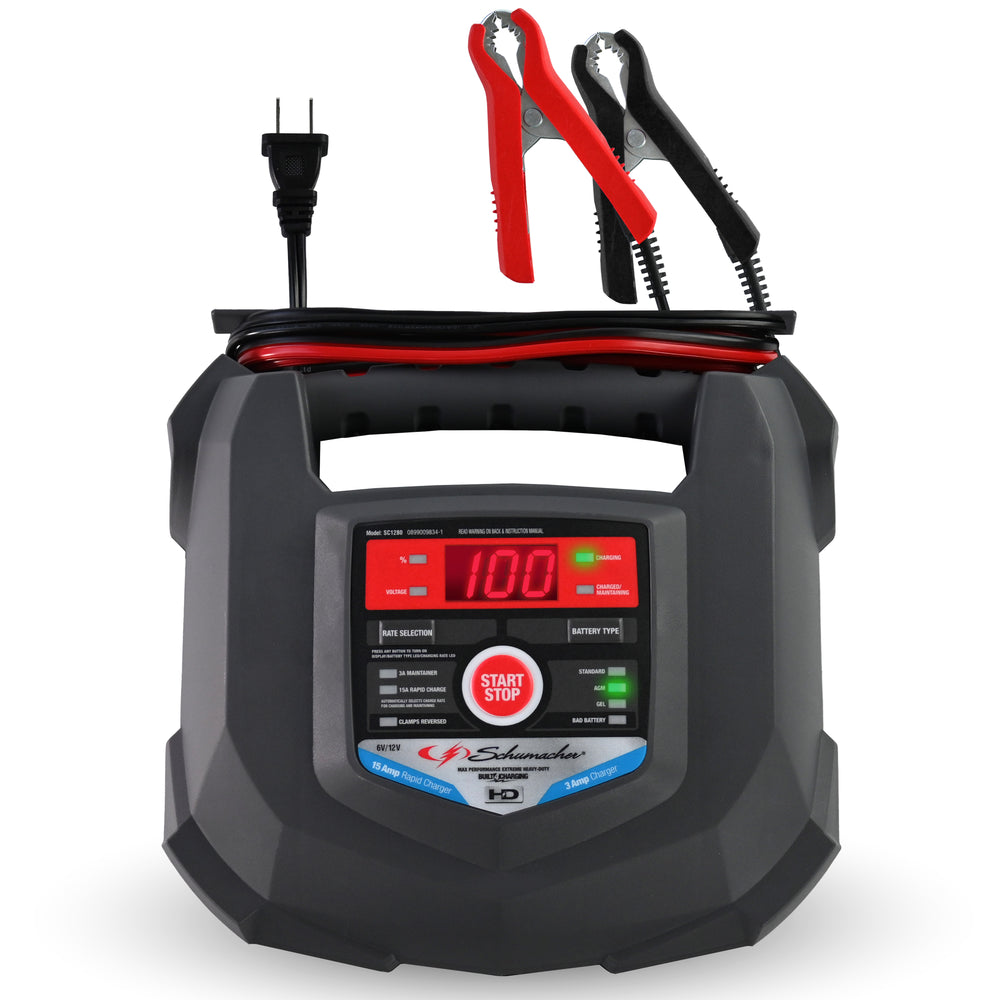
For 12 V use, Schumacher states a 15 A rapid charge setting; for 6 V, the same product page calls out 2 A charging. The image associated with the exact page shows a 6 V/12 V charger face and the SC1280 model marking. This is a useful distinction from a charger with one generic output number: a 15 A minimum can screen the documented 12 V arrangement, but the SC1280 does not meet that same threshold in its 6 V plan.
There is a documentation wrinkle worth keeping visible. The current page-linked manual, 0099001990-04, prints UL models 97-1 and 97-3, and the product page lists UL model 97-3, so there is a model-code bridge. Yet the manual's operating section describes 3 A and 15 A rate selections without assigning those two settings to the individual 6 V and 12 V plans. The current page separately states the 2 A 6 V rate. I use that exact page value for the 6 V assessment and preserve the manual's unmapped selector wording rather than pretending both sources say the same thing. Check that the delivered unit's panel and manual correspond before relying on a voltage-specific rate.
Charge, test and maintain are different jobs
The manufacturer describes the SC1280 as a four-function device for charging, maintaining, testing and restoring batteries. The linked manual says the 3 A setting is for charging small batteries and can also be used to maintain fully charged larger batteries; its automatic-charge procedure switches to maintenance when charging finishes. In that later maintenance mode, the manual describes a small current supplied when needed and recommends occasional monitoring. The page's 3 A Charge/Maintain wording does not establish a continuous 3 A float current, a fixed maintenance current or a reason to leave a battery unattended indefinitely.
The display reports voltage and estimated charge, not battery capacity; the manual warns that surface charge can mislead. Desulfation is described, but an unsuccessful attempt may abort, so the feature does not promise to recover a damaged battery.
Lead-acid modes only in the reviewed plan
The page-linked manual says to charge 6 V or 12 V lead-acid batteries and names Standard, AGM and Gel modes; the exact page also mentions deep-cycle batteries as an application. The matching assessment includes explicitly named AGM and Gel subtypes. “Standard” is not automatically converted into flooded/wet, EFB, calcium or every maintenance-free subtype, and “deep-cycle” describes a use class rather than a separate chemistry. The reviewed manual documents no lithium charging profile or battery-management-system condition, so LiFePO4 is not a supported match here.
Nor does the manual's example charge-time table establish a universal battery-size range. It combines sample battery sizes and CCA classes under a stated 50-percent-discharge assumption, but sets no SC1280 maximum Ah ceiling. If you enter an Ah value as an essential requirement, this model remains unconfirmed by the capacity filter. The 800 CCA marketing line is not an Ah limit and does not replace the battery maker's charging instructions.
Plan the outlet, cables and location
The SC1280 needs a grounded, nominal 120 V AC outlet. It is a portable, single-output charger, not an installed on-board unit or a two-bank system. The page lists one SC1280 and a manual and identifies a six-foot power cord. Its separate Cable Reach field also says six feet but does not clarify whether that means DC clamp reach; the photograph cannot measure the leads. Confirm actual reach and package condition with the seller.
The manual calls for ventilation and a dry, nonflammable surface, says not to expose the charger to rain or snow, and recommends indoor cool, dry storage. It also says not to charge a frozen battery. Although Schumacher names marine batteries on the page, the manual directs boat batteries to be removed and charged ashore unless the equipment is specifically designed for on-board marine charging. The SC1280 has no confirmed IP rating or outdoor-use claim.
How it compares with another 15 A Schumacher
The separately reviewed SC1323 is also listed as a 15 A 12 V charger/maintainer, but its source record has a different manual/rate discrepancy and unresolved 6 V mapping. The SC1280's own product form, GTIN and model image identify a distinct item; do not transfer dimensions or package contents between these models. The SC1341 is a lower-current, 12 V-only alternative with separate Boost and Engine Start modes; those higher figures do not make it a 15 A routine charger.
Who should consider it
Consider it if one portable, mains-powered charger suits a confirmed 6 V or 12 V AGM/Gel battery at its page-stated 2 A or 15 A capability and automatic post-charge maintenance is useful. It is a poor fit for multiple simultaneous outputs, permanent marine installation, wet-weather use, lithium, a known universal Ah ceiling or a confirmed DC lead reach. Check the label, manual, battery instructions, outlet grounding and seller terms. This assessment uses manufacturer documents and an exact page-associated image, not hands-on use or performance testing.
Sources: Schumacher's SC1280 product page and its directly linked manual 0099001990-04. When the page and manual do not assign a selector the same way, the distinction is retained rather than inferred.
Key specifications
Key details at a glance
| Output battery voltages | 6 / 12 V |
|---|---|
| Supported chemistries | Lead-acid |
| Independent battery outputs | 1 |
| Arrangement | Portable plug-in charger |
Use the exact model’s instructions for operating limits, supplied equipment and version differences.
Sources for this review
Sources for this assessment
- Frozen Schumacher U.S. Battery Chargers collection record for SC1280
- Current Schumacher Automotive Battery Chargers collection, SC1280 card
- Current U.S. Schumacher SC1280 product page and product-form identity
- Manual 0099001990-04 linked from the current SC1280 page; cover lists UL models 97-1 and 97-3
- Official image associated with the exact SC1280 manufacturer product page
- Dated U.S. CPSC Schumacher manufacturer recall index; limited SC1280 check

Keep the next step evidence-led
Use the finder to combine voltage, battery chemistry, charging job and setup requirements; then check the exact model and its manual.