
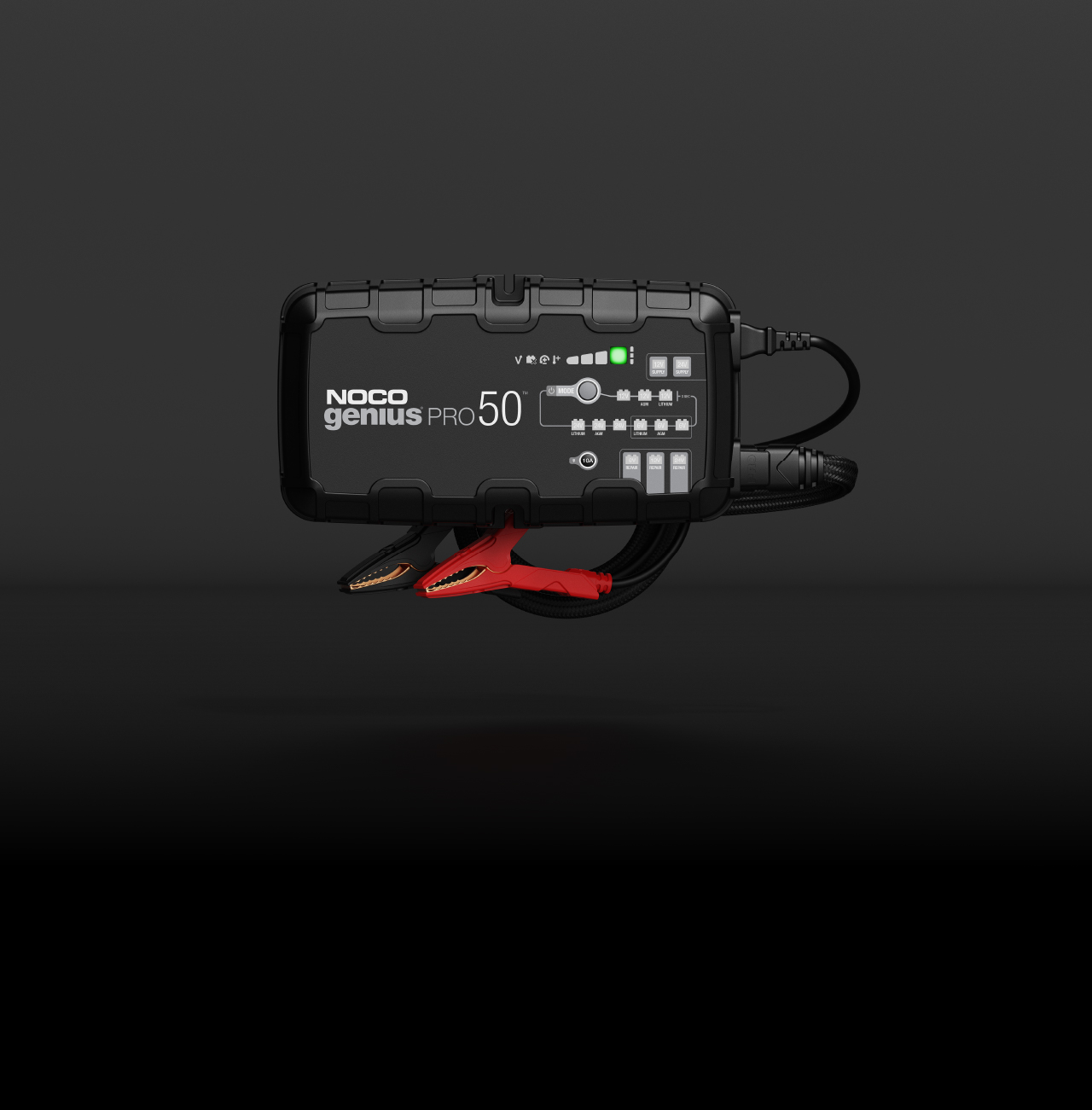
Your needs, this model
Does it fit your priorities?
How much current does GENIUSPRO50 provide for a 24 V battery?
The exact-model guide and specifications rate its 24 V charge profiles at 25 A, half the 50 A rating for 6 V and 12 V. The listed 24 V charging-capacity ceiling is 1,000 Ah, while a separate 10 A reduced-current mode is shown for batteries up to 400 Ah. Confirm the battery maker’s permitted voltage and charge rate; these are manufacturer ratings, not a charge-time promise.
Explore this need in the finder →Does the 10 A mode make GENIUSPRO50 suitable for every smaller battery?
Not by itself. The North American manual lists the 10 A Reduced Charge Current mode for batteries up to 400 Ah, and it is still the visitor’s battery maker—not the charger rating alone—that determines an acceptable charging rate. Do not confuse that reduced-current limit with the regular charge-mode ceiling of 2,000 Ah at 6/12 V or 1,000 Ah at 24 V, or assume the 10 A setting is available as a separate portable output.
Explore this need in the finder →Can GENIUSPRO50 power a 12 V accessory without charging a battery?
Yes, it has a separate 13.6 V 12 V Supply mode rated up to 50 A; a separate 27.2 V Supply mode is rated up to 25 A for compatible 24 V devices. These are device-power modes, not battery-charge profiles. NOCO instructs users to select Supply with the clamps disconnected and warns that safety features are disabled and live power is present at the connectors, so verify device requirements and follow the exact manual before use.
Explore this need in the finder →Assessment basis: This is a source-based review of NOCO's current GENIUSPRO50, not a hands-on test. The assessment relies on the manufacturer product page, technical specifications, support material, data sheet and English North American user guide. No charging test, ownership or measured performance is claimed.
A high-output charger, with output that changes by battery voltage
The GENIUSPRO50 is a portable, AC-powered charger for one battery at a time. Its headline 50-amp rating applies to 6- and 12-volt charging; at 24 volts, the manufacturer rates it at 25 amps. Those figures matter more than the model name if you are comparing it with a smaller unit or calculating whether the battery maker permits the rate. The charger recognizes separate nominal-voltage profiles rather than automatically making every battery compatible.
NOCO gives ordinary charging-capacity ceilings of up to 2,000 amp-hours for 6- and 12-volt batteries and 1,000 amp-hours at 24 volts. The guide's 10-amp Reduced Charge Current mode is a different operating plan: its mode table lists that setting for batteries up to 400 Ah. That ceiling should not be stretched to the normal high-current plans, nor should the much larger ordinary-mode capacity figures be read as approval to use 10 amps on any battery. Confirm the chemistry, voltage and permissible charge current in the battery maker's own instructions.
The data sheet shows approximate time examples for 6- and 12-volt modes at 50 percent depth of discharge. They are not a promise for a particular vehicle: state of charge, battery condition, temperature, loads and the battery's charge acceptance can change the result. For most everyday cars, a 50-amp capable unit is substantially more output than necessary; the practical case is a documented need for the higher rate, a larger supported capacity, or the professional functions—not simply a desire to buy the biggest number.
Separate profiles for lead-acid and LiFePO₄
The North American guide lists 6-, 12- and 24-volt lead-acid profiles for wet/flooded, gel, maintenance-free, calcium and enhanced flooded batteries, plus separate AGM profiles. It also documents lithium iron phosphate (LiFePO₄) profiles at all three voltages, with a built-in battery management system required. That requirement belongs to the lithium operating plan; it is not evidence that a battery without a BMS can be charged by selecting Force mode.
Mode selection deserves care. NOCO's manual says the AGM profiles use a higher-than-normal charging voltage. If the battery's label or instructions are missing, do not guess from the vehicle or charger alone. The manual also warns against charging a damaged or frozen battery and calls for ventilated, dry operation. Its safety section says not to leave the charger unattended. That instruction is a more useful guide for a buyer than broad promotional language about continuous maintenance.
Charging, maintenance and recovery are not interchangeable
NOCO says this model can maintain batteries of all sizes. That claim describes its maintenance function; it does not expand the normal charging ceiling, certify a discharged battery of any size, or establish that a defective battery can be restored. The separate Repair mode is an advanced recovery feature, not a diagnosis or guarantee. Force mode can start a charge when voltage is below the charger’s normal detection threshold, but it requires careful mode selection and the manual warns that it disables safety features and leaves live power at the connectors. Treat it as a restricted procedure in the manual, not a shortcut for an unknown or unsafe battery.
The two Supply modes are also separate from battery charging. NOCO specifies 13.6 volts up to 50 amps for compatible 12-volt DC equipment and 27.2 volts up to 25 amps for compatible 24-volt equipment. The manual directs users to select Supply with the clamps disconnected and warns that the mode disables safety features. Check the device's voltage and current requirements before considering this use; a 12-volt-device Supply mode is not an extra battery-charging profile.
Where PRO50 differs from GENIUSPRO25
The PRO50 doubles the PRO25's rated charging output at each supported voltage: 50 versus 25 amps at 6/12 volts and 25 versus 12.5 amps at 24 volts. Its ordinary-mode capacity ceilings are likewise twice as high, and its reduced-current setting is 10 amps up to 400 Ah rather than the PRO25's 5 amps up to 200 Ah. Its Supply outputs are also higher. These are real functional differences, so the two models are not interchangeable configuration names.
The extra capability brings a larger physical unit. NOCO lists the PRO50 at 5 pounds and about 12.44 by 6.89 by 3.58 inches; the PRO25 is 2.7 pounds and about 9.21 by 5.16 by 2.95 inches. Both are single-output portable chargers, so PRO50 does not solve a need for two independently charged batteries or permanent on-board wiring. Its 750-watt maximum draw and forced-air cooling also deserve attention when choosing a safe, ventilated work area.
Check the package, environment and cable reach
The current specifications page lists 100–240 V AC, 50–60 Hz, IP20, a three-year limited warranty, a replaceable 60-amp ANL fuse, a 10-foot extension, EVA case, two self-tapping screws, regional power cables and one clamp set with interchangeable connectors and eyelets. Verify the exact retail model and included regional cable set rather than assuming every seller package is identical. IP20 is not a waterproof rating, and the guide says to keep the charger dry, uncovered and ventilated.
There are discrepancies among NOCO's current materials that matter to installation. The specifications page says the upper operating temperature is 60°C and the DC lead-plus-clamp reach is 64.8 inches; the North American manual and data sheet give a 50°C upper limit, while the manual describes roughly 72 inches from the charger to the clamp or eyelet. The data sheet and manual also round the body dimensions differently from the specifications page. This assessment keeps the more conservative manual temperature limit and does not treat either cable figure as guaranteed usable reach. Check the product label and current manual, and measure the actual safe route before mounting or setting up the charger.
Who should consider it
GENIUSPRO50 is a plausible shortlist candidate when a single 6-, 12- or 24-volt battery needs a manufacturer-documented high-current profile, when the battery's permitted rate and charge capacity support the selected plan, or when a compatible device needs its separate Supply function. It is a poor match for someone who only needs a compact low-current maintainer, more than one independent bank, a permanently installed on-board charger, a weatherproof unit, or an unattended charging setup. Compare the complete requirements in the charger finder, then check the battery instructions and exact manual before use.
Key specifications
Key details at a glance
| Output battery voltages | 6 / 12 / 24 V |
|---|---|
| Supported chemistries | Lead-acid / Lithium-ion |
| Rated DC charging current | 50 A |
| Published charge capacity limit | 2000 Ah |
| Maintenance claim | Yes |
| Independent battery outputs | 1 |
| Arrangement | Portable plug-in charger |
| Ingress rating | IP20 |
| Minimum operating temperature | -20 °C |
| Maximum operating temperature | 50 °C |
| Included connection | One Genius PRO clamp set with interchangeable connectors and integrated eyelets; verify the exact seller package and regional AC leads. |
Use the exact model’s instructions for operating limits, supplied equipment and version differences.
Sources for this review
Sources for this assessment
Keep the next step evidence-led
Use the finder to combine voltage, battery chemistry, charging job and setup requirements; then check the exact model and its manual.