
Your needs, this model
Does it fit your priorities?
Can the GEN5X1 charge a 12 V starter battery?
NOCO describes it as a 12 V on-board unit for marine, boat, starter and deep-cycle batteries. The shared North American guide gives a separate 12 V AGM profile and a standard 12 V lead-acid profile, each at 5 A and up to 120 Ah. This is a fixed-installation charger, not a portable jump starter; confirm that the battery maker approves the exact profile and charging rate.
Explore this need in the finder →Can the GEN5X1 charge a 12 V LiFePO4 battery?
The manufacturer documents a separate 12 V lithium mode, including lithium iron phosphate, but the GEN Series guide restricts it to batteries with a built-in BMS. The mode is 5 A per bank and the stated charging capacity is up to 120 Ah. Verify the pack voltage and permitted charge rate with its maker before selecting lithium mode.
Explore this need in the finder →Is the GEN5X1 a portable 5 A charger?
No. NOCO classifies this model as an on-board charger. It has one 5 A bank and fixed AC/DC leads with a listed 72-inch DC cable, so planning an installation and checking lead reach, AC access, mounting and battery compatibility matter more than the portable-handheld format. The exact-model page lists 120–240 V AC, while the 2024 manual lists 100–240 V; verify the present model documentation for any supply outside ordinary US 120 V service.
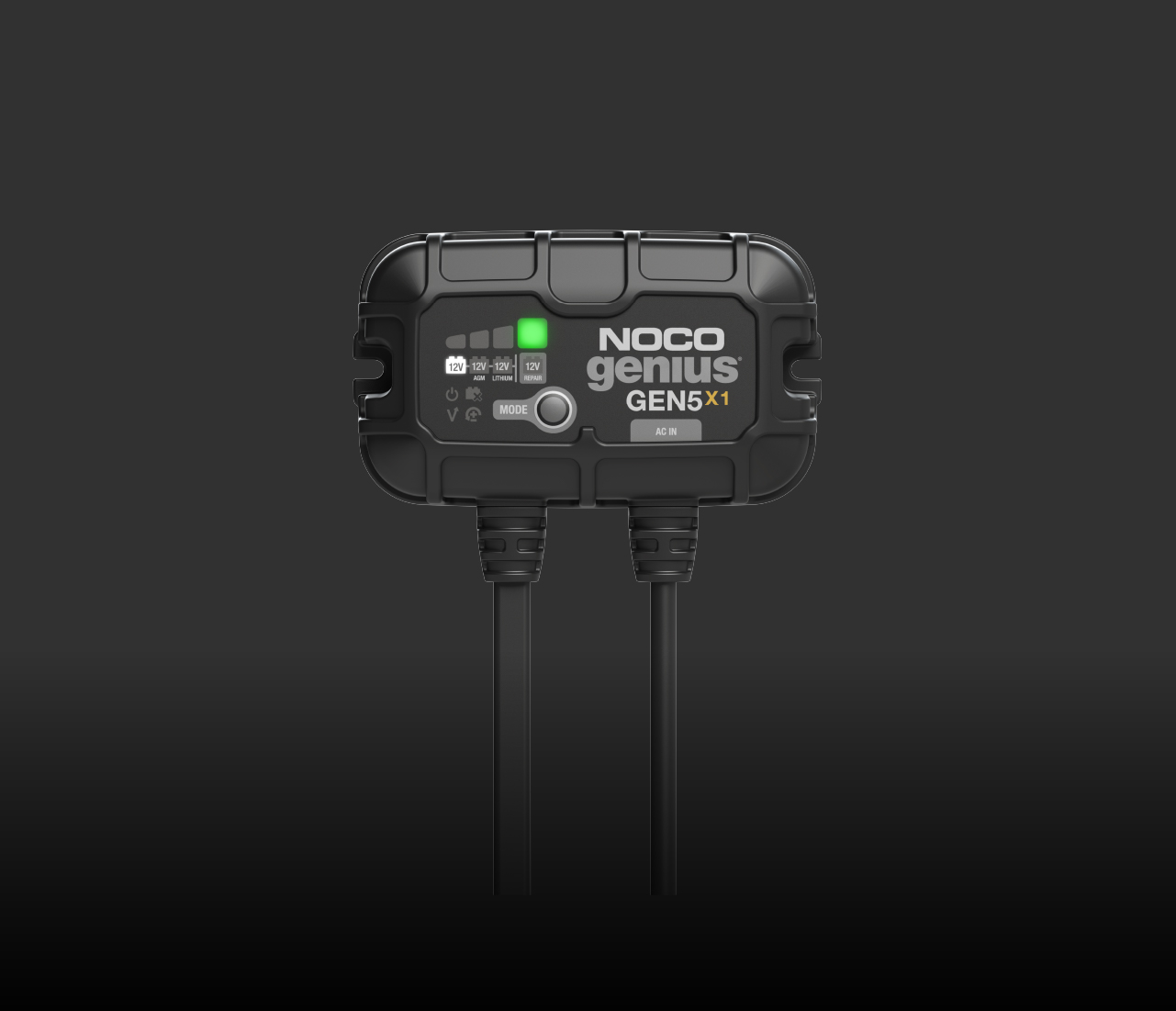
Explore this need in the finder →The NOCO GEN5X1 is the one-bank member of the current GEN5X on-board line. NOCO lists a 5 A, 12 V charger with a separate lead-acid profile, AGM mode and lithium mode, plus 120 Ah as the stated charge-capacity ceiling and maintenance for all battery sizes. This is a source-based review of the US model, not a hands-on test. Its central tradeoff is simple: a permanently installed 5 A channel may suit one compatible starter or deep-cycle battery, but it is not a portable clamp charger or a multi-voltage bench unit.
One fixed installation, one 12 V battery
NOCO describes the GEN5X1 as a one-bank on-board charger for marine, boat, starter and deep-cycle batteries. Its North American guide also provides procedures for a battery installed in a vehicle. That makes it relevant to a compatible 12 V vehicle battery when a fixed installation is wanted, but not a substitute for a portable charger that can be carried from car to car. The AC cord and battery leads are part of an installed arrangement; check the actual mounting area, route, battery location and available mains supply before choosing it.
The single output is the product’s main boundary. The GEN5X1 has one independently selected battery channel at 5 A. Its name does not imply a second output, and it cannot charge two separate batteries at once. For two batteries that should remain connected, compare the two-bank GEN5X2; for a portable one-output charger, compare the GENIUS5, while remembering that the latter’s separate portable format has its own voltage and input details.
Read the amp-hour limit as a charging limit
The manufacturer lists 5 A output and charging up to 120 Ah. It separately says the GEN Series maintains all battery sizes. Those are different claims: the 120 Ah figure is the stated capacity range for charging; “all sizes” describes maintenance after a battery is charged. It should not be used to infer that a depleted battery above 120 Ah is supported for ordinary charging. Nor does a 5 A rating establish that every battery accepts 5 A. Use the exact battery maker’s permitted voltage and rate, not the charger’s maximum as a target.
The shared manual documents three normal profile families relevant here: 12 V lead-acid, 12 V AGM and 12 V lithium. The lithium setting includes lithium iron phosphate, but NOCO restricts it to a 12 V pack with a built-in battery-management system. The standard lead-acid list covers wet/flooded, gel, EFB, maintenance-free and calcium types; AGM is a separate profile. A label saying “12 V” alone does not resolve chemistry. Do not select a mode just because another model or a neighboring profile uses the same voltage.
Repair and Force are not routine charge settings
The GEN5X1 offers a 12 V Repair mode. The manual describes it as a high-voltage lead-acid recovery mode, not a universal battery fix: it may cause water loss in flooded cells, some batteries and vehicle electronics may be sensitive, and NOCO says to disconnect the battery before using it to reduce electronic risk. It also cautions that not every battery can be recovered. Treat a suspect battery as a health and safety problem, not as a reason to assume Repair will restore it.
Force mode is for a battery below the charger’s 1 V detection threshold. The manual says it overrides safety features and leaves live power at the connectors; after five minutes, ordinary low-voltage detection returns. This is not a way to bypass a battery maker’s instructions, force charge damaged/frozen cells or make an unknown chemistry safe. NOCO’s general safety material warns against unattended use, and its troubleshooting material directs a bad battery to professional evaluation.
Mounting evidence has a few conflicts
The current exact-model specifications page lists 120–240 V AC, a 72-inch AC cable and a 72-inch DC cable with eyelets; the older North American guide lists 100–240 V AC. Both sources cover ordinary US 120 V service, but the discrepancy means this review does not promise operation below 120 V. The specifications page also lists 16 AWG DC cable, an 18 AWG AC cord, a 7.5 A mini-blade fuse, IP68, a three-year limited warranty and two self-tapping screws in the box. Check the current package and exact mounting hardware before beginning an installation.
The 2026 exact-model page gives dimensions of 2.99 × 5.09 × 1.90 inches and a weight of 2.95 lb. The 2024 North American guide and sell sheet show about 4.6 × 2.9 × 1.9 inches and 1.85 lb. The order, footprint and reported weight differ enough that I would not drill from either drawing alone: verify the actual unit and clearance first. The page calls the enclosure IP68 and waterproof; the guide also describes IP68 immersion up to 1.5 m in fresh water for 30 minutes, but its general safety warning says not to submerge or get the charger wet and it says not to leave it wet for long periods. Do not plan routine underwater or prolonged wet operation; consult current instructions.
Who should compare it
The GEN5X1 is a plausible comparison for one compatible 12 V starter or deep-cycle battery where an on-board mounting plan, 5 A output and up-to-120-Ah charge limit fit the job. It also documents AGM and BMS-protected 12 V LiFePO₄ modes and has a separate all-size maintenance claim. It is a poor match for multiple batteries, 6 V or 24 V packs, a portable charger requirement, a higher per-battery current request, or anyone planning around an unverified dimension or weight. Confirm the exact battery profile, charge rate, environment, lead reach, power source and current manual before purchase or installation.
Primary sources checked: NOCO’s GEN and GENPRO collection, GEN5X1 overview, technical specifications, mode and troubleshooting guide, North American GEN Series manual and GEN Series sell sheet. This assessment does not establish test results, measured performance, seller stock, a seller package or personal use.
Key specifications
Key details at a glance
| Output battery voltages | 12 V |
|---|---|
| Supported chemistries | Lead-acid / Lithium-ion |
| Rated DC charging current | 5 A |
| Published charge capacity limit | 120 Ah |
| Maintenance claim | Yes |
| Independent battery outputs | 1 |
| Arrangement | On-board charger |
| Ingress rating | IP68 |
| Minimum operating temperature | -20 °C |
| Maximum operating temperature | 40 °C |
| Included connection | Fixed on-board AC cord and hard-wired battery-bank leads; the exact-model specifications list 72-inch AC and DC cable lengths. Package contents include the charger, two self-tapping screws, user guide and warranty information. |
Use the exact model’s instructions for operating limits, supplied equipment and version differences.
Sources for this review
Sources for this assessment

Keep the next step evidence-led
Use the finder to combine voltage, battery chemistry, charging job and setup requirements; then check the exact model and its manual.