
Your needs, this model
Does it fit your priorities?
Can the US 0.8 recharge a 32 Ah 12 V AGM battery?
Yes, the exact U.S. page and linked North American manual put 32 Ah at the top of the documented 1.2–32 Ah charging range and list AGM support. The 0.8 A rating is slow, and the battery maker's charge-rate instructions still control; the maintenance limit of 100 Ah does not raise the recovery-charge ceiling.
Explore this need in the finder →Can the US 0.8 recharge a depleted 60 Ah car battery?
Not within the reviewed charging range: CTEK states up to 32 Ah for charging. Its separate up-to-100 Ah figure is for maintaining an already-charged battery, not recovering a depleted 60 Ah battery. Use the same finder conditions to compare chargers whose charge limits cover 60 Ah.
Explore this need in the finder →Can the US 0.8 maintain a fully charged 100 Ah flooded battery?
The exact U.S. page and linked manual document maintenance up to 100 Ah for a 12 V lead-acid battery; they separately cap recovery charging at 32 Ah. This assumes the battery is compatible, already charged and within the battery maker's instructions. Follow the manual's Step 5 and no-rain/no-snow warnings before any long-term connection.
Explore this need in the finder →Best understood as a small-battery charger and car-battery maintainer
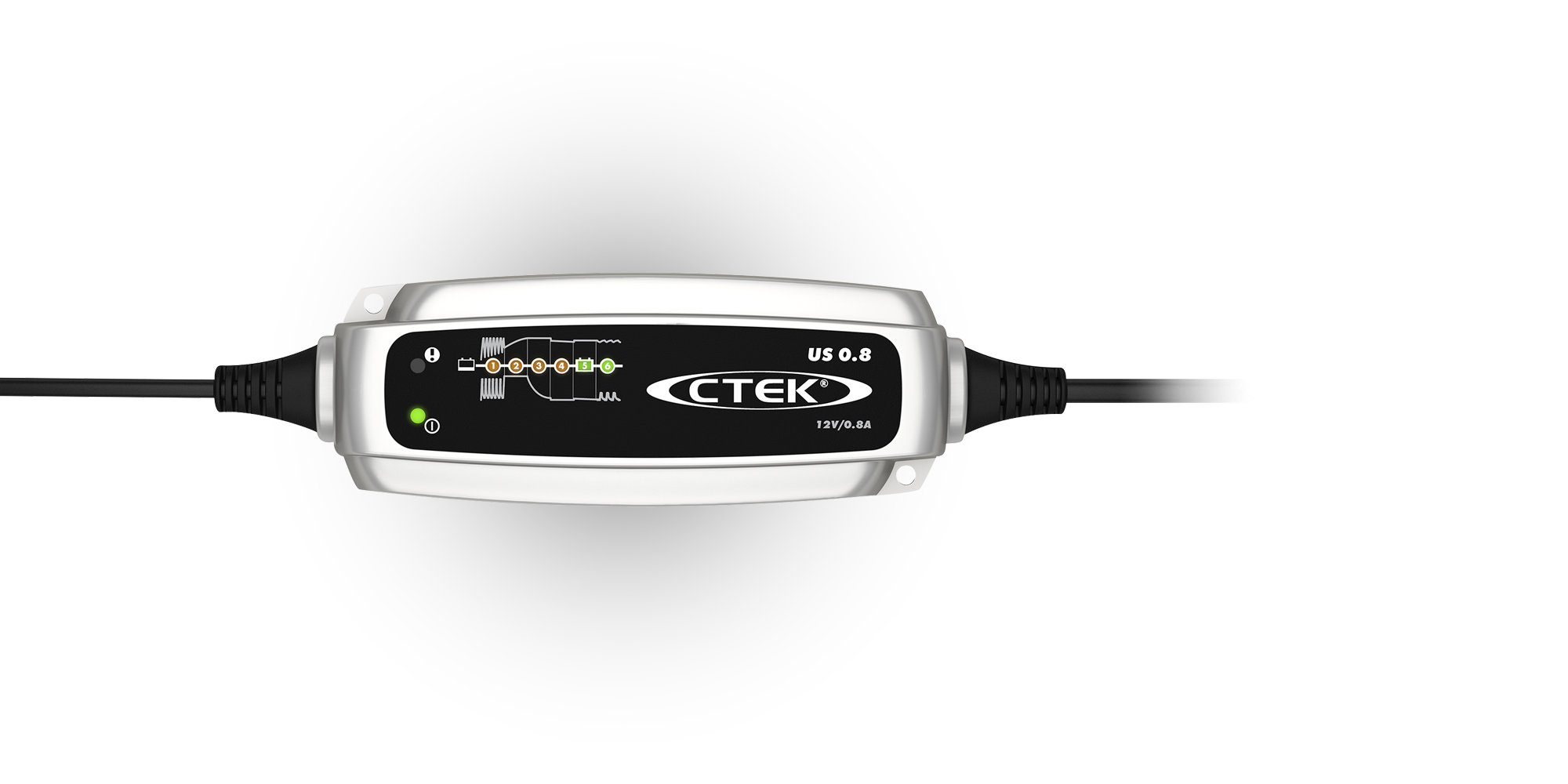
The CTEK US 0.8 is a deliberately low-output 12 V charger, not a quick way to refill a large, depleted starter battery. Its strongest use in the reviewed material is charging a small compatible lead-acid battery, then moving into float and pulse maintenance; CTEK also explicitly describes maintaining a normal-size car battery when it is already charged. The current U.S. product page identifies item 56-865 as US 0.8 and links a North American manual and U.S. product sheet whose document title is XS 0.8. That manual identifies technical model 1064. This exact page-to-document link is the basis for treating the manual as relevant, not an assumption that every similarly named regional product is identical.
Capacity is different for recharge and storage maintenance
CTEK rates the unit at 0.8 A and 14.4 V. Its exact U.S. product page, linked U.S. sheet and North American manual support charging 12 V batteries in the 1.2–32 Ah range; the page and manual separately describe maintenance for batteries up to 100 Ah. Those figures answer different questions. A depleted 60 Ah car battery is outside the documented charging range even though a compatible, already-charged 60 Ah battery falls within the maintenance statement. The 100 Ah figure is not a license to recover-charge a discharged 100 Ah battery.
The manual includes a time-to-80% table for empty batteries, with a 32 Ah example taking 32 hours to reach that point. Treat that as a manufacturer estimate for its stated conditions, not a full-charge promise or a diagnosis of battery condition. At 0.8 A this is a slow option for recharge work. If you expect repeated recovery charging or need more current for a larger battery, compare the 4.3 A MXS 5.0 NA or 7 A MULTI US 7002, while respecting each one's separate battery-size and chemistry limits.
Use the supported 12 V lead-acid chemistry, not a guessed lithium mode
The U.S. page and 2024 U.S. product sheet name wet/flooded, maintenance-free, calcium/calcium, AGM and GEL lead-acid types. The page-linked North American manual additionally names EFB among its 12 V lead-acid types. Because the exact page and sheet do not repeat EFB in their type list, this assessment relies on the linked manual's explicit EFB statement and keeps that document discrepancy visible; confirm the manual supplied with the exact unit. None of these sources documents a lithium mode, so don't infer LiFePO₄ support from a general claim about a 12 V charger. The battery label and its maker's permitted charging rate still control.
The manual's six-step sequence shows progress and transitions through charging, analysis and storage maintenance. It is a useful status display, not evidence that a weak battery will recover. The instructions say to disconnect and seek attention if the charger does not reach Step 5 within 40 hours; this is especially important when the product page's seasonal-storage language suggests leaving the unit connected for long periods.
Connection and package details need an exact check
This is one portable AC charger with one battery output. CTEK's page states that eyelet connections are included, and the linked manual's package table lists charge clamps, a mains adapter, user instructions, a sticker and a gift box; product packaging can vary. Verify item 56-865 and the connector set in the actual offer rather than assuming an image or an unrelated listing describes the bundle. A clamp lead and an eyelet harness are alternate ways to reach one battery, not two independent banks.
There is also a small input-specification difference: the current U.S. page and sheet say 100–120 VAC, while the linked manual says 110–120 VAC. Check the rating on the exact unit and use a suitable outlet rather than relying on the broader number alone. CTEK's page and sheet give an ambient range beginning at +5 °C and ending at +50 °C; the linked manual gives a broader −20 °C to +50 °C range. The narrower current page/sheet range is used for this assessment. Check the exact revised instructions when temperature is near either limit.
IP65 is not permission to ignore the manual
The product page describes the charger as splash- and dustproof and markets weather resistance, while the linked North American manual says not to expose it to rain or snow and never to charge a frozen battery. Follow the more restrictive operating instruction; IP65 does not settle whether an exposed charging setup is safe. The manual also calls for ventilation, sound connections and checking that Step 5 is reached before leaving a connected charger for a long period. It warns that vehicle accessories can prolong charging or drain the battery. Do not place the charger directly above the battery, cover it, or route the leads where a hood, door or moving engine part could damage them; an automatic mode is not a substitute for battery-maker guidance.
Who should shortlist the US 0.8?
It is a reasonable document-supported candidate when the battery is 12 V lead-acid, within 1.2–32 Ah for charging, and a 0.8 A output suits the battery maker's instructions. It is also relevant to a compatible, already-charged car battery up to CTEK's 100 Ah maintenance limit. It is not the choice for fast replenishment, batteries above the charge ceiling, 6 V or 24 V systems, a multi-bank installation, or a documented lithium charge mode. The finder asks for whole amp-hour values and only filters against a maximum; check the 1.2 Ah lower charging limit in the exact documentation, and leave the current threshold open if 0.8 A is adequate because the finder’s current input starts at 1 A.
Key specifications
Key details at a glance
| Output battery voltages | 12 V |
|---|---|
| Supported chemistries | Lead-acid |
| Rated DC charging current | 0.8 A |
| Published charge capacity limit | 32 Ah |
| Independent battery outputs | 1 |
| Arrangement | Portable plug-in charger |
| Ingress rating | IP65 |
| Minimum operating temperature | 5 °C |
| Maximum operating temperature | 50 °C |
Use the exact model’s instructions for operating limits, supplied equipment and version differences.
Sources for this review
Sources for this assessment

Keep the next step evidence-led
Use the finder to combine voltage, battery chemistry, charging job and setup requirements; then check the exact model and its manual.