
Your needs, this model
Does it fit your priorities?
Can the MXS 5.0 NA charge a 12 V AGM battery at the 110 Ah boundary?
CTEK lists AGM in the 12 V lead-acid types and its North American manual specifies 1.2–110 Ah for charging. The exact product page and manual list 4.3 A, while the U.S. product sheet lists 5.0 A; this assessment uses 4.3 A and the battery maker's permitted rate still controls.
Explore this need in the finder →Can it maintain an already-charged 12 V flooded battery for storage?
Yes, within the manufacturer's maintenance plan: CTEK documents automatic float/pulse maintenance up to 160 Ah. That is a maintenance limit, not permission to use the same 160 Ah figure as a recovery-charging ceiling; charging is listed up to 110 Ah.
Explore this need in the finder →Is the MXS 5.0 NA suitable for a 12 V GEL battery?
CTEK lists GEL among the supported 12 V lead-acid types, but its manual says not to use RECOND with GEL. Confirm the battery maker's charging instructions and select the regular program instead of RECOND when GEL is present.
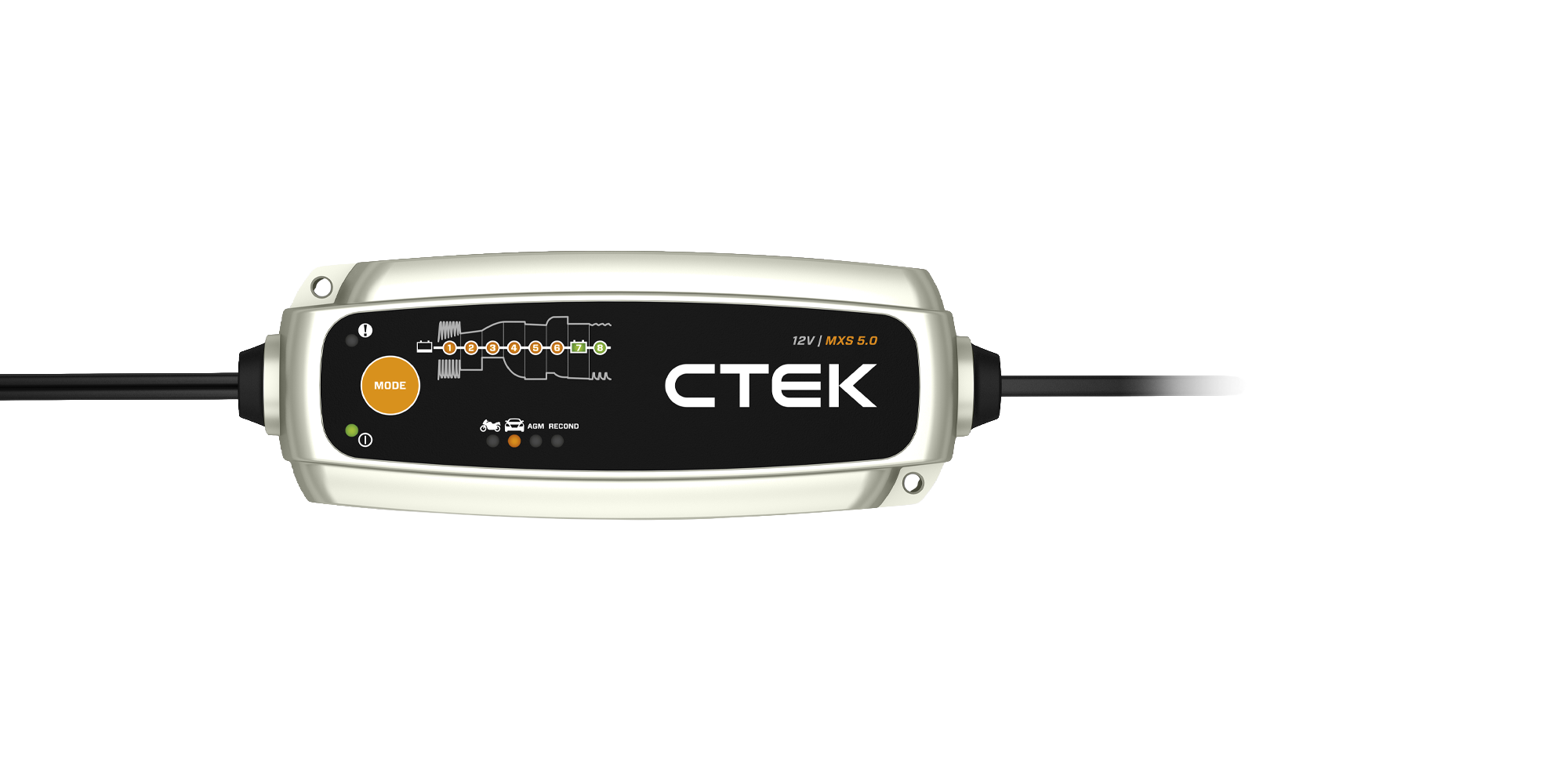
Explore this need in the finder →The CTEK MXS 5.0 NA (item 40-206; North American manual model 1090) is a portable, one-output 12 V AC charger for lead-acid batteries. Its case for consideration is the combination of a moderate output, several named lead-acid programs, and automatic float/pulse maintenance. This is a document-based assessment of CTEK's U.S. product page, North American manual and U.S. product sheet, not a hands-on test.
Check the charge rating and capacity boundary
The current exact U.S. product page and North American manual identify a 4.3 A maximum output, with the manual showing a separate 0.8 A small-battery program. The official U.S. product sheet for the MXS 5.0 says 5.0 A instead. Those source statements do not agree, so this assessment and the finder use 4.3 A rather than promising the higher number. It is sensible to confirm the current manual with CTEK if that 0.7 A distinction matters to a planned charge or to a battery maker's limit. In any case, a charger's maximum is not an instruction to force that rate into a battery that accepts less.
The capacity distinction matters just as much. CTEK's page and North American manual list charging for 1.2–110 Ah batteries and maintenance up to 160 Ah. The manual's technical specifications place those values under different jobs; the U.S. product sheet likewise separates a charge limit of 110 Ah from float/pulse maintenance for up to 160 Ah. The 160 Ah figure is not evidence that a deeply discharged battery of that size should be recovery-charged with this unit. The manual gives a 2.0 V start threshold, but that is not a diagnosis or a guarantee that a neglected, damaged or sulfated battery can be restored. An error or battery that fails to progress through the eight-step sequence deserves attention rather than repeated attempts.
Lead-acid programs, with a specific RECOND warning
CTEK lists 12 V wet/flooded, maintenance-free, calcium, AGM, EFB and GEL batteries. The eight-step sequence includes small and normal charge programs, an AGM program and RECOND. CTEK describes float/pulse maintenance for long connection periods; the automatic steps are useful for a battery kept charged in storage, provided the battery, vehicle and charger manuals allow that arrangement and the user follows the charger status indicators.
RECOND should not be treated as a universal repair mode. The North American manual specifically warns against applying it to AGM or GEL batteries. Use it only when the battery maker's instructions and the exact CTEK manual permit that treatment for the specific battery. The listed profiles are all lead-acid: the MXS 5.0 NA is not a LiFePO₄ charger, and its 12 V output does not qualify it for 6 V or 24 V batteries. The CTEK NXT 5 NA is a nearby model that documents a separate lithium program, although it has its own chemistry and capacity limitations.
Placement, input and connection planning
This unit is a mains-powered, portable charger with one battery output, so it needs access to a suitable 110–120 V AC outlet; it is not an on-board installation or a 12 V socket charger. The page lists a 110–120 V, 50–60 Hz input, 1.1 A AC draw, temperature compensation, an IP65 enclosure and a +5°C to +50°C operating range. The manual says output is reduced automatically at high temperature. CTEK's product page calls it splash- and dustproof, but the manual separately says not to expose it to rain or snow. The IP rating should not be read as permission to charge outdoors in wet conditions. Plan a dry, ventilated location and safe reach to the battery before buying; the manual warns against a restricted ventilation area and placing the charger directly above a battery.
The package listing names the charger, clamps and user manual. Confirm the exact item number and supplied connections on the specific offer rather than assuming a seller has the same connectors or accessories as a CTEK image. The manual also calls for proper polarity and connection sequence, forbids charging a frozen battery, and warns that lead-acid batteries can release explosive gases. An automatic charger still needs correct placement and battery-specific precautions. CTEK lists a five-year limited warranty; verify the original-purchaser terms and seller return conditions for the actual offer.
Who should compare it, and who should keep looking?
The MXS 5.0 NA merits a comparison when the requirement is one 12 V lead-acid battery, a documented 4.3 A conservative current, support for the listed subtypes, and maintenance use within the 160 Ah figure. It is not a fast large-bank charger, a lithium option, a multi-output system or a general-purpose DC supply. If your battery is larger than 110 Ah and needs recovery charging, do not infer fit from the separate maintenance limit. If your battery is AGM or GEL, leave RECOND out of the plan unless its maker explicitly permits it.
CTEK's MXS 5.0 POWER KIT NA is a separately listed bundle built around this charger and adds an M8 indicator eyelet, connect clamp and 5000 mAh device powerbank; its extra items do not increase charging current. Compare the package-specific assessment if those accessories matter. For any offer, verify item 40-206, the North American manual, the chemistry and capacity limits, the battery maker's permitted charge rate, and the exact connector package. No category-finder result substitutes for those checks.
Key specifications
Key details at a glance
| Output battery voltages | 12 V |
|---|---|
| Supported chemistries | Lead-acid |
| Rated DC charging current | 4.3 A |
| Published charge capacity limit | 110 Ah |
| Independent battery outputs | 1 |
| Arrangement | Portable plug-in charger |
| Ingress rating | IP65 |
| Minimum operating temperature | 5 °C |
| Maximum operating temperature | 50 °C |
Use the exact model’s instructions for operating limits, supplied equipment and version differences.
Sources for this review
Sources for this assessment

Keep the next step evidence-led
Use the finder to combine voltage, battery chemistry, charging job and setup requirements; then check the exact model and its manual.