
Your needs, this model
Does it fit your priorities?
Does the PRO25SE NA have enough lead for a fixed workshop position?
The exact PRO25SE page and its U.S. product sheet identify 19.6 ft charging leads, plus a wall hanger and mounting bracket for a work bay or ramp post. The charger remains a portable AC unit rather than a vehicle-installed charger. CTEK's manual says not to extend the charging cable, so check the built-in length against your bay before purchase.
Explore this need in the finder →Can the PRO25SE NA charge a 12 V LiFePO₄ battery?
CTEK documents a dedicated 12 V LiFePO₄ program and a 30–450 Ah compatibility range; the exact manual and sheet specify 22 A output. The source materials reviewed do not say whether a built-in BMS is required. Confirm the battery's own manual and make sure the battery can accept the charger mode and rate.
Explore this need in the finder →Does PRO25SE Supply mode establish compatibility with any 12 V device?
No. CTEK describes the 13.6 V/22 A Supply setting for diagnostic support and float maintenance, but the shared North American manual says the charger is not intended to supply low-voltage electrical systems except for a starter-motor application. Its Supply mode also disables spark protection. This review therefore does not match the unit as a general device-power source; the longer 19.6 ft lead changes reach, not that restriction.
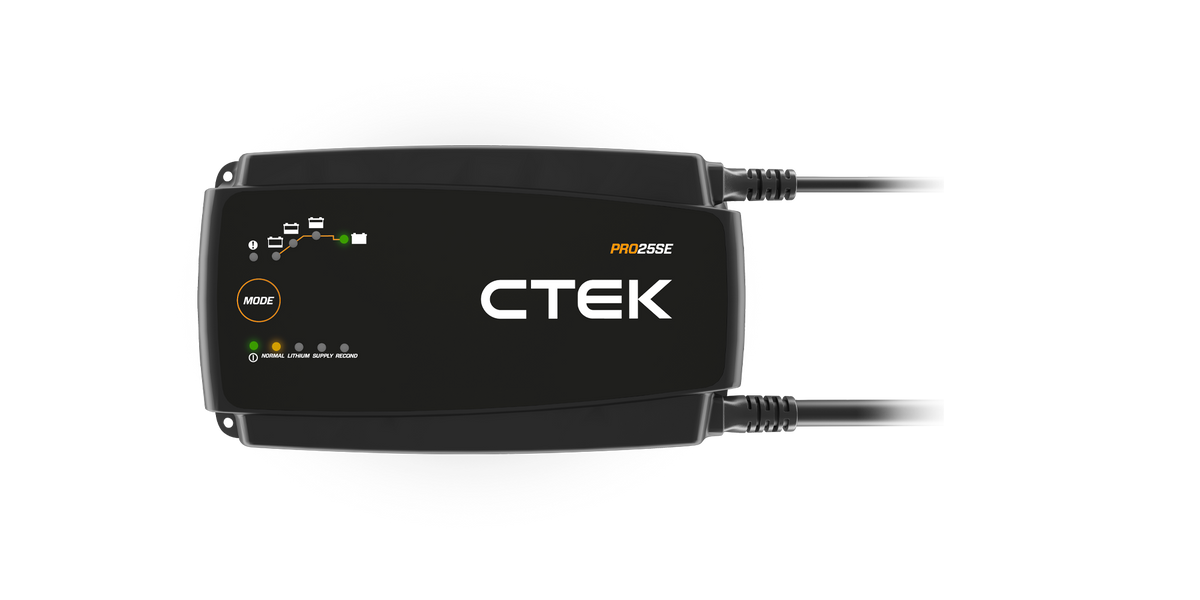
Explore this need in the finder →The CTEK PRO25SE NA (item 40-327) is a North American 12 V AC charger designed for a workshop where the charger body may need to stay on a wall, ramp post or work-bay bracket while the vehicle is farther away. CTEK's U.S. page and product sheet identify the long 19.6 ft charging leads and the supplied wall hanger and bracket. The PRO25SE shares its documented charging programs with the PRO25S NA; the meaningful difference is reach and mounting, not a separate battery-bank count.
A detailed-rating discrepancy to keep visible
CTEK's exact product page uses a 25 A headline for the PRO25-series models. However, the technical table on that page, the shared North American manual (model 1094) and the PRO25SE U.S. sheet state 22 A. This review and the finder use 22 A, the rating repeated in the detailed sources. Check the exact charger label and current instructions instead of assuming the headline is the output available for every mode.
The product page and manual document a single 12 V output for lead-acid batteries and a distinct LiFePO₄ program. The stated charging ranges are 40–500 Ah for lead-acid and 30–450 Ah for LiFePO₄. Lead-acid modes cover WET/flooded, MF, Ca/Ca, AGM, EFB and GEL; the lithium mode is for 12 V LiFePO₄. The manual lists 2 V as lead-acid start voltage and 8 V for lithium. It does not state whether a battery BMS is required. CTEK also describes wake-up steps for some under-voltage-protected lithium batteries; that is not a substitute for checking the battery's own manual and BMS condition.
Those capacities are manufacturer's documented charging ranges, not a guarantee of recharge time for a particular vehicle battery. The shared finder applies only a maximum-capacity check and its numeric field ends at 300 Ah, so it cannot test this model's published 450 or 500 Ah upper limits. The lower edges—40 Ah lead-acid and 30 Ah LiFePO₄—are explained in the review but not enforced by that filter. Entering an Ah value is useful only for a charging job; for maintenance, leave it blank and verify the actual battery instructions.
Program choice matters more than the cable length
NORMAL is CTEK's lead-acid charging program, while LITHIUM is the dedicated LiFePO₄ profile. RECOND is a separate lead-acid function that adds an elevated-voltage stage; the manual specifies it for empty WET and Ca/Ca batteries, not as a routine mode for AGM, GEL or lithium. The SUPPLY program is also separate from ordinary battery charging. It is rated 13.6 V/22 A and the manual describes it for float maintenance when a battery is already at full capacity. CTEK's exact page markets vehicle-diagnostic support, but the shared manual's safety section says the charger is not intended to supply low-voltage electrical systems except in a starter-motor application. Given that conflict, this review does not characterize the PRO25SE as a general accessory supply. The manual also says spark protection is disabled in Supply mode.
The charger includes automatic temperature compensation, and CTEK lists an ambient operating range from −20 to +50 °C. The U.S. page gives IP44, but the North American manual explicitly says not to expose the unit to rain or snow and never to charge a frozen battery. Use the vehicle maker's connection procedure, keep the charger ventilated and dry, and do not extend the charging cable: the manual specifically warns against extending it. A long factory lead solves a reach problem but does not remove routing, heat, moving-engine-part or battery-gas concerns.
Choose the SE for a fixed bay, not more banks
The PRO25SE sheet lists 19.6 ft DC leads, a 5.25 ft AC cord and a 7.1 lb unit-with-cables weight; it also identifies a wall hanger and mounting bracket. CTEK describes mounting points for ramp posts and work bays. The PRO25S sheet instead lists 6.5 ft DC and 6.25 ft AC leads, with a 4.0 lb unit-with-cables weight. This is a useful distinction if moving the charger around is less important than reaching underneath a vehicle without moving the body. The PRO25SE remains a portable plug-in charger, not an onboard vehicle charger, and it has one battery output rather than independent channels for several batteries.
CTEK lists 100–120 VAC, 50–60 Hz, 4.0 A input and a two-year warranty. Its product materials mention the external temperature sensor and the manual shows battery clamps, but the exact current retail package should still be checked against item 40-327; included accessories can be package-specific. Confirm that the long charging lead fits the actual bay and that a suitable dry outlet is available before choosing this version. If you need the same core battery programs with a shorter, lighter lead set, compare the PRO25S. If you do not need the installation reach, the extra cable and bracket are not a battery-capacity upgrade.
Assessment limits
This is an evidence-based review of the exact PRO25SE NA page, its linked North American manual and U.S. product sheet—not a bench test or a report of ownership. The sources establish model identity, core programs, published ranges, cable lengths and package distinctions, but they cannot establish condition, stock, the health of a specific battery or the suitability of a vehicle connection point. Before use, check item number 40-327, the supplied manual and accessories, the battery's charging-rate guidance, and the vehicle instructions. The repeated 22 A detailed specification is used here despite CTEK's higher page headline.
Key specifications
Key details at a glance
| Output battery voltages | 12 V |
|---|---|
| Supported chemistries | Lead-acid / Lithium-ion |
| Rated DC charging current | 22 A |
| Published charge capacity limit | 500 Ah |
| Independent battery outputs | 1 |
| Arrangement | Portable plug-in charger |
| Ingress rating | IP44 |
| Minimum operating temperature | -20 °C |
| Maximum operating temperature | 50 °C |
Use the exact model’s instructions for operating limits, supplied equipment and version differences.
Sources for this review
Sources for this assessment
- CTEK U.S. Car Battery Chargers collection, finite 11-card view
- CTEK PRO25SE NA exact U.S. product page, item 40-327
- CTEK PRO25S/PRO25SE North American manual, model 1094, linked from exact PRO25SE page
- CTEK PRO25SE U.S. product sheet linked from exact PRO25SE page
- CTEK PRO25SE charger image from exact PRO25SE NA page

Keep the next step evidence-led
Use the finder to combine voltage, battery chemistry, charging job and setup requirements; then check the exact model and its manual.