
Your needs, this model
Does it fit your priorities?
Can the PRO25S NA charge a 300 Ah 12 V AGM battery?
CTEK lists AGM under the PRO25S NA's 12 V lead-acid types, and the exact North American manual and U.S. sheet specify 22 A with lead-acid capacity from 40 to 500 Ah. A 300 Ah AGM battery is within that stated range, but verify the battery maker's permitted current and exact unit instructions. The product page also uses a 25 A headline; its detailed table and linked documents say 22 A, which is the rating used here.
Explore this need in the finder →Does the PRO25S NA have a LiFePO₄ charge mode?
Yes. The exact page, North American manual and U.S. product sheet document a 12 V LiFePO₄ program, rated at 22 A and listed for 30–450 Ah. CTEK's reviewed materials do not say whether a built-in battery-management system is required, so an open BMS choice is not evidence that every lithium battery is compatible; verify the battery and charger instructions.
Explore this need in the finder →Does the PRO25S NA Supply setting qualify for any 12 V DC device?
No general device compatibility is established. CTEK describes the 13.6 V/22 A Supply setting for diagnostic support and float maintenance, but the shared North American manual warns that the charger is not intended to supply a low-voltage electrical system except for a starter-motor application. The manual also says spark protection is disabled in Supply mode. Treat that source conflict as a limitation and do not assume an arbitrary accessory is compatible.
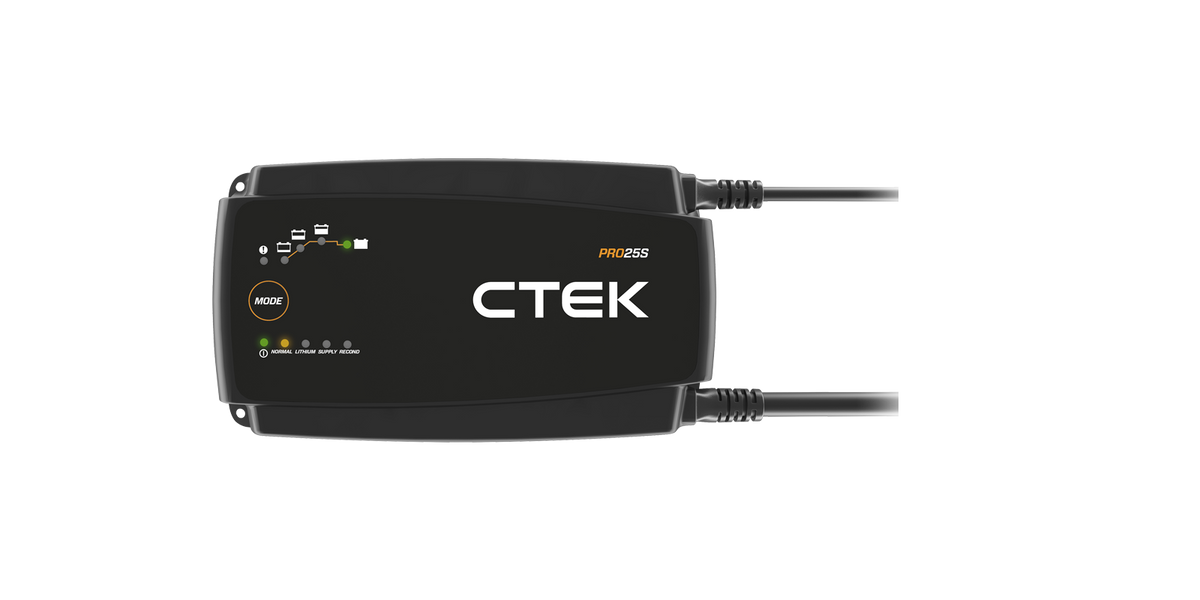
Explore this need in the finder →The CTEK PRO25S NA (item 40-328) is a mains-powered 12-volt workshop charger, not a jump starter or a 6/24-volt bench supply. Its useful distinction is the combination of lead-acid and LiFePO₄ charging with a separate Supply mode. CTEK's page headline calls it a 25 A charger, but the same page's technical table, its linked North American manual and the exact U.S. product sheet specify 22 A. This assessment uses 22 A rather than carrying the higher headline into a recommendation. That discrepancy is worth checking against the label and manual supplied with the exact unit.
Two charging chemistries, with different stated ranges
The product page and manual list 12 V flooded/WET, maintenance-free, calcium, AGM, EFB and GEL lead-acid types, plus a dedicated 12 V LiFePO₄ program. The maker's stated charging ranges are 40–500 Ah for lead-acid and 30–450 Ah for LiFePO₄. The manuals' technical table says the charger starts at 2 V on lead-acid batteries and 8 V on lithium, which is not permission to ignore a battery maker's limits or force-charge a damaged battery. The charger also includes under-voltage wake-up procedures for some lithium batteries; CTEK's reviewed page and documents do not settle whether a built-in BMS is required, so confirm that condition with the battery manufacturer before connecting it.
Capacity numbers here describe manufacturer-stated compatibility, not a measured recovery time. The finder compares a requested recharge size with a plan's upper charging limit; it does not enforce the 40 Ah lead-acid or 30 Ah LiFePO₄ lower edge. Its capacity control also stops at 300 Ah, so it cannot test this model's 450 or 500 Ah ceilings. Check battery voltage, chemistry, actual capacity and permitted charge rate on the battery label and its instructions before choosing a program.
Do not collapse charge, recondition and Supply into one job
The manual separates NORMAL charging for lead-acid, LITHIUM charging for LiFePO₄, RECOND and SUPPLY. RECOND adds a higher-voltage phase and is restricted by the manual to empty WET and calcium batteries; it is not a generic recovery button for AGM, GEL or lithium. The separate SUPPLY program is 13.6 V/22 A. CTEK's product page describes Supply as support during vehicle diagnostics, and the manual describes float maintenance when a battery is already at full capacity. There is a material caution: the same manual's safety text says this charger is not intended to supply low-voltage electrical systems except for a starter-motor application. Because that warning conflicts with a broad interpretation of the diagnostic-power marketing, this review and finder do not treat the unit as a general 12 V accessory supply. The manual also says spark protection is disabled while Supply is selected.
The automatic temperature sensor adjusts charging voltage to ambient conditions, and the listed operating span is −20 to +50 °C. The exact U.S. materials specify IP44, but the North American manual still says not to expose the charger to rain or snow. It also says never charge a frozen battery. These limitations matter more than an attractive “rugged workshop” description: place the unit in a dry, ventilated location and follow the vehicle and battery instructions. For a lead-acid battery installed in a vehicle, the manual directs the user to the vehicle's procedure for connection and disconnection.
Portable reach and package checks
The U.S. sheet lists a 6.5 ft charging lead and a 6.25 ft AC lead, and describes the unit as lightweight and portable. That is a shorter setup than the PRO25SE NA, whose U.S. page and sheet list a 19.6 ft charging lead plus a wall hanger and bracket for work bays or ramp posts. The base charger mode and documented output are otherwise the same; choose between them for lead reach and mounting, not a supposed increase in the SE's charging amperage. The PRO25S page's captured package area does not itemize every retail component, so verify the exact bundle and the supplied temperature-sensor/clamp setup before purchase.
Its single set of battery connections serves one battery at a time; it is not a multi-bank unit. CTEK lists 100–120 VAC input, 4 A, an external temperature-compensation sensor, IP44 protection and a two-year warranty for this North American model. A 22 A rating can suit a sizeable battery whose maker allows that rate, but it may be more current than a small battery should receive. If you want a simpler lower-current home maintainer, compare the CTEK NXT 5 NA or MXS 5.0 NA and check their different capacity limits. If you need genuine reach across a fixed shop bay, compare the PRO25SE package instead.
What this assessment can and cannot establish
This is a source-based reading of CTEK's product page, linked manual and U.S. product sheet, not a hands-on test of charge time, vehicle compatibility or durability. The cited manufacturer materials identify the operating modes and published ranges, but they do not prove that a particular damaged, cold, deeply discharged or aged battery is safe to charge. Confirm the exact item number, the unit's input rating, the supplied connections, the battery's own instructions and a dry installation site before use. The manual's warnings take priority over assumptions based on IP rating or a marketing headline.
Key specifications
Key details at a glance
| Output battery voltages | 12 V |
|---|---|
| Supported chemistries | Lead-acid / Lithium-ion |
| Rated DC charging current | 22 A |
| Published charge capacity limit | 500 Ah |
| Independent battery outputs | 1 |
| Arrangement | Portable plug-in charger |
| Ingress rating | IP44 |
| Minimum operating temperature | -20 °C |
| Maximum operating temperature | 50 °C |
Use the exact model’s instructions for operating limits, supplied equipment and version differences.
Sources for this review
Sources for this assessment
- CTEK U.S. Car Battery Chargers collection, finite 11-card view
- CTEK PRO25S NA exact U.S. product page, item 40-328
- CTEK PRO25S/PRO25SE North American manual, model 1094, linked from exact PRO25S page
- CTEK PRO25S U.S. product sheet linked from exact PRO25S page
- CTEK PRO25S charger image from exact PRO25S NA page

Keep the next step evidence-led
Use the finder to combine voltage, battery chemistry, charging job and setup requirements; then check the exact model and its manual.