
Your needs, this model
Does it fit your priorities?
Can the NXT 15 NA charge a large 12 V lead-acid battery?
CTEK's NXT 15 NA product sheet specifies 20–350 Ah for lead-acid, 15 A output and listed 12 V lead-acid profiles including AGM. The web page and manual give a different 30 Ah lower bound and a general 30–350 Ah range, so check the exact current instructions; this review uses the more detailed sheet's 350 Ah ceiling, not a guarantee that every battery accepts 15 A.
Explore this need in the finder →What should a 12 V LiFePO₄ owner check before using the NXT 15 NA?
CTEK documents a separate 12 V lithium program and its NXT 15 NA product sheet lists LiFePO₄ charging up to 300 Ah at 15 A. The reviewed sources do not state whether the battery must have a built-in BMS; confirm the battery maker's voltage, current and BMS instructions rather than interpreting missing information as permission.
Explore this need in the finder →Is the NXT 15 NA Supply mode a battery charger setting?
No. The manual and product page describe a distinct constant 13.6 V/15 A Supply mode for a compatible 12 V DC device or battery-support task. Do not combine that mode with a requested battery voltage, chemistry, subtype or Ah charging range; follow the manual's selection and connection sequence because this is not a battery-charging plan.
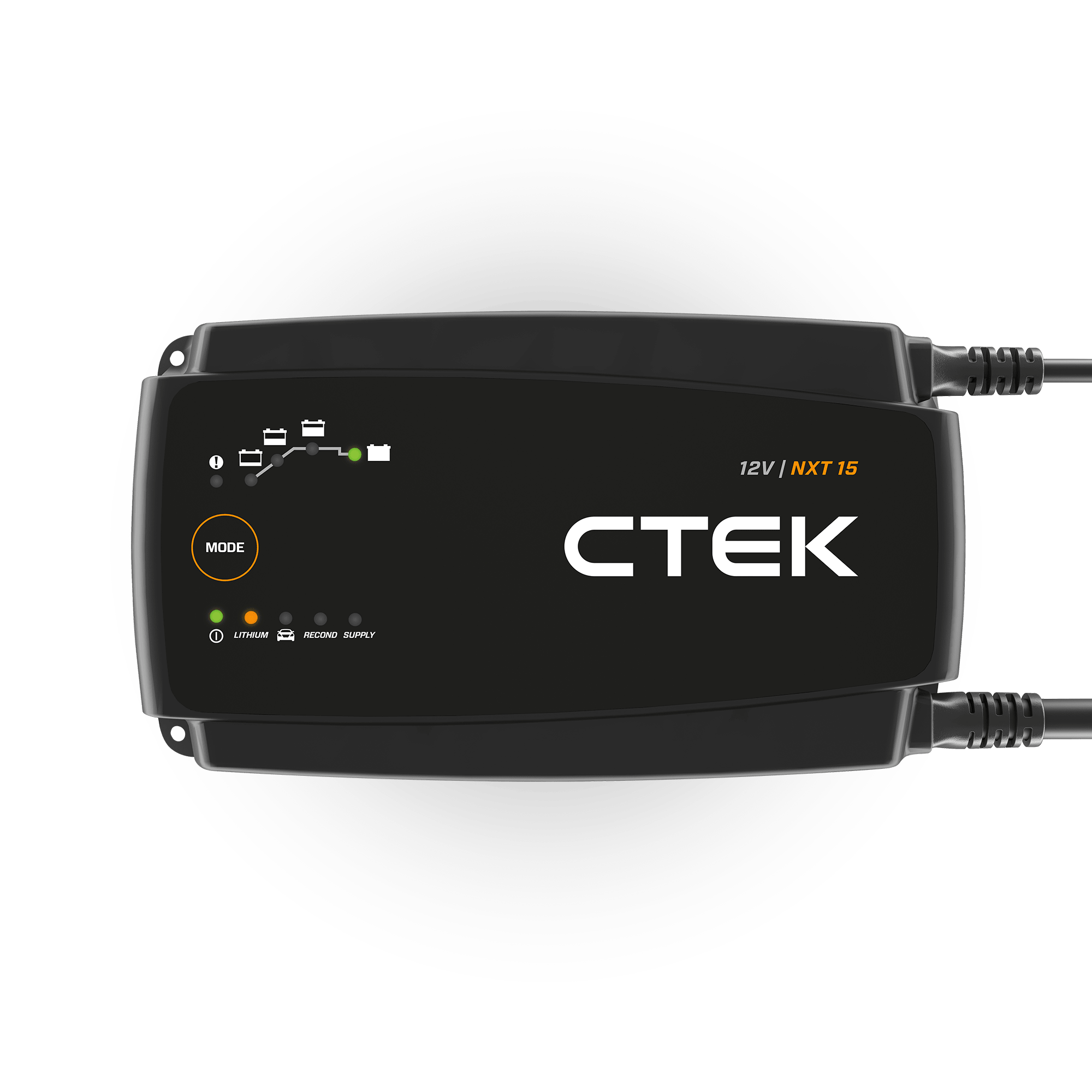
Explore this need in the finder →The CTEK NXT 15 NA (item 40-727) is a portable, one-output 12 V charger with a 15 A rating. It is the higher-current member of the CTEK NXT pair reviewed here: unlike the NXT 5, it also provides a distinct 13.6 V/15 A Supply program for compatible device-power or battery-support work. This is a source-based assessment of the North American model, not a bench test.
Capacity and current depend on the battery
The NXT 15 product page and North American manual state a general 30–350 Ah capacity range. CTEK's exact NXT 15 NA product sheet provides a more specific chemistry split: 20–350 Ah for lead-acid and 20–300 Ah for LiFePO₄. These lower bounds conflict, so check the current unit label and instructions, especially for smaller batteries; the more detailed product-sheet limits are preserved in this assessment, but they do not erase the manual/page difference. The capacity ceiling is also not a charging-rate recommendation. A battery's manufacturer must permit the charger's 15 A output. For lead-acid, CTEK lists wet/flooded, maintenance-free, calcium, AGM, EFB and gel types. The manual describes 15 A charging, desulfation and a RECOND program for lead-acid batteries. Treat those as distinct programs, not a way to revive any failed battery. CTEK's guidance limits RECOND to lead-acid, and the manual warns against using it on lithium, gel or AGM batteries. A battery that is frozen, damaged or unsuitable for the stated charge rate needs a different decision, not a more aggressive mode.LiFePO₄ is supported, but the BMS condition is not stated
The NXT 15 has a separate 12 V lithium program, with CTEK listing LiFePO₄ and a maximum charging capacity of 300 Ah in the product sheet. The reviewed page, manual and sheet do not tell us whether the lithium battery must have an integrated battery-management system. That is an unknown, not evidence that the charger works without one. Confirm the battery's own charge voltage, current limit and BMS requirements before selecting this mode. A capacity match by itself does not resolve those safety and chemistry conditions. The unit also includes external temperature compensation. Its stated ambient range is -20°C to +50°C, while lithium operation is shown in the manual with a narrower 0°C to +40°C program range. Observe the chemistry-specific manual instructions rather than applying the wider lead-acid range to every battery. CTEK gives an IP44 rating, but the North American manual says not to expose the charger to rain or snow; the rating does not override that instruction.Supply mode is a separate operating plan
The NXT 15's Supply mode provides a constant 13.6 V/15 A output for a compatible 12 V DC device or battery-support task. It is not a 15 A battery-recharging program and should not be selected as though it were another battery chemistry or Ah capacity. Keep device Supply and battery charging distinct; use the connection sequence and conditions in the exact manual. The display labels a separate SUPPLY program, which is why this model can answer a device-power need that the 4.3 A NXT 5 does not. For ordinary charging, the product page lists a single 12 V battery connection, a 2 m (about 6.6 ft) output cable and an external temperature sensor. Check the physical lead reach and outlet position in the actual vehicle or work area; do not assume the cable can be extended. CTEK gives five years of warranty coverage, subject to its terms. The IP44 designation and a portable enclosure do not make an uncovered outdoor charging arrangement appropriate.When the NXT 5 is the better comparison
The NXT 5 is rated at 4.3 A and its manual separates 110 Ah charging from maintenance up to 160 Ah. It is the more modest-output option for a single 12 V battery when 15 A would be unnecessary or exceed the battery maker's allowed rate. The NXT 15 is the more capable choice only where its 15 A setting and chemistry-specific capacity range are appropriate, or when its separate Supply program solves a genuine device-power task. It is still 12 V only and has one output; it is not a multi-bank charger or a 24 V workshop unit. Before choosing, verify the exact North American item number, battery voltage and subtype, allowed charging current, Ah range, BMS instructions, connection reach and environmental limits. Treat the 20-versus-30 Ah lower-capacity difference as unresolved, and rely on current official instructions for the precise unit. A finder match reports documented characteristics; it cannot certify the condition of a battery, establish a seller's package contents or replace the battery manufacturer's charging guidance.Key specifications
Key details at a glance
| Output battery voltages | 12 V |
|---|---|
| Supported chemistries | Lead-acid / Lithium-ion |
| Rated DC charging current | 15 A |
| Published charge capacity limit | 350 Ah |
| Independent battery outputs | 1 |
| Arrangement | Portable plug-in charger |
| Ingress rating | IP44 |
| Minimum operating temperature | -20 °C |
| Maximum operating temperature | 50 °C |
Use the exact model’s instructions for operating limits, supplied equipment and version differences.
Sources for this review
Sources for this assessment

Keep the next step evidence-led
Use the finder to combine voltage, battery chemistry, charging job and setup requirements; then check the exact model and its manual.