
Your needs, this model
Does it fit your priorities?
Can the U.S. item 56-958 charge a 12 V AGM battery at 110 Ah?
Yes, within its documented charging range: the exact page-linked North American manual and U.S. sheet state 1.2–110 Ah charging and list AGM among supported lead-acid types. They specify up to 4.3 A; the battery maker's permitted rate still controls, and the manual says not to select RECOND for AGM.
Explore this need in the finder →Does the POLAR cold-weather design mean it is safe to charge any battery outdoors in freezing weather?
No. CTEK documents cables adapted to -30°C and an operating range down to -30°C, but the manual says never to charge a frozen battery and not to expose the charger to rain or snow. Confirm battery temperature and the battery maker's cold-weather charging instructions, and use a dry location.
Explore this need in the finder →Can the 160 Ah figure be used as the MUS 4.3 POLAR's recovery-charge ceiling?
No. The directly linked manual and U.S. sheet put charging at 1.2–110 Ah and place 160 Ah under float/pulse maintenance. The product page's overview row combines the capacity figures, so use 110 Ah for a charging decision and treat 160 Ah only as the separate maintenance claim.
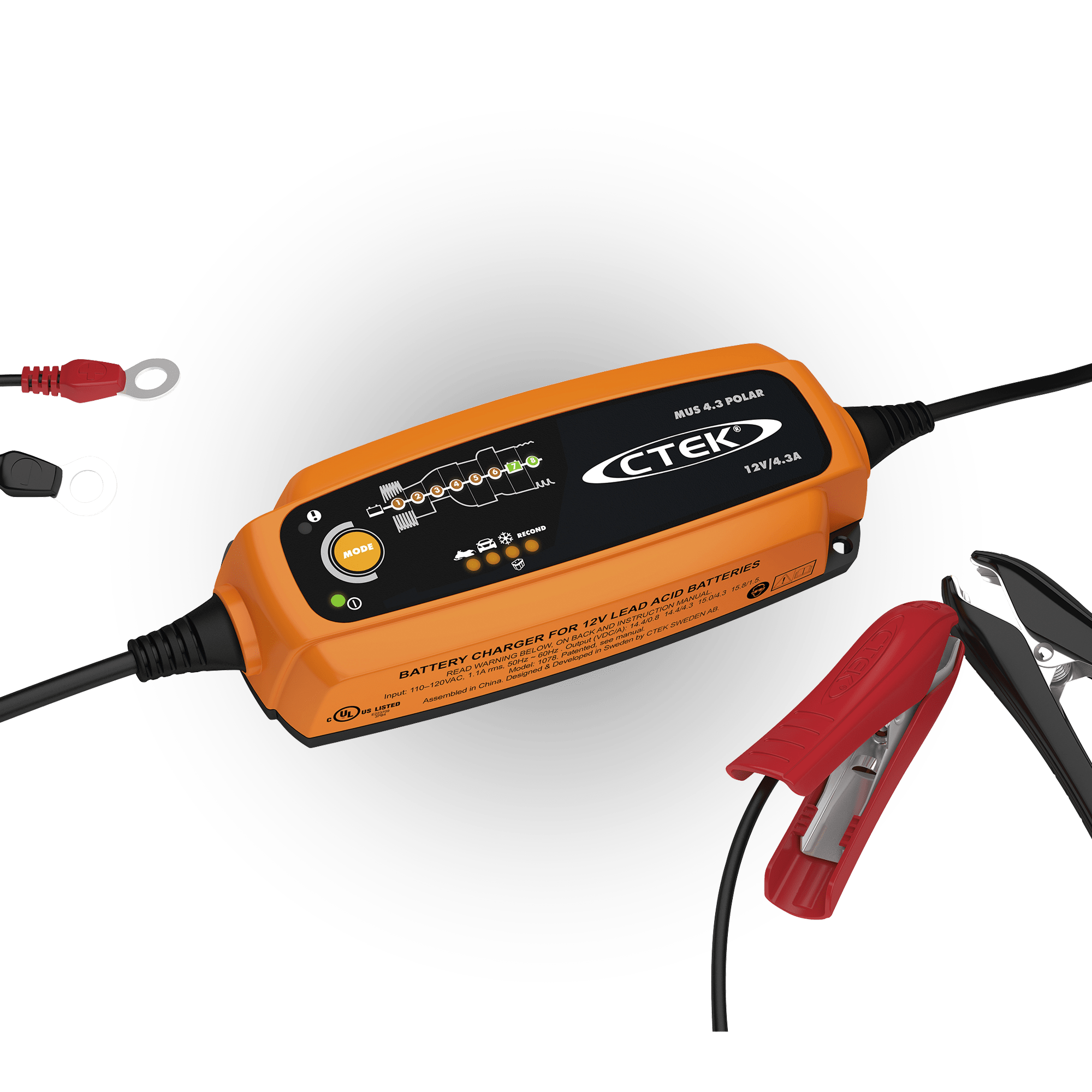
Explore this need in the finder →The CTEK MUS 4.3 POLAR is a portable, single-output 12 V AC charger for lead-acid batteries. CTEK's exact U.S. page identifies retail item 56-958 as “MUS 4.3 POLAR,” while the North American manual and U.S. sheet linked from that page use the name “MXS 5.0 POLAR”; the manual identifies technical model 1078. I keep those labels distinct rather than treating the manual model number as a retail SKU. This is a document-based assessment of CTEK's U.S. product page, its linked North American manual and linked U.S. product sheet, not a hands-on test.
The Polar distinction is in the cables, not a higher charge rating
CTEK describes the AC and DC cables as adapted for severe cold down to -22°F (-30°C), and the exact page lists an ambient operating range of -30°C to +50°C. That addresses a real winter setup problem: cables that stiffen in low temperatures are harder to route and position. It does not turn the charger into a faster unit or a second battery bank. The manufacturer documents one portable 12 V charging output at up to 4.3 A, with a separate 0.8 A program for smaller batteries. The manual says the device is an eight-step automatic charger and the product sheet retains the 4.3 A figure. Buyers comparing it with the MXS 5.0 NA should focus on this cable-and-cold-weather distinction rather than assuming “Polar” means more current.
Separate the charging ceiling from the maintenance claim
There is an important capacity ambiguity to resolve before choosing it. The U.S. product page's overview specification shows 1.2–160 Ah as a single battery-capacity range. Its description says the charger works on batteries up to 110 Ah and separately describes long-term Float/Pulse maintenance. The directly linked North American manual and U.S. product sheet make that division explicit: 1.2–110 Ah for charging, with float/pulse maintenance up to 160 Ah. This assessment uses 110 Ah as the charge ceiling. A fully charged 160 Ah battery may fall within the maintenance claim; that is not evidence this unit is the right tool to recover-charge a discharged 160 Ah battery.
The listed 2.0 V start threshold is another limit, not a promise that the charger can restore a badly damaged, sulfated or frozen battery. The manual says to follow the battery maker's instructions and never charge a frozen battery. If a battery does not progress through the charger’s status sequence as described, stop and investigate instead of assuming that repeated cycles will repair it.
Lead-acid modes need battery-specific restraint
The exact U.S. page lists 12 V wet, maintenance-free, calcium, AGM and GEL lead-acid batteries. The linked manual also lists EFB, so this assessment recognizes EFB as a documented type while preserving its omission from the page's shorter table. The output modes are listed as 14.4 V, 15.0 V and 15.8 V. CTEK's manual explains the small-battery, normal, cold-weather and RECOND settings; it warns not to use RECOND on AGM or GEL batteries. A cold-weather voltage option is not permission to override the battery maker's charging voltage, current or temperature limits.
Cold-resistant cabling is not weatherproof permission
The charger is rated IP65, but the North American manual says not to expose it to rain or snow. Treat the rating as an enclosure specification, not a guarantee that charging in precipitation is safe. Keep the unit dry and ventilated, route the mains and DC leads away from hot, sharp or moving parts, and make the connections in the manual's order. Its cold-adapted cables may help in low ambient temperatures; they do not make charging a frozen battery safe. CTEK's temperature range also includes a +50°C upper bound, and the manual says output is reduced at high temperatures.
The page lists a 110–120 V AC, 50–60 Hz input and a 1.1 A input current. It is therefore an outlet-dependent charger, not a vehicle-socket charger or a permanent on-board system. The manual's box list includes a mains adapter cable and charge clamps. Confirm the item number and supplied connections in the particular package rather than treating a gallery image as a packing list. CTEK lists a five-year limited warranty; verify the seller, original-purchaser terms and return conditions for the exact offer.
Where it fits beside other CTEK choices
The standard MXS 5.0 NA is the closest comparison: its current page and North American manual also use 4.3 A and a 110 Ah charging ceiling with a separate 160 Ah maintenance figure. The Polar edition's case is the cold-adapted cabling and cold-weather program, not a larger capacity or output. The MUS 4.3 TEST&CHARGE is another 4.3 A lead-acid model, but its distinguishing extra is documented battery, starting-power and alternator-voltage testing. Choose by the actual need: cold-weather cable handling, diagnostic checks, or a different battery/installation plan are separate requirements.
The MUS 4.3 POLAR merits comparison for a single 12 V lead-acid battery within the 1.2–110 Ah charging range when the cold-adapted leads are useful and an appropriate AC outlet is available. It is not a LiFePO₄ charger, a 6 V or 24 V charger, a multi-bank setup, or a license to charge a frozen battery in snow or rain. Before buying, verify item 56-958, the page-to-manual naming bridge, nominal battery voltage, subtype, battery-maker-approved charge rate, the 110 Ah charge ceiling, the separate maintenance limit and dry placement.
Key specifications
Key details at a glance
| Output battery voltages | 12 V |
|---|---|
| Supported chemistries | Lead-acid |
| Rated DC charging current | 4.3 A |
| Published charge capacity limit | 110 Ah |
| Independent battery outputs | 1 |
| Arrangement | Portable plug-in charger |
| Ingress rating | IP65 |
| Minimum operating temperature | -30 °C |
| Maximum operating temperature | 50 °C |
Use the exact model’s instructions for operating limits, supplied equipment and version differences.
Sources for this review
Sources for this assessment
- CTEK U.S. All Products collection product records
- CTEK MUS 4.3 POLAR exact U.S. product page, item 56-958
- CTEK North American MXS 5.0 POLAR user manual, technical model 1078, linked from MUS 4.3 POLAR
- CTEK U.S. MXS 5.0 POLAR product sheet linked from MUS 4.3 POLAR
- CTEK MUS 4.3 POLAR exact U.S. product image

Keep the next step evidence-led
Use the finder to combine voltage, battery chemistry, charging job and setup requirements; then check the exact model and its manual.