
Your needs, this model
Does it fit your priorities?
Can the MUS 4.3 TEST&CHARGE check both a battery and an alternator?
Yes. CTEK's linked manual identifies separate BATTERY, START POWER and ALTERNATOR voltage-test programs, and says testing mode does not require mains power. It also sets conditions: the battery should be fully charged before START POWER and ALTERNATOR checks, and the BATTERY check requires at least 41 °F / 5 °C and an hour without charging. Treat the indicators as a screening aid, not a repair diagnosis.
Explore this need in the finder →Is a 150 Ah battery within the MUS 4.3's recovery-charging range?
No, not according to the conservative exact-page and technical-table assessment. CTEK lists 1.2–110 Ah charging and maintenance up to 160 Ah. Do not use the maintenance ceiling as the recharge limit; the manual's separate normal-program table is broader and remains a documented source difference.
Explore this need in the finder →Can the MUS 4.3 maintain a charged 12 V lead-acid battery?
Yes, the linked manual describes float/pulse maintenance and the exact U.S. page states maintenance up to 160 Ah. That maintenance ceiling is not a recovery-charging rating; the same page and technical tables give a lower 110 Ah charge maximum.
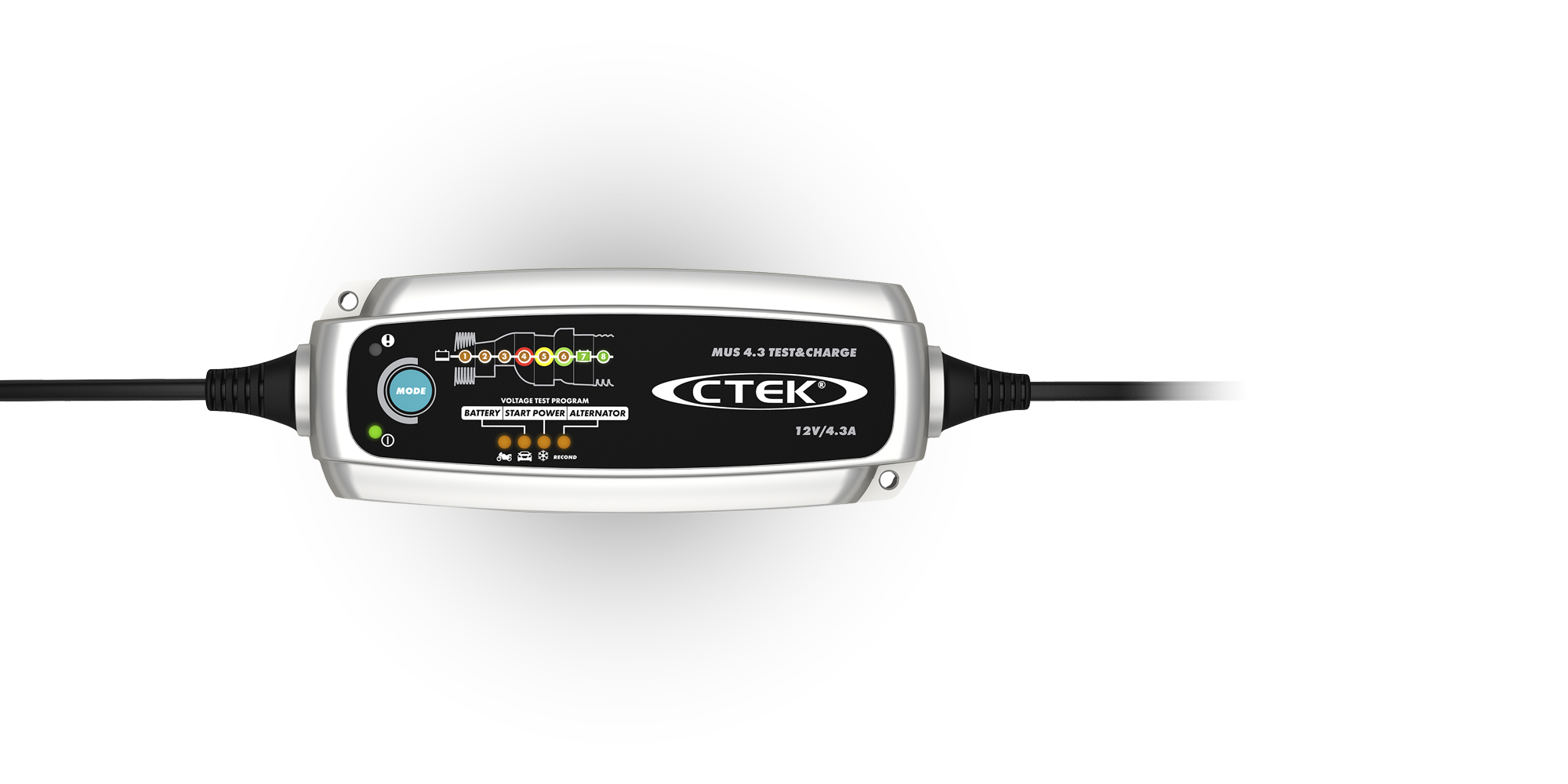
Explore this need in the finder →The MUS 4.3 TEST&CHARGE is more than a small automatic maintainer: CTEK combines an 8-step 12 V lead-acid charger with three simple electrical checks. Its most distinctive feature is not a claimed repair ability but the inclusion of battery-voltage, cranking/start-power and alternator-voltage test modes. This review is a source-based assessment of North American item 56-959, not a hands-on test. CTEK's exact U.S. page links a manual for technical model 1077 and a product sheet whose footer lists a different part number, 56-949, so check the retail item marking and included manual when comparing an offer.
Where the combined charger-and-tester helps
For a garage that occasionally needs to distinguish a low charge from a possible starting or charging-system problem, three labeled test modes can be more useful than a charger that only shows progress through its charge cycle. The product page describes checks of battery condition, start power and alternator performance. The manual gives the important qualifications: its START POWER and ALTERNATOR procedures are to be done with a fully charged battery, and its BATTERY reading calls for at least 41°F (5°C) and a battery that has not been charged by the vehicle or a mains charger during the previous hour. The indicator is a first-pass clue, not a load-test certificate or a diagnosis of the cause of a starting problem. An alternator check also requires the engine to be running, as the manual instructs.
Testing mode is available without mains power, but the product still needs a connected battery. The same case carries one 12 V charging output; there is no second channel for leaving another battery on maintenance while checking the car. The manual's connection and safety steps remain controlling, especially the correct chassis ground on many vehicles and the need for ventilation around a lead-acid battery.
Read the capacity ratings as separate jobs
The exact U.S. product page and the technical specification tables give 1.2–110 Ah for charging and maintenance up to 160 Ah. That distinction is more useful than a single blended range: 160 Ah is not evidence that the unit can recover-charge a depleted 160 Ah battery. One section of the manual's program table describes a broader 14–160 Ah normal program, which conflicts with the product page and the manual's own technical capacity table. This assessment uses 110 Ah as the conservative charge ceiling and preserves the discrepancy rather than treating maintenance capacity as charging capacity.
Output is 4.3 A maximum in the normal program, while the manual separately describes a 0.8 A small-battery program for 1.2–14 Ah. The current question in the finder means the charger rating you require; it does not select a specific current into a battery. Follow the battery maker's charge-rate guidance, since a battery's permissible rate can be lower than this charger's maximum. The manual also explains that high-temperature output can reduce automatically.
CTEK lists 14.4 V, 14.7 V and 15.8 V charging options, a cold-weather/AGM option and RECOND, in addition to the standard automatic cycle. RECOND adds a controlled-gassing step at elevated voltage; it is not a universal remedy for old, sulfated or physically damaged batteries. Confirm from the battery manufacturer's instructions that the chosen option is appropriate. The charger is lead-acid only; there is no documented lithium program, onboard arrangement, 6 V or 24 V output, or general-purpose device-supply plan.
Maintenance, connections and practical limits
CTEK describes the normal eight-step cycle with float/pulse maintenance, and the page gives a separate maintenance ceiling of 160 Ah. For a car stored between drives, that is a different use case from recharging a depleted battery. The listed package includes a CONNECT Clamp and CONNECT Eyelet, which gives a choice between temporary clamp connection and a more permanent eyelet lead. Confirm those connectors are present in the exact package: the manual model 1077 is technical identification, not the retail item number.
The official product page and manual specify 110–120 VAC, 50–60 Hz, 1.1 A input, a 2.0 V battery start threshold, IP65 and a five-year warranty. IP65 should not be interpreted as permission for exposed outdoor charging: the North American manual explicitly says not to expose the charger to rain or snow. It also advises against charging frozen or damaged batteries, and warns not to extend the charge cable. A safe ventilated location and the vehicle maker's connection points matter more than a weather-resistance shorthand.
How it differs from TIME TO GO
The CT5 TIME TO GO family uses an LED estimate and TRY/GO/CARE stages to answer when a battery is approaching a usable state. MUS 4.3 TEST&CHARGE instead emphasizes separate battery, starting-power and alternator checks, and it supports a much smaller battery program. If the most valuable task is diagnosing whether charging-system voltage deserves attention, MUS's separate test modes are the differentiator. If an approximate charge-time display is more useful, assess the CT5's capacity limits and display behavior instead. Neither feature replaces a professional test when a battery or charging system is suspect.
Primary evidence: CTEK's exact U.S. item 56-959 page, its linked North American model 1077 manual and U.S. product sheet. See the answer guide for same-condition alternatives and the 12 V lead-acid finder for the complete currently reviewed set.
Key specifications
Key details at a glance
| Output battery voltages | 12 V |
|---|---|
| Supported chemistries | Lead-acid |
| Rated DC charging current | 4.3 A |
| Published charge capacity limit | 110 Ah |
| Independent battery outputs | 1 |
| Arrangement | Portable plug-in charger |
| Ingress rating | IP65 |
| Minimum operating temperature | -20 °C |
| Maximum operating temperature | 50 °C |
Use the exact model’s instructions for operating limits, supplied equipment and version differences.
Sources for this review
Sources for this assessment

Keep the next step evidence-led
Use the finder to combine voltage, battery chemistry, charging job and setup requirements; then check the exact model and its manual.