
Your needs, this model
Does it fit your priorities?
Can it charge a 24 V AGM battery at a 50 A minimum?
Yes, the PL6850 manual and item page document a 24 V AGM plan with selectable rates up to 60 A. Its 12 V 120 A headline does not carry over to the 24 V battery plan; confirm the battery’s permitted rate and 20 A AC service.
Explore this need in the finder →Does its LiFePO4 mode have an unrestricted temperature range or known BMS rule?
No. The 2024 manual limits LiFePO4 charging to 0–50 °C ambient and does not state the battery BMS requirement. It says to use LiFePO4 only, not other lithium chemistries, and to read the exact battery instructions.
Explore this need in the finder →Can I use the 120 A Supply mode to run any 12 V accessory?
The manual describes Supply as vehicle-system support for programming, ADAS recalibration, repair or diagnosis, using a suitable fully charged vehicle battery. It is separate from battery charging and is not a general accessory supply.
Explore this need in the finder →This is a research-based assessment of the current PL6850 U.S. model page, its 2024 operator manual and current information sheet. It is not a workshop trial or charge-time test.
The Clore portable model with documented 12 V and 24 V fleet plans
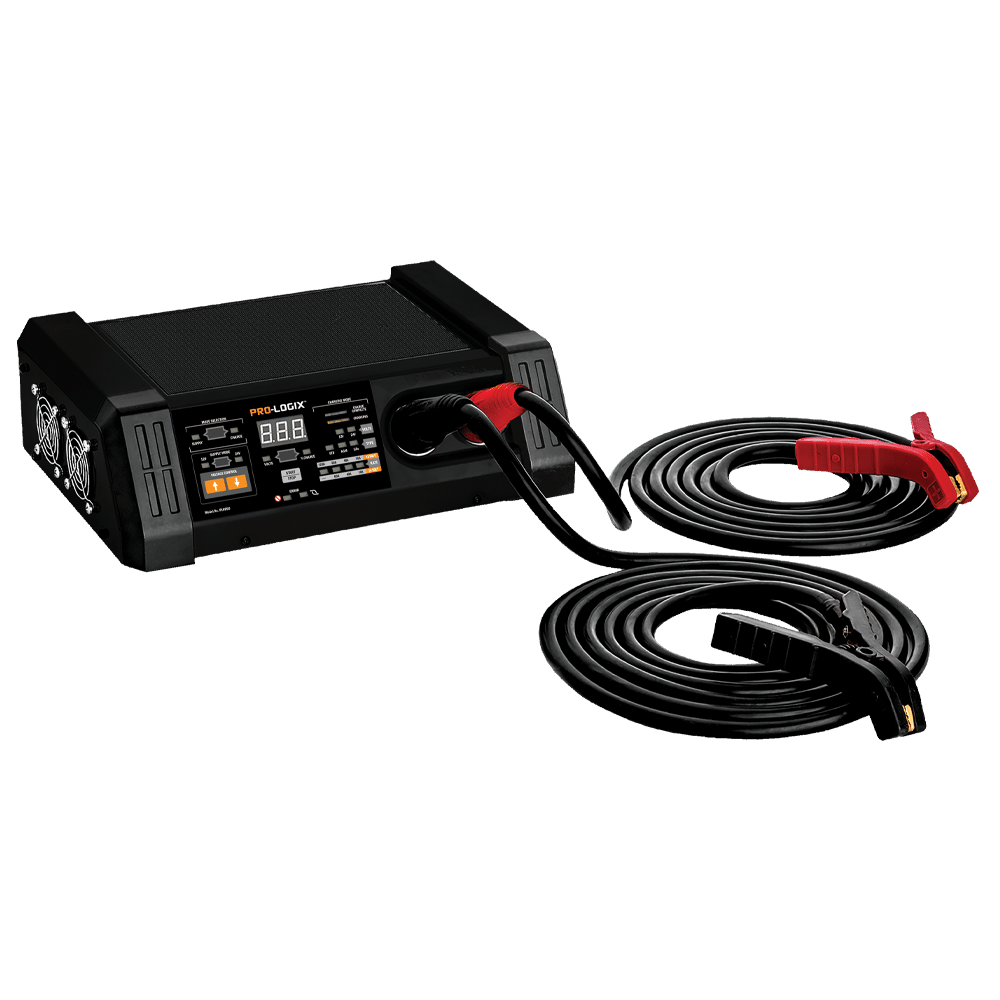
The PL6850 is a portable, one-output charger with separate 12 V and 24 V battery plans. Its documented lead-acid settings reach 120/60/40/10 A at 12 V and 60/40/10 A at 24 V. The distinction matters: the 120 A headline is the top 12 V charging setting, not a 24 V setting and not the output of its separate Power Supply mode. Choose a rate only within the battery maker’s permitted limits; the charger’s largest selectable number does not determine an appropriate current for a particular battery.
The 2024 manual describes flooded, maintenance-free, AGM and spiral-wound lead-acid types, and its 24 V mode gives a useful alternative for a compatible fleet battery. The product is single-output, so the high current rating does not mean separate independent charging channels for multiple batteries. Clore’s heavy-duty examples and 150 Ah reference are not stated as a numeric min/max Ah range, which remains unknown.
LiFePO4 support comes with a temperature boundary
The exact manual supports LiFePO4 only among lithium chemistries and gives an ambient charging range of 0–50 °C. It does not state a BMS requirement. The fact record therefore treats 12 V and 24 V LiFePO4 as separate documented plans, carries over the voltage-specific rate menus, and leaves the BMS condition unknown. Confirm the battery’s own BMS, voltage and current instructions before choosing a setting; do not assume that another lithium chemistry is compatible.
Clore’s literature lists selectable LiFePO4 charging. However, the manuals do not publish a supported Ah range or BMS rule, and the existence of a dedicated chemistry mode does not prove every battery in that chemistry is compatible. Temperature is an important filter: a planned charge outside the documented ambient range is not established as supported by these sources.
Vehicle-system Supply is not a general outlet
The separate adjustable Supply modes support vehicle programming, ADAS recalibration, repair and service procedures. Clore lists 13.1–14.9 V in 0.1 V steps and up to 120 A at 12 V, plus 26.2–29.8 V and up to 60 A at 24 V. Those are vehicle-system outputs, not battery-charge current, accessory power for arbitrary devices, or additional banks. Match the exact service-tool and vehicle requirements; do not rely on the numbers alone as proof that any reprogramming operation is safe.
The unit needs grounded 120 V AC service on a 20 A circuit. It weighs 27 lb and uses 13-foot #2 AWG output leads. Those are practical shop constraints: the cord and clamps must reach while the fans remain unobstructed, and the outlet must meet the required service. It is portable in the sense that it can be moved, not a small continuously installed tender.
Operating environment and expected use
The operator manual calls for a dry, stable, well-ventilated setup, prohibits rain and snow, and says not to mount the unit permanently in a marine or RV application. Its maintenance mode does not remove the need to follow the manual and battery instructions. High current and fleet positioning do not guarantee recovery of a damaged battery or predict exact charge time. This assessment reports no hands-on charging, temperature, ripple or service-tool testing.
The PL6850’s breadth is helpful when a shop serves both 12 V and 24 V batteries, needs selectable lead-acid rates, and has a 20 A supply. It is not automatically the right choice for a single small battery; a lower-current charger may be easier to power and store. It also should not be selected as a generic DC power source simply because its Supply mode has large current figures.
Who should shortlist it
Consider the PL6850 for one compatible 12 V or 24 V battery when the battery’s chemistry and rate are known, the ambient temperature for LiFePO4 is within 0–50 °C, and a dry ventilated location with grounded 20 A AC service is available. Its 24 V lead-acid plan tops at 60 A, so comparing only the 12 V 120 A headline would misstate the actual fit. A user who needs multiple simultaneous outputs, weather exposure, unknown-temperature lithium charging or an explicit BMS assurance should not treat the model page as answering those requirements.
Before ordering, check the current PL6850 part/model, exact voltage and chemistry profile, the battery maker’s allowed current, temperature, BMS instructions, outlet service, cable reach and supplied accessories. Confirm that the intended Supply task is a vehicle-system service task and not a generic accessory need. The official image shows the model but does not establish what a seller includes in a package.
Sources: Clore’s PL6850 product page, 2024 operator manual and information sheet. No ownership, personal testing, measured result or customer experience is claimed.
Key specifications
Key details at a glance
| Output battery voltages | 12 / 24 V |
|---|---|
| Supported chemistries | Lead-acid / Lithium-ion |
| Rated DC charging current | 120 A |
| Independent battery outputs | 1 |
| Arrangement | Portable plug-in charger |
Use the exact model’s instructions for operating limits, supplied equipment and version differences.
Sources for this review
Sources for this assessment
- Clore Automotive current U.S. SOLAR Portable Battery Chargers category snapshot
- Clore Automotive PRO-LOGIX PL6850 exact U.S. product page
- Clore Automotive PL6850 operator manual 842-685-001 (2024 edition)
- Clore Automotive PL6850 2024 information sheet
- Clore Automotive PRO-LOGIX PL6850 exact-model manufacturer image

Keep the next step evidence-led
Use the finder to combine voltage, battery chemistry, charging job and setup requirements; then check the exact model and its manual.