
Your needs, this model
Does it fit your priorities?
Can it meet a 50 A minimum for a 12 V AGM charge?
Yes, the exact PL6800 page and manual list a 100 A top charge setting for 12 V AGM batteries, plus 40 and 10 A. The manual’s application guidance warns that a high setting is not suitable for every battery; use the battery maker’s limit.
Explore this need in the finder →Does its fleet Group 31 language establish an Ah maximum?
No. Clore describes multi-battery Group 31 service, but does not state a numeric Ah charging interval for an individual battery. The finder therefore leaves capacity unknown rather than converting its 100 A rating into Ah.
Explore this need in the finder →Can its flashing Supply mode power a 12 V accessory?
The manual describes vehicle-system support for programming, ADAS or on-vehicle repair, with a target adjusted from 13.1 to 14.9 V. That is not a generic DC accessory output or a second battery bank. It also requires a 20 A AC supply and dry, ventilated setup.
Explore this need in the finder →This is an evidence-based assessment of the exact PRO-LOGIX PL6800 from Clore’s current product materials, linked manual and information sheet. It does not describe hands-on charging or workshop testing.
One 12 V fleet output with a 100 A lead-acid ceiling
The PL6800 is a portable, single-output charger for 12 V batteries. Its documented lead-acid rates are 10, 40 and 100 A, putting it above the PL6100’s 60 A lead-acid maximum while retaining the same general shop-oriented layout. That rate difference matters only if the battery, work procedure and 20 A electrical service can support it. A charger setting is not a recommendation to apply 100 A to any battery.
The exact manual describes flooded, maintenance-free, AGM and spiral-wound lead-acid types. It also discusses deep-cycle and marine usage by battery construction. Those application examples do not establish an amp-hour range: the current page/manual do not publish numeric minimum or maximum Ah limits, and a Group 31 example is not an individual battery-size ceiling. Check battery chemistry and the battery maker’s allowed charge current rather than extrapolating from category language.
The present product materials do not establish a LiFePO4 profile for this exact model. This review therefore treats its documented charger plan as lead-acid only. Do not transfer the PL6100 update article or another nearby Clore model’s lithium feature to the PL6800 without exact model evidence.
The Power Supply mode has a different job
Clore gives the PL6800 a separate adjustable 0–100 A vehicle-system Supply function with a 13.1–14.9 V target range. It is intended for vehicle module programming, reprogramming, ADAS calibration or related on-vehicle repair support, not generic accessory power. Those amps are not another battery-charge setting and do not create an additional battery bank. A shop should compare the specific vehicle or service-tool requirement, including target voltage, current stability and permitted setup, before relying on this mode.
The charger also needs a grounded 120 V, 60 Hz source with 20 A service. The unit weighs 25 lb and has 13-foot #2 AWG output leads. It can be moved for portable use, but it is not a small glove-box maintainer. A 20 A circuit, dry ventilated area, fan clearance and cable reach are part of the operating fit.
Care and limits are part of the purchase choice
The manual prohibits operation in rain, snow or dripping moisture and requires ventilation with the fans unobstructed. This is workshop equipment, not a weatherproof permanently mounted boat or vehicle charger. The model’s one output serves one battery connection at a time; a high single-channel rate should not be mistaken for independent charging of a multi-battery bank. Clore lists a one-year limited warranty, but confirm warranty and exact contents for the offered PL6800 package.
The product’s charge, maintain or reconditioning language does not prove that a failed battery can be restored, or predict an exact charging duration. Battery condition, acceptance rate, temperature and selected current all matter, and no independent runtime test was performed for this review. Follow the battery and vehicle manufacturers’ instructions, especially before using the separate vehicle-system support mode.
PL6800 compared with the nearby Clore units
Against the PL6100, the PL6800 raises the documented lead-acid maximum from 60 A to 100 A, but neither is a 24 V battery charger. Against the PL6850, the PL6800 is 12 V-only and its current ceiling is lower; the PL6850’s manuals document 12/24 V and LiFePO4 operation, while the PL6800’s current materials do not. Those are more important differences than the similar product-page names. The PL2545, by contrast, is a portable 12 V consumer unit with a 20 A lead-acid ceiling and a brief, separate engine-start-assist function, not a shop Supply mode.
Shortlist the PL6800 when a single 12 V lead-acid battery needs a high selectable rate up to 100 A, the documented vehicle-system mode is relevant, and the worksite has suitable 20 A AC service and ventilation. It is a poor fit if 24 V, lithium support, multibank charging, outdoor operation or an ordinary DC accessory output is required.
Checks before ordering
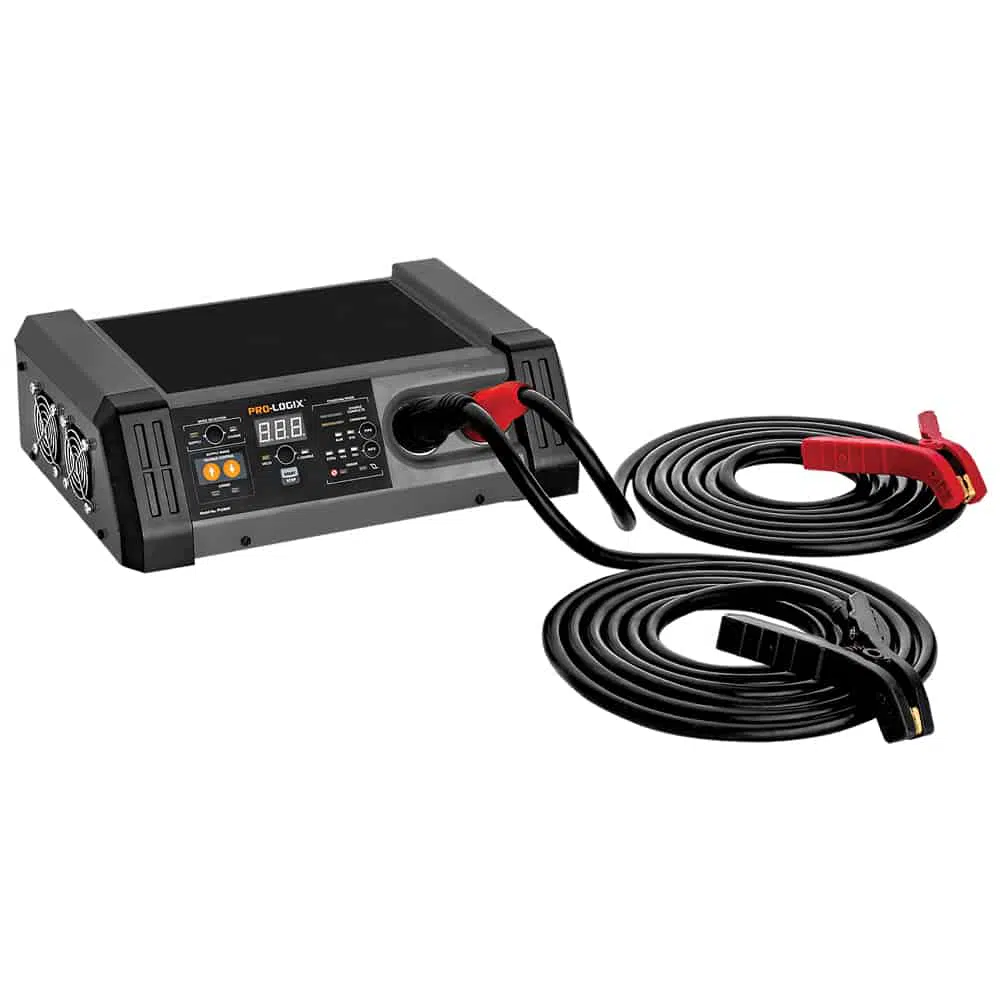
Verify the exact PL6800 identity and current manual, battery construction, approved rate, one-output arrangement, 20 A branch-circuit access and cable reach. Confirm that the actual vehicle service task falls within Clore’s Supply-mode instructions. The official image is an exact PL6800 model image, but it is not proof of a seller’s included clamps or accessories.
Sources: Clore’s PL6800 product page, operator manual and information sheet. No personal use, testing, measured performance or customer experience is claimed.
Key specifications
Key details at a glance
| Output battery voltages | 12 V |
|---|---|
| Supported chemistries | Lead-acid |
| Rated DC charging current | 100 A |
| Independent battery outputs | 1 |
| Arrangement | Portable plug-in charger |
Use the exact model’s instructions for operating limits, supplied equipment and version differences.
Sources for this review
Sources for this assessment

Keep the next step evidence-led
Use the finder to combine voltage, battery chemistry, charging job and setup requirements; then check the exact model and its manual.