
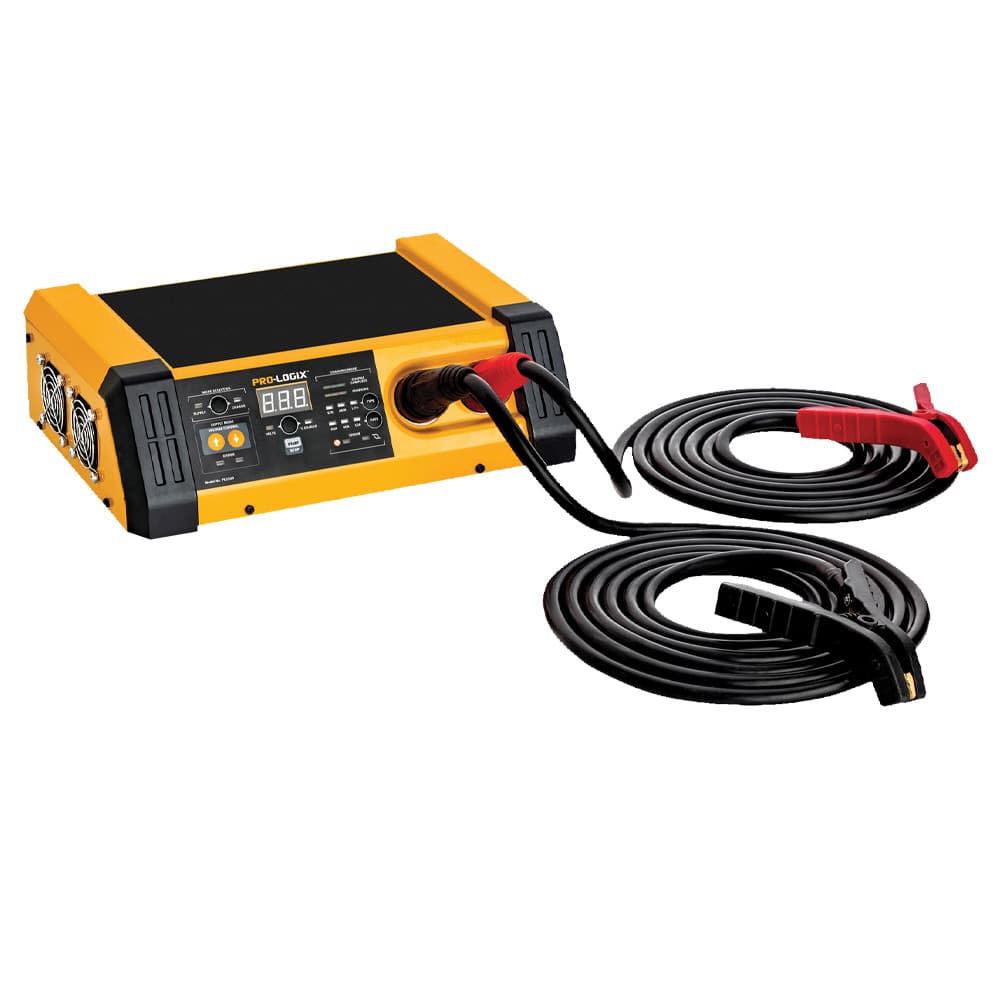
Your needs, this model
Does it fit your priorities?
Can the PL6100 meet a 50 A lead-acid charging minimum?
For a documented 12 V lead-acid plan, yes: the exact page/manual list a selectable 60 A battery-charge setting, along with 40 and 10 A. Clore’s manual advises against exceeding the battery maker’s allowed current, so 60 A is not an automatic recommendation.
Explore this need in the finder →Does Clore’s lithium update settle the PL6100 LiFePO4 charge rate?
No. Clore’s official article says PL6100 was recently updated for LiFePO4, but the exact page-linked manual and spec table do not document a lithium selection or LFP current/BMS limits. The finder leaves LFP current unknown; confirm the exact unit generation and current instructions with Clore and the battery maker.
Explore this need in the finder →Can I use its Supply mode to power a generic 12 V accessory?
The manual describes this separate mode as stable vehicle-system support for programming and repair, with an adjustable 13.1–14.9 V target. It is not a second battery bank, an ordinary battery charge rate or a generic accessory output; follow the vehicle maker’s required voltage and current.
Explore this need in the finder →This assessment uses Clore’s exact PL6100 page, its linked manual and sheet, and Clore’s later model-specific LiFePO4 update. The manual is not a current LFP specification, so the review keeps that version bridge visible rather than borrowing unverified limits.
A portable shop charger for a 12 V lead-acid service bay
The PL6100 is a single-output, 12 V-only fleet charger. For its documented lead-acid plan, the selectable charge settings are 10, 40 and 60 A. That 60 A ceiling is materially higher than portable homeowner maintainers and is suited to a shop that can use a high-current charger and has the required electrical service. Clore specifies a 20 A grounded 120 V, 60 Hz supply; this is not a typical assumption for every household outlet, so confirm the branch circuit and connection before buying.
Clore’s page and manual document standard flooded, maintenance-free flooded, AGM and spiral-wound lead-acid batteries. The selected rate should still be within the battery maker’s approved limit; the charger’s largest setting does not establish what an individual battery can accept. The product documents do not state a numeric Ah range. References to fleet or Group 31 use are examples of the intended service context, not a universal Ah ceiling or guarantee for every battery in that category.
The lithium update is real but incomplete in the linked manual
Clore’s later official low-voltage battery article says the PL6100 was “recently updated for LiFePO4.” That is model-specific evidence that lithium support exists on an updated version, so the current fact record retains a 12 V LiFePO4 charging plan. But the exact PL6100 product page and its linked manual still describe the lead-acid program and do not establish the current lithium selector, rate, BMS condition, Ah range or maintenance behavior. The published 60 A lead-acid maximum must not be applied to LiFePO4 by assumption.
That source gap makes exact unit generation important. Before using lithium, confirm with Clore the serial/version, current manual and selection procedure, and check the battery maker’s instructions. The documentation does not state that the BMS is either required or unnecessary. The finder intentionally leaves its LFP current unknown and only records the supported chemistry/voltage bridge; it cannot promise a particular rate or BMS fit.
Supply is workshop support, not a generic DC outlet
The PL6100’s separate adjustable Power Supply mode covers 13.1–14.9 V in 0.1 V steps and a 0–100 A range for vehicle-system support during programming, ADAS calibration or on-vehicle repair. It is not battery-charging current, a second bank or an everyday accessory socket. Match the specific vehicle procedure’s voltage, current and ripple requirements; a mode name alone does not establish compatibility with every programming tool.
At 25 lb, with 13-foot #2 AWG output leads, the PL6100 is heavier and larger-cable equipment than the low-current portable models. Its length and conductor size may suit a work bay, but the one output remains one output. A multi-battery demand requires a proper multi-bank arrangement or an approved service workflow, not parallel assumptions about this unit.
Setup and use boundaries
The manual requires dry, ventilated placement, unobstructed cooling fans and no rain, snow or dripping moisture. The specified 20 A service and ventilation requirement are real purchase constraints, not minor footnotes. The product is not a permanently mounted marine or outdoor charger. Clore lists a one-year limited warranty; check the exact package, cable reach, mains outlet and work-bay clearances for the item being considered.
Clore describes service and maintenance functions, but the exact manual’s limits and the battery manufacturer’s instructions govern a specific application. A high-current rating does not diagnose battery condition, guarantee a recovery, or shorten every charge by a predictable amount. This review reports no hands-on charging, vehicle programming, timing, or temperature measurements.
Who should consider it
The PL6100 is most relevant to a workshop needing one portable 12 V lead-acid output up to 60 A and a separate adjustable vehicle-system support mode, with access to a suitable 20 A circuit and a ventilated dry work area. The later LFP update may be useful, but it should not be the sole basis for buying until the exact version’s lithium settings are confirmed. For consumers seeking a small plug-in maintainer, this size, current and service requirement are likely more than necessary; for 24 V batteries, this model’s documented charge plan is not a match.
Before purchase, confirm the exact PL6100 revision, the battery’s chemistry and allowed charge current, circuit rating, intended Supply-mode application, and whether a 13-foot lead reaches safely. Request the current LFP instructions if relevant; no Ah range, LFP current or BMS rule is established by the linked manual and update article together.
Sources: Clore’s PL6100 page, linked operator manual and information sheet, plus its LiFePO4 update article. The review makes no claim of ownership, personal testing or customer experience.
Key specifications
Key details at a glance
| Output battery voltages | 12 V |
|---|---|
| Supported chemistries | Lead-acid / Lithium-ion |
| Rated DC charging current | 60 A |
| Independent battery outputs | 1 |
| Arrangement | Portable plug-in charger |
Use the exact model’s instructions for operating limits, supplied equipment and version differences.
Sources for this review
Sources for this assessment
- Clore Automotive current U.S. SOLAR Portable Battery Chargers category snapshot
- Clore Automotive PRO-LOGIX PL6100 exact U.S. product page
- Clore Automotive PL6100 operator manual
- Clore Automotive PL6100 12 V information sheet
- Clore Automotive low-voltage lithium update article (PL6100-specific update statement)
- Clore Automotive PRO-LOGIX PL6100 exact-model manufacturer image

Keep the next step evidence-led
Use the finder to combine voltage, battery chemistry, charging job and setup requirements; then check the exact model and its manual.