
Your needs, this model
Does it fit your priorities?
Will it meet a 20 A minimum for a 12 V gel battery?
The exact manual documents 12 V operation, a GEL setting for gel-cell lead-acid and a highest ordinary charge rate of 20 A. That is a capability ceiling, not a safe-rate recommendation; confirm the gel battery maker’s instructions.
Explore this need in the finder →Does its 28 A start-assistance rating mean a 28 A battery charger?
No. Ordinary charging uses 20/10/2 A settings. The 28 A figure belongs to a separate 12 V engine-start-assistance mode, limited to four minutes; it is not a generic accessory supply or a battery-free jump starter.
Explore this need in the finder →Can it stay on a stored 12 V flooded battery?
The PL2545 manual describes an enhanced storage-maintenance routine and says to monitor the charger daily during extended maintenance. It provides no numeric Ah maintenance range and says not to expose the charger to rain or snow.
Explore this need in the finder →This is a research-based assessment of the exact PRO-LOGIX PL2545 from Clore’s product page, linked manual and information sheet. It is not a hands-on review, start test or charge-time measurement.
A 12 V, 20 A lead-acid charger with a separate short start-assist mode
The PL2545 is a portable, one-output 12 V charger/maintainer. Its ordinary battery-charge settings are 2, 10 and 20 A. This gives it a higher published lead-acid charge ceiling than Clore’s PL2410, but the PL2545 does not document the PL2410’s 24 V operation or LiFePO4 setting. It is not a multi-bank station: the output serves one battery connection at a time.
The manual lists FLD for conventional and maintenance-free flooded lead-acid, AGM for AGM and spiral-wound batteries, and a GEL selection for gel-cell batteries. Do not infer that any profile suits an unidentified battery. The highest selectable charge rate is a capability limit, not a safe-current recommendation for every battery. Verify the battery maker’s permitted rate; lower settings can matter for smaller batteries or a conservative charging instruction.
The 28 A figure is not its charge rate
The title’s start-assistance feature is separate from 20/10/2 A charging. Clore describes a 28 A, 12 V engine-start-assistance mode for a maximum of four minutes. It is not a battery-free jump starter, and it should not be represented in the finder as 28 A charging or generic 12 V device power. Clore cautions that some vehicle computers may be damaged when using this function, so follow the exact connection sequence and vehicle instructions before considering it. If the buying need is only conventional charging, the extra start-assist mode may be irrelevant; if the need is emergency starting away from AC power, this product description does not establish that use.
The sources do not specify an amp-hour charging interval. Neither its 20 A ceiling nor examples of vehicles establish a supported battery-size range. The manual also explicitly warns against using the charger with lithium batteries; there is no documented lithium profile to match.
Storage and fault recovery need attention
Clore describes an enhanced storage-maintenance routine, but the operator manual says the charger should be checked daily during extended maintenance. A maintenance mode is not permission to leave the unit indefinitely unattended. The manual also calls for a dry, ventilated work location and prohibits rain or snow exposure. For marine batteries it instructs users to remove the battery and charge it ashore, rather than assume this portable unit is an onboard charger.
The manual includes fault and low-voltage procedures; those are troubleshooting steps, not proof a failing battery is recoverable. Stop if battery condition, polarity, chemistry or vehicle compatibility is uncertain. No recovery test or charging-time test was conducted for this assessment.
Practical checks before choosing it
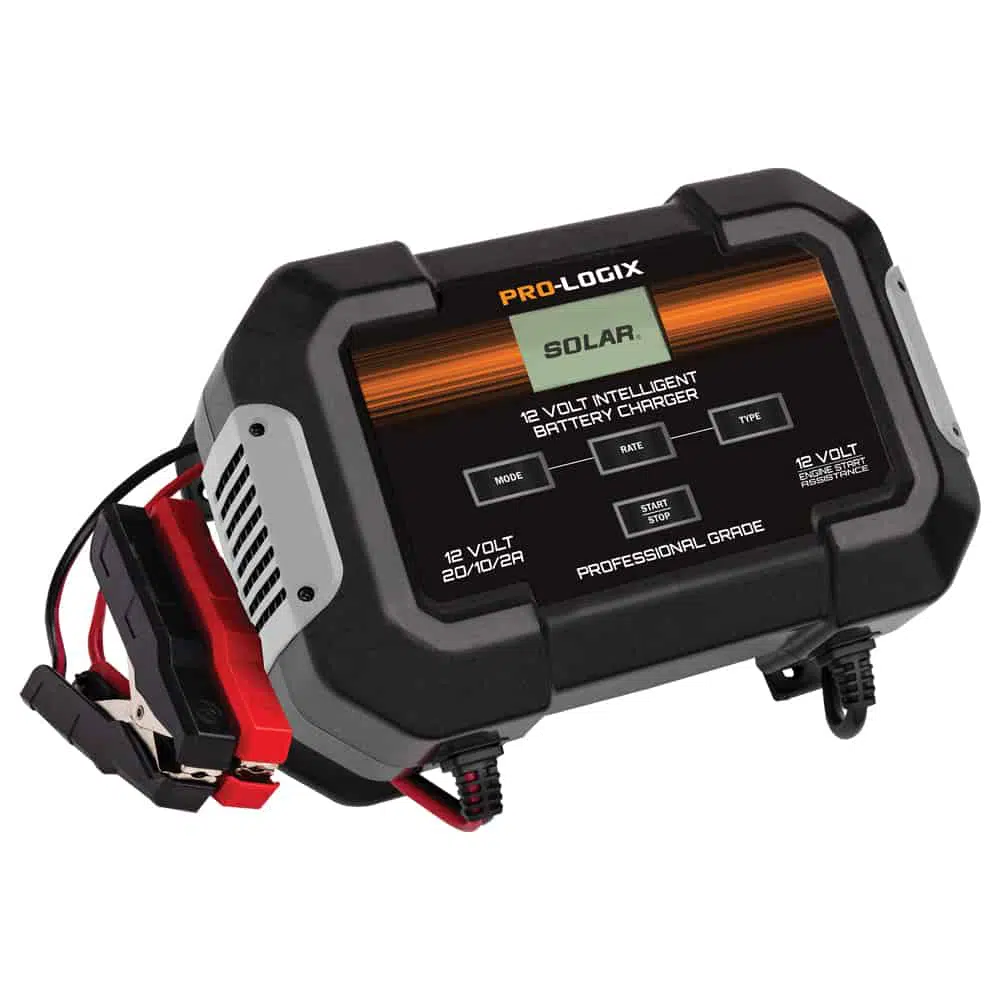
Clore lists 120 V AC, 60 Hz input and a one-year limited warranty. The product page and manual are more useful for the operating decision than a listing headline: identify a 12 V lead-acid battery, choose its correct flooded/AGM/GEL profile, and make sure its maker allows the selected charge rate. Check whether the supplied leads can reach the battery and whether an AC outlet is safely available nearby. The official image shows the PL2545 model and its 20/10/2 A controls, but it does not prove what a particular seller’s box includes.
Who should shortlist the PL2545
It fits a narrow task: one 12 V lead-acid battery, a portable single output, selectable charging up to 20 A, and perhaps a brief AC-connected engine-start-assist function that the vehicle manufacturer permits. A user needing 24 V or a lithium charger should look elsewhere. A user needing multiple independent batteries charged simultaneously should choose a multi-bank design. A shop requiring a sustained, high-current vehicle-system supply should compare a fleet charger’s separate service mode rather than assume the four-minute start-assist function is equivalent.
Before purchase, verify the exact PL2545 model, the battery’s chemistry and subtype, permitted charging current, and the vehicle’s computer/start-assistance restrictions. Confirm that dry indoor operation and daily maintenance checks fit the planned use. The product documentation does not publish an Ah range, so do not turn the charger’s current number into an invented capacity limit.
Sources: Clore’s PL2545 product page, operator manual and information sheet. No ownership, human testing or customer experience is claimed.
Key specifications
Key details at a glance
| Output battery voltages | 12 V |
|---|---|
| Supported chemistries | Lead-acid |
| Rated DC charging current | 20 A |
| Independent battery outputs | 1 |
| Arrangement | Portable plug-in charger |
Use the exact model’s instructions for operating limits, supplied equipment and version differences.
Sources for this review
Sources for this assessment

Keep the next step evidence-led
Use the finder to combine voltage, battery chemistry, charging job and setup requirements; then check the exact model and its manual.