
Your needs, this model
Does it fit your priorities?
What does the PL2320's 20 A rating change compared with the PL2310?
Both have one 6/12 V output, but the exact product pages list 20/10/2 A for the PL2320 and 10/6/2 A for the PL2310. The 20 A option is not permission to exceed the battery maker's rate; the manual says small batteries should use the lowest setting. LiFePO₄ is limited to 10 A on either model.
Explore this need in the finder →Can it charge a 6 V AGM battery at a 20 A minimum?
The current page/manual establish 6 V operation and an AGM setting, while the model's available battery-charge rates include 20 A. That ceiling is selectable, not a universal recommended rate; consult the battery instructions and use a lower mode when required.
Explore this need in the finder →Can the PL2320 revive a battery below 1 V?
The manual describes a protected override after the operator first unplugs the charger, checks the connections and verifies all settings; holding START for three seconds can then begin charging when low voltage alone caused the fault. It does not establish that an internally damaged battery is safe to charge or that a charging attempt will succeed.
Explore this need in the finder →This is a research-based assessment of the exact PL2320, not a use report or charging-time test. The current Clore item page identifies a 6/12 V, 20/10/2 A portable charger/maintainer. Its shared manual documents operating limits that materially narrow what the largest number means.
The difference is a higher selectable lead-acid rate
The PL2320 and PL2310 share a housing style, one battery output, 6/12 V selection and the same operator manual. The distinction is not another bank or a different voltage family: the PL2320 offers 20/10/2 A, while the PL2310 page lists 10/6/2 A. The PL2320’s 20 A setting is a maximum option for a compatible battery, not a recommended rate for every battery. Clore’s manual says smaller motorcycle, lawn and similar batteries should be charged at the lowest possible setting; the battery maker’s instructions remain decisive.
That distinction makes the PL2320 a candidate when the battery’s permitted rate is above the PL2310’s 10 A ceiling. It does not establish that it will charge every battery faster in practice: actual time depends on battery condition, state of charge, battery limits and charging stages, and no independent timing test was performed here. The exact item page lists the unit at 4.7 lb, with 72-inch, 12 AWG output leads and a one-year limited warranty.
Match voltage and chemistry as a combination
The current exact page and the shared manual cover 6 V and 12 V operation. For lead acid, the manual names a standard setting for conventional and maintenance-free flooded batteries, an AGM setting for AGM, and notes that most spiral-wound batteries use AGM. Deep-cycle and marine batteries need their construction checked before choosing a program. If the battery is small, selecting a lower rate may matter more than having a higher ceiling available.
The manufacturer also describes a lithium program, but only for LiFePO4; the shared manual limits that program to 10 A. So the 20 A headline does not apply to its LiFePO4 mode. Neither the page nor manual states whether the battery must have a built-in BMS. Their voltage and chemistry instructions are separate controls, but no source expressly confirms a 6 V LiFePO4 plan. This assessment conservatively records lithium at 12 V only and leaves BMS fit unresolved rather than guessing.
The sources provide no amp-hour range. Do not treat the 20 A setting as approval for a battery of any inferred size; the charger’s output ceiling and a battery’s allowed charge rate are different questions. The PL2320 still serves one battery output at a time.
Storage, recovery and safety limits
Clore lists automatic multi-phase charging, temperature compensation, soft start, reconditioning and enhanced maintenance for long-term storage. The manual describes rest and exercise stages after the charging phase, but it also says to monitor the charger daily during extended maintenance. This is not an instruction to leave it indefinitely without supervision. The manual says the charger must not be exposed to rain or snow, and that a marine battery must be removed and charged ashore unless the equipment is specifically designed for onboard marine use.
The manual gives a protected procedure for a very low-voltage battery: a reading below 1 V can trigger a fault; after unplugging, checking connections and confirming settings, holding START for three seconds can override the fault if low voltage alone caused it. That narrow override is not a diagnosis of battery health or a guarantee of recovery. Follow the battery’s own warnings and stop if its condition or chemistry is uncertain.
Power Supply is a separate repair function
Like the PL2310, the PL2320 includes a Power Supply mode for on-vehicle repair. Clore’s exact page and shared manual state up to 20 A in this mode, aiming to maintain system voltage at 14.1 V. It is not the battery-charge setting and is not a general-purpose accessory outlet: selecting Power Supply disables the charger’s battery-type and rate settings. The manual recommends beginning with a fully charged vehicle battery, says the mode will not activate below 11.0 V at the vehicle battery, and cautions against using it for module flash reprogramming. These details matter for a workshop choosing between a general-purpose charger and specialized reprogramming support.
Who should shortlist it
Consider the PL2320 when one compatible 6 V or 12 V battery needs a selectable 2, 10 or 20 A lead-acid charge rate, and its maker permits the selected rate. For the same supported low-current tasks, the PL2310 has the same basic voltage and one-output arrangement; the extra cost or bulk of a higher rate only makes sense if that selectable ceiling is actually useful. For multiple batteries at once, neither compact single-output unit substitutes for an independent-channel station.
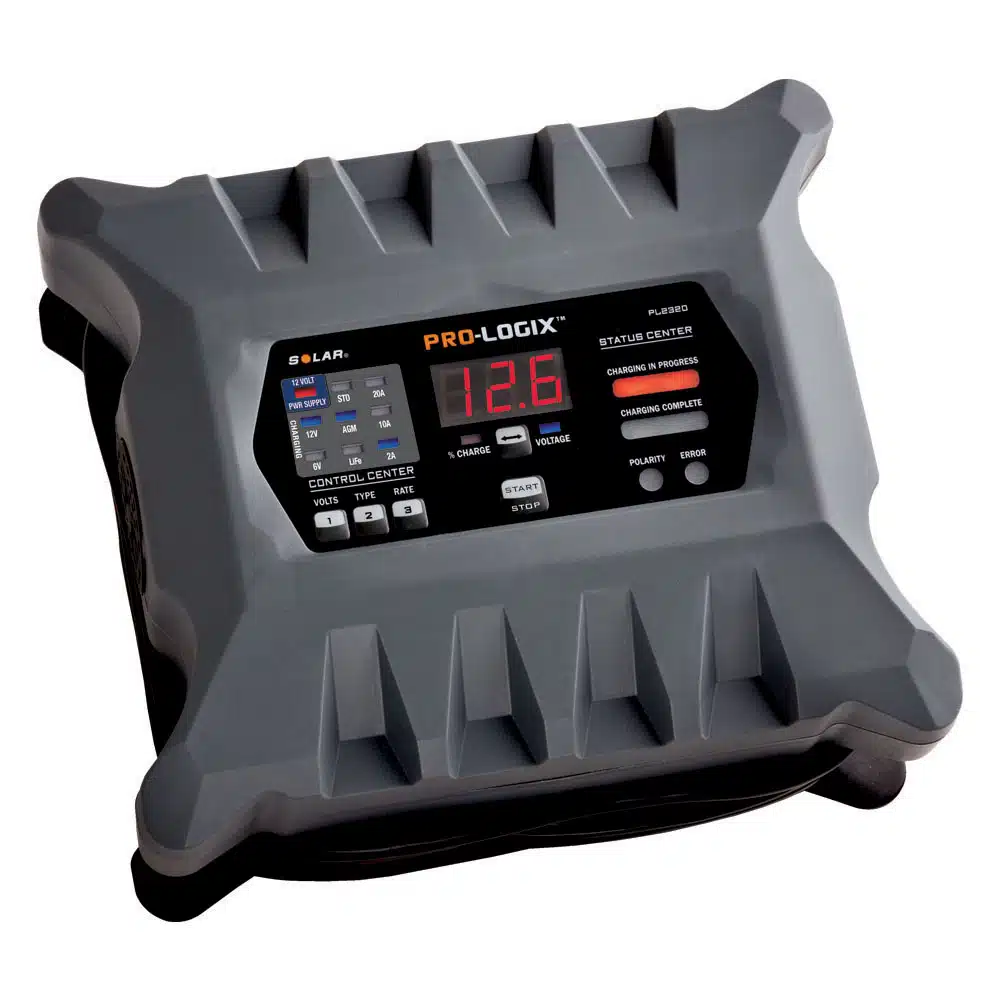
Before purchase, confirm the exact PL2320 code, the battery’s labeled voltage and chemistry, its accepted charge current, the outlet and grounding arrangement, and whether a 72-inch lead reaches the intended connection point. For LiFePO4, verify BMS and 6 V compatibility with Clore and the battery maker because the reviewed documentation does not settle either issue. The product image is the manufacturer’s exact PL2320 artwork, not a photograph of an independently tested package.
Source checks: Clore PL2320 product page and its PL2310/PL2320 operator manual. This assessment does not claim measured charge time, ownership or customer experience.
Key specifications
Key details at a glance
| Output battery voltages | 6 / 12 V |
|---|---|
| Supported chemistries | Lead-acid / Lithium-ion |
| Rated DC charging current | 20 A |
| Independent battery outputs | 1 |
| Arrangement | Portable plug-in charger |
Use the exact model’s instructions for operating limits, supplied equipment and version differences.
Sources for this review
Sources for this assessment
- Clore Automotive SOLAR Portable Battery Chargers category snapshot
- Clore Automotive PRO-LOGIX PL2320 exact-model page
- Clore Automotive shared PL2310/PL2320 operator's manual 842-460-000-H
- Clore Automotive PL2310/PL2320/PL2410 series information sheet (older 12 V presentation)
- Clore Automotive PRO-LOGIX PL2320 official product image

Keep the next step evidence-led
Use the finder to combine voltage, battery chemistry, charging job and setup requirements; then check the exact model and its manual.