
Your needs, this model
Does it fit your priorities?
Can the 4745 charge a 24 V lead-acid battery?
Clore’s exact page and 4745 information sheet specify 24 V charging at 20 A or 2 A; the model manual has a voltage selector and 24 V error threshold, although one generic rate-guidance paragraph still says 12 V only. Use the 24 V modes only with the matching battery and current manufacturer instructions.
Explore this need in the finder →Is the 4745 a long-term battery maintainer after a charge is complete?
No maintenance stage is documented. The manual says the Charge Complete indicator comes on and the charger turns off. Choose equipment whose exact instructions establish a float/maintenance mode if that is the intended job.
Explore this need in the finder →Which 12 V medium rate should I use when the page says both 10 A and 20 A?
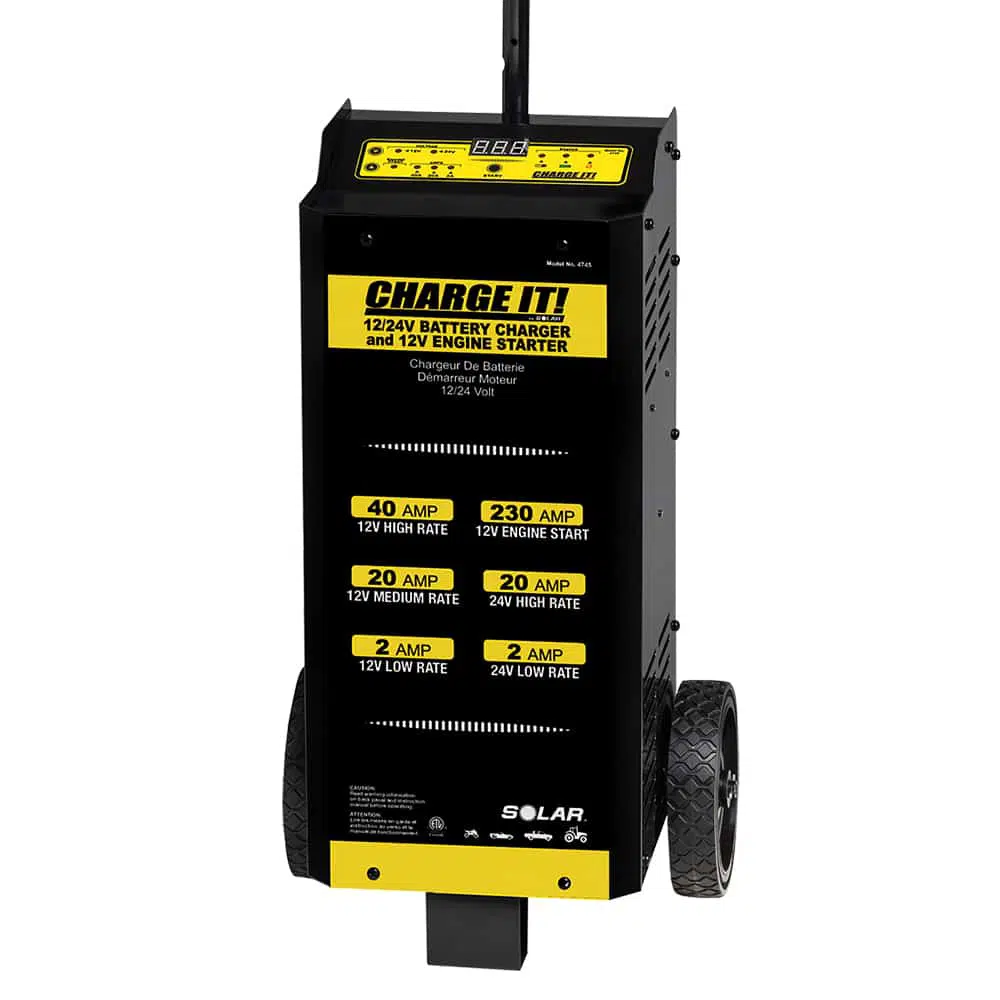
The exact page is internally inconsistent: one feature bullet says 10 A, while its title/specification box says 20 A. The linked 4745 control manual, model information sheet and photographed unit label support 20 A as the medium 12 V selection. We preserve the conflicting 10 A line and recommend verifying the latest model instructions; neither rate is automatically safe for a particular battery.
Explore this need in the finder →The CHARGE IT! 4745 is a 42 lb wheeled charger that Clore identifies for both 12 V and 24 V lead-acid charging. Its charge choices are not the same at each voltage: the documented 12 V arrangement is 40 A, 20 A and 2 A; 24 V offers 20 A and 2 A. A separate 230 A engine-start-assistance mode is for 12 V. There are two source conflicts worth seeing before shopping: one live-page bullet says 10 A for the 12 V medium setting, and one generic paragraph in the manual says 12 V batteries only. The exact model information sheet, page specification box, controls and image clarify the intended ratings, but those inconsistencies remain part of the assessment. This is source research, not a hands-on test.
12 V and 24 V are distinct operating plans
Clore’s model page and 4745 information sheet specify 12 V charging at 40/20/2 A and 24 V at 20/2 A. The exact operator’s manual describes a voltage selector, and its fault guidance recognizes over-voltage at both 12 V and 24 V. One general rate-selection paragraph nonetheless says the charger is designed for 12 V batteries only. Because the same exact-model manual elsewhere presents 12/24 controls and a 24 V error threshold—and the model-specific information sheet confirms the 24 V modes—the 24 V output is documented. Still, the copied-looking generic sentence means a buyer should verify the current manual and exact model setting rather than treating a quick-start interpretation as sufficient.
The 12 V 20 A medium rate has a different conflict: the live product page’s title/specification list says 20 A, but one feature bullet says 10 A. The linked 4745 manual lists 40/20/2 A controls; the exact information sheet calls 20 A the medium 12 V rate; the page’s specification box and the photographed unit also show 20 A. Those independent exact-model sources support 20 A as the manufacturer’s intended setting, so this assessment encodes 20 A and keeps the conflicting 10 A bullet visible. If selecting a seller package, verify that it is model 4745 and obtain the latest manufacturer instructions.
The top rate is not a direction to use 40 A on every 12 V battery. The manual advises using the battery maker’s charge-rate limits and supplies broad guidance for small, deep-cycle and maintenance-free automotive/marine batteries. Its chart includes a generic 12 V-only statement, so do not apply that chart to 24 V batteries or infer a specific 24 V battery-size rule. The public finder treats current as the charger’s available maximum in one supported plan, not as a safe current for an individual battery.
Lead-acid charging, not a documented maintainer
The model manual limits use to lead-acid batteries, and the exact product page tags the 4745 as AGM-related. The manual also supplies rate guidance for maintenance-free automotive/marine and deep-cycle batteries, but there is no dedicated user-selectable AGM profile in the reviewed material. The product sources do not establish lithium charging or an associated BMS condition. Likewise, they state no minimum or maximum Ah charging range. A 40 A label should not be converted into an invented capacity recommendation.
“Fully automatic” describes charging operation, not an ongoing storage-maintenance promise. The manual says the Charge Complete light comes on and the charger turns off after a full charge; it does not describe a float stage or permission to leave it connected indefinitely. If you need long-term battery maintenance, compare a model whose exact instructions explicitly describe that stage. The 4745 has one clamp output arrangement, not multiple independent banks.
The 230 A setting is for a separate 12 V start-assist routine
The 230 A start-assistance rating is not battery-charging current and is not a 24 V start rating. Clore’s manual describes a sequence that starts with several minutes of charging at a suitable rate, then selects Engine Start. The mode lasts 30 seconds; a starting attempt should stop after three or four seconds, followed by a three- or four-minute rest. The unit includes thermal protection, but repeated cranking can still overheat the charger or damage the vehicle starter. The manual also warns against using the start mode without a battery in the vehicle and notes that some vehicle electronics may be harmed. Read the vehicle owner’s manual first. A wheeled AC charger with start-assistance is not a replacement for a portable battery-free jump starter.
Shop placement and physical tradeoffs
The unit weighs 42 lb, so the wheels help with movement around a service area but do not make it portable in the small-tool sense. It requires a nominal grounded 120 V, 60 Hz outlet and indoor placement; the manual says not to expose it to rain or snow. No IP rating, wet-weather use permission, exact DC lead length or complete seller-package contents are stated in the reviewed sources. Check outlet access, measure the route, provide a dry ventilated area and confirm the current included clamps/cables before ordering. The exact page lists a one-year limited warranty; verify current terms.
Compared with the neighboring 4735, the 4745 adds documented 24 V charging, raises the 12 V medium setting according to the manual and sheet, provides a 20 A 24 V setting, and has a higher 230 A 12 V start-assist rating. It is also nine pounds heavier than the 33 lb 4735. The 4735 is simpler for a 12 V-only shop that needs the 40/10/2 A menu; neither is a multi-bank maintainer or a light trunk charger. Choose by confirmed battery voltage, chemistry, permitted charge rate, start-assist need, outlet and placement—not by headline amperage alone.
Before connecting, confirm the exact 4745, the battery’s nominal voltage and lead-acid chemistry, the safe rate stated by the battery maker, a grounded indoor 120 V outlet, and safe vehicle start-assist procedures. Review Clore’s official CHARGE IT! 4745 page, linked 4745 operator’s manual and 4745 information sheet alongside the vehicle and battery instructions.
Key specifications
Key details at a glance
| Output battery voltages | 12 / 24 V |
|---|---|
| Supported chemistries | Lead-acid |
| Rated DC charging current | 40 A |
| Independent battery outputs | 1 |
| Arrangement | Portable plug-in charger |
| Included connection | One heavy clamp output is shown and the manual describes large saw-tooth clamps; exact output-cable length and every seller-box item are not stated in the reviewed exact sources. |
Use the exact model’s instructions for operating limits, supplied equipment and version differences.
Sources for this review
Sources for this assessment

Keep the next step evidence-led
Use the finder to combine voltage, battery chemistry, charging job and setup requirements; then check the exact model and its manual.