
Your needs, this model
Does it fit your priorities?
Does the 4735 charge 24 V batteries as well as 12 V batteries?
No. Clore’s exact page and model 4735 manual identify it as a 12 V charger. Its 200 A engine-start assistance is also rated only for 12 V; do not transfer the 12/24 V capability of the separate 4745 model.
Explore this need in the finder →Can I leave the 4735 connected as a long-term battery maintainer?
The 4735 manual says charging completes and the unit turns off. It does not document a float-maintenance stage, so use a model whose exact manual specifies maintenance if that is the job; it is not a storage-tender claim.
Explore this need in the finder →Does its 200 A engine-start rating mean it charges a battery at 200 A?
No. The charge settings are 2 A, 10 A and 40 A. The separate 200 A 12 V start-assistance mode has its own short operating window and instructions; it is neither a 200 A charge rate nor a battery-free jump starter.
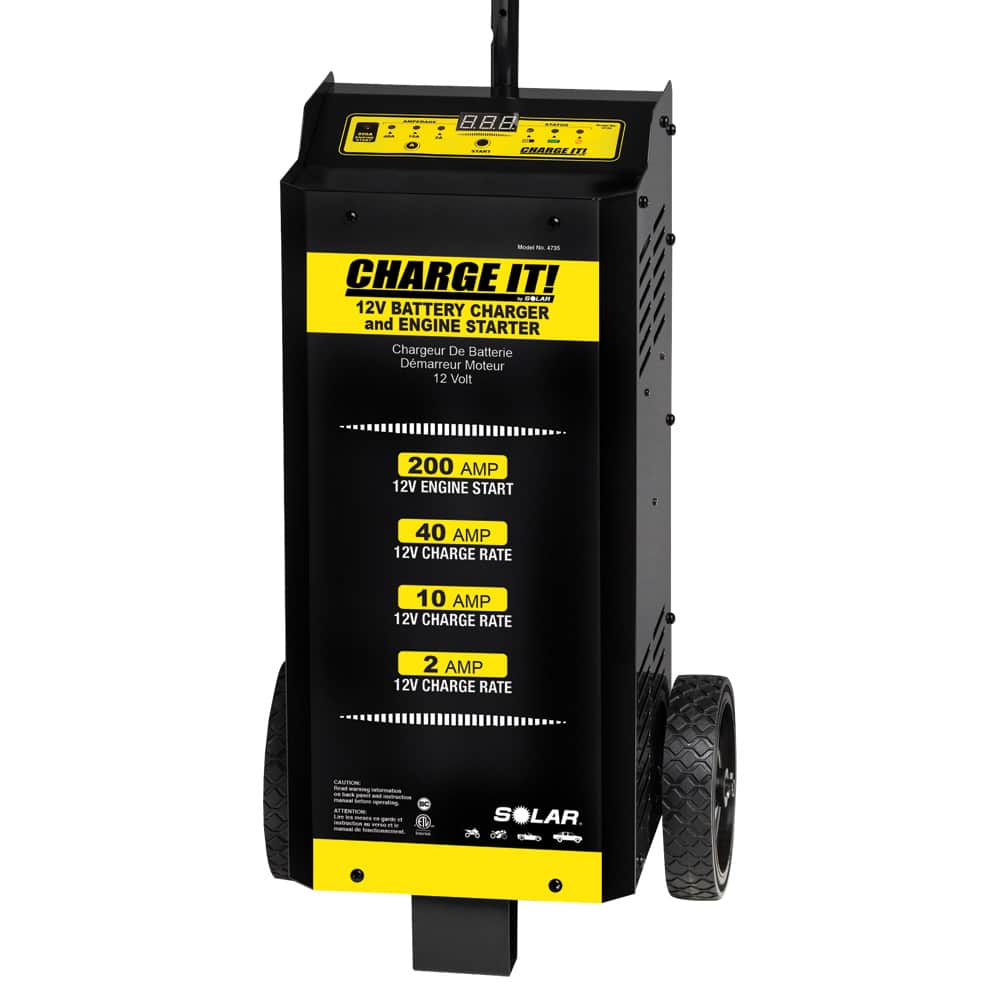
Explore this need in the finder →The CHARGE IT! 4735 is a wheeled shop charger for a single 12 V lead-acid battery. Clore documents three selectable charging rates—2 A, 10 A and 40 A—and a separate 200 A 12 V engine-start-assistance mode. That high start label is not a charging rate, and the unit is not a battery-free jump starter. At 33 lb, this is a rolling garage tool rather than a compact maintainer. This assessment is based on the exact manufacturer page, 4735 manual and product image, not hands-on use.
Choose the charge rate for the battery, not the headline
The 40 A setting is the top documented charging rate, with 10 A and 2 A as lower choices. The manual does not present 40 A as a universal safe setting: it directs owners to the battery maker’s guidance and gives its own limits by use. In that chart, small motorcycle-type and lawn-mower/tractor batteries are limited to 2 A or less; deep-cycle batteries to 10 A or less; maintenance-free automotive or marine cranking batteries to 40 A or less. Follow the battery’s instructions if they are more specific. A finder result at a 40 A minimum means only that the charger has a documented setting at least that high; it is not a recommendation to use that setting on a particular battery.
Clore identifies 12 V charging only. The product page carries an AGM tag, and the manual restricts use to lead-acid batteries; it does not describe a separate AGM selector or a lithium profile. The exact page also does not identify gel, EFB or calcium modes. Do not transfer capabilities from the neighboring 4745, which is a different 12/24 V configuration, or from a charger with explicit lithium settings. Verify the battery’s nominal voltage and chemistry before connecting.
Charging completion is not long-term maintenance
One important distinction separates the 4735 from a trickle maintainer: its manual says the Charge Complete indicator comes on and the unit turns off when the battery reaches full charge. The reviewed instructions do not describe a float stage or continuous maintenance mode. It may suit a shop that expects to charge and disconnect batteries, but it should not be shortlisted as a leave-connected storage tender based on the word “automatic.” The 4735 also has no published minimum or maximum Ah range in the exact page or manual. Its current menu cannot be turned into a capacity estimate.
Plan for a dry indoor work area and a suitable grounded 120 V, 60 Hz AC receptacle. The manual prohibits exposure to rain or snow, asks for ventilation and safe clamp placement, and warns against charging a frozen battery. Marine batteries must be removed from the boat and charged indoors on shore; the manual specifically rules out use on a dock or pier. Clore lists one output clamp arrangement, but the exact reviewed material does not establish the lead length or every accessory included in each seller’s carton. Measure the route and confirm the current package rather than relying on the product photo.
The 200 A label belongs to a separate start-assist routine
The 200 A figure applies to a 12 V engine-start-assistance setting, not to the charger’s battery-charge output. The manual describes a deliberate sequence: connect the charger, charge the weak battery for five to ten minutes at an appropriate charge rate, then select start mode. That mode remains available for 30 seconds; a cranking try should last only three or four seconds, followed by a three- or four-minute wait before another attempt. The charger includes an internal thermal protector, but repeated long cranking can damage the vehicle starter. Clore also warns not to attempt a start when the vehicle has no battery and directs users to consult the vehicle manual because some onboard electronics can be damaged by auxiliary starting.
This is therefore a shop charger with an additional short start-assist function, not a portable lithium jump pack. It still needs a compatible 12 V battery in the circuit and an appropriate AC outlet. If your goal is emergency roadside starting, read the vehicle guidance and compare equipment designed for that separate use instead of treating 200 A as a promise of a successful start.
Wheeled size and nearby alternatives
The 33 lb weight and wheel/handle design favor moving the unit around a service area, while making it a poor fit for carrying in a trunk or leaving installed in a vehicle. The display uses seven-segment readout and status LEDs; the page lists a one-year limited warranty. The maker does not state an ingress rating, exact cable reach, or Ah ceiling in the reviewed exact sources, so those are genuine checks rather than details to assume.
The 4745 is the closest CHARGE IT! wheel alternative when 24 V capability matters: it has 12 V and 24 V charge arrangements, a 230 A 12 V start-assistance mode and a different 12 V medium setting. It is heavier at 42 lb. The 4735 keeps the choice simpler—12 V only, 40/10/2 A charge settings and a 200 A 12 V start-assistance label—but it does not provide the 4745’s voltage flexibility. Both require a battery-specific rate choice; neither earns a capacity match from amperage alone.
Before use, check the exact 4735 model, the 12 V lead-acid battery, the battery maker’s safe rate, your grounded 120 V outlet, dry indoor placement, output-lead reach, and the vehicle’s instructions before using engine-start assistance. Read Clore’s official CHARGE IT! 4735 page and model 4735 manual alongside the battery and vehicle manuals.
Key specifications
Key details at a glance
| Output battery voltages | 12 V |
|---|---|
| Supported chemistries | Lead-acid |
| Rated DC charging current | 40 A |
| Independent battery outputs | 1 |
| Arrangement | Portable plug-in charger |
| Included connection | One heavy clamp output is shown and the manual describes large saw-tooth clamps; exact output-cable length and every seller-box item are not stated in the reviewed exact sources. |
Use the exact model’s instructions for operating limits, supplied equipment and version differences.
Sources for this review
Sources for this assessment

Keep the next step evidence-led
Use the finder to combine voltage, battery chemistry, charging job and setup requirements; then check the exact model and its manual.