
Your needs, this model
Does it fit your priorities?
Does its 26 A rating mean 26 A to each of several batteries?
No. The exact 022-2011 page and manual describe one 12 V 26 A charger output, not a multi-bank unit. A second battery would need a compatible separate connection plan or charger; do not divide or reassign the listed rating. The maker page states 40–400 Ah for this model, while the manual does not give that capacity range. Confirm the exact battery’s allowed rate and the package cable plan.
Explore this need in the finder →Can this PowerPlus charge a 24 V commercial-truck battery?
No. SKU 022-2011 is the fixed 12 V, 26 A member of the PowerPlus family. The 24 V system has its own SKU, 022-2012, rated 20 A; check the vehicle battery’s nominal voltage and model plate rather than selecting by the shared family name.
Explore this need in the finder →Does an IP68 claim mean I can leave it exposed to rain?
Do not assume so. Although the exact product page advertises IP68, manual P/N 392-0449-R0 says not to expose the charger to rain or snow. Follow the manual and verify installation conditions; this review does not treat it as a rain-exposure charger.
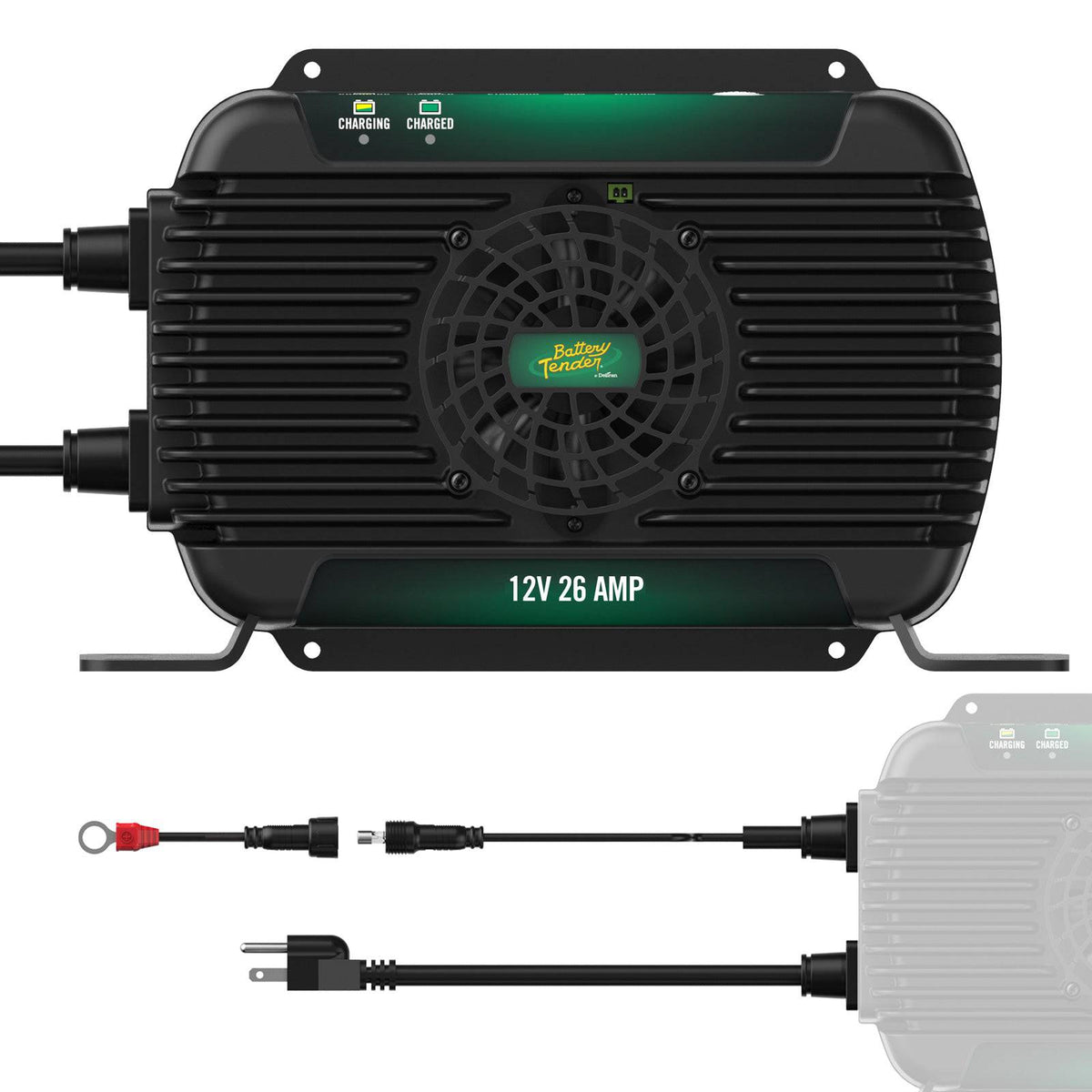
Explore this need in the finder →The Battery Tender PowerPlus 12V 26 A, SKU 022-2011-DL-WH, is a high-output single-battery charger intended for a 12 V setup. The manufacturer names commercial vehicles and trucks among its applications, so this is not only a marine product; it can be relevant when a vehicle actually uses the listed 12 V battery chemistry and the battery maker permits the selected current. This is a desk assessment of the maker page and exact shared manual, not a hands-on test.
One 12 V output rated at 26 A
The 26 A figure applies to this model’s one battery connection. It is not an aggregate across several independent banks, and there is no second output to divide among auxiliary batteries. Battery Tender’s page describes a bulk, absorption and float sequence that moves from charging into maintenance; the P/N 392-0449-R0 manual names SKU 022-2011 and its 12 V, 26 A configuration. That makes the model a plausible match for a larger compatible 12 V vehicle or auxiliary battery, not an automatic choice for every car battery. A battery that is sized for a lower rate still needs its own maker-approved charge limit followed. Battery Tender’s current page states 40–400 Ah for this exact model. The shared manual confirms the hardware and supported charging profile but does not restate an Ah range. Treat 400 Ah as a manufacturer page claim, not a promise of charge time, recovery of a damaged battery or a verified maximum for every chemistry. This site’s capacity question stops at 300 Ah, so it cannot test the product page’s full upper edge. The page-stated 40 Ah lower end is also a check on the exact battery rather than a detail to ignore when reading a shortlist.Check the chemistry mode and voltage before connecting
The SKU-matched manual names Standard, AGM and four-cell LiFePO4 selections. It does not document a built-in BMS requirement for lithium, so the lithium mode is not a blanket compatibility claim for every pack. The product page lists a wider lead-acid subtype set, including gel and sealed maintenance-free batteries, but the review tags remain limited to what the manual identifies clearly. If a battery label gives a particular subtype, voltage, charge voltage or current restriction, use that battery manufacturer’s guidance rather than assuming that “multi-chemistry” covers an unlisted profile. Voltage is fixed at 12 V. This model is not the right PowerPlus for a 24 V heavy-truck system; SKU 022-2012 is the distinct 24 V/20 A sibling. Nor does the higher current make the 022-2011 a multi-bank unit. For a single 12 V battery that needs less current, Battery Tender’s 022-1006 offers separate 2 A and 10 A settings according to its exact manual, while the 022-0234 is a separate 15/8/2 A product. These are different models, not interchangeable settings or package variants.Plan the connection and mounting location
The maker describes both portable use and permanent on-board installation. Its page lists mounting hardware, a 6.5 ft AC lead, a 4.9 ft DC lead and fused ring-terminal accessories, but the exact package and usable reach should be checked against the retail SKU before purchase. The heavy body and ring-terminal format are better suited to an intentional charging location than to assuming an included small clamp set. The manual gives the vehicle-installed connection sequence and says to disconnect AC before removing the DC connections; follow its polarity, ventilation and battery-location instructions. There is an important environmental conflict: the product page advertises IP68 and wet-location installation, while manual P/N 392-0449-R0 expressly says not to expose the charger to rain or snow. This assessment follows the manual and does not treat the marketing claim as permission for open-weather exposure. The page also advertises marine ignition protection, but the inspected manual does not provide the supporting certification declaration used here to establish a fuel-vapor installation. Do not use this review as a substitute for exact installation approval.Who should consider it
The PowerPlus 022-2011 is most relevant when the target is one 12 V battery, 26 A is acceptable under the battery maker’s instructions, and the chosen Standard/AGM or LiFePO4 profile is correct. It is a poor fit when voltage is uncertain, the vehicle is 24 V, the battery is outside the maker’s stated page range, multiple independent outputs are needed, or rain exposure is part of the plan. Confirm the exact 022-2011-DL-WH label, compatible battery chemistry, fuse/cable package, AC access and installation environment before treating a listing as the same configuration.Key specifications
Key details at a glance
| Output battery voltages | 12 V |
|---|---|
| Supported chemistries | Lead-acid / Lithium-ion |
| Rated DC charging current | 26 A |
| Published charge capacity limit | 400 Ah |
| Independent battery outputs | 1 |
| Arrangement | Portable and on-board |
| Included connection | The page lists mounting hardware, a 6.5 ft AC cord, 4.9 ft DC lead and fused ring-terminal accessories; verify the actual 022-2011 package, lead reach and connection method before buying. |
Use the exact model’s instructions for operating limits, supplied equipment and version differences.
Sources for this review
Sources for this assessment
Keep the next step evidence-led
Use the finder to combine voltage, battery chemistry, charging job and setup requirements; then check the exact model and its manual.