
Your needs, this model
Does it fit your priorities?
Is a 15 A charge setting suitable just because the 022-0234 offers it?
No. The 15/8/2 settings and AUTO mode establish the charger's available choices, not the rate every battery can accept. Check the battery's own specifications, the chosen chemistry, state and condition, and the exact manual. The charger FAQ's 14–250 versus 50–300 Ah range conflict also means its numeric capacity ceiling is not resolved here.
Explore this need in the finder →Does the 022-0234 support a lithium battery with a built-in BMS?
Its exact manual provides a four-cell LiFePO4 chemistry setting, but it does not state whether a built-in BMS is required. That is why the open BMS answer can show the supported chemistry plan while explicit required/not-required filters do not treat this missing condition as a match. Verify the actual battery and instructions.
Explore this need in the finder →Can the 022-0234 supply power while the car battery is removed?
The exact manual documents a separate supply mode to preserve vehicle settings while removing a battery, with output up to 10 A. It does not state a supply voltage or authorize general-purpose accessory power. Treat it as a memory-retention task only, separate from charging a battery, and confirm the vehicle's requirements before use.
Explore this need in the finder →Three charge rates and an LCD, for one 12 V battery
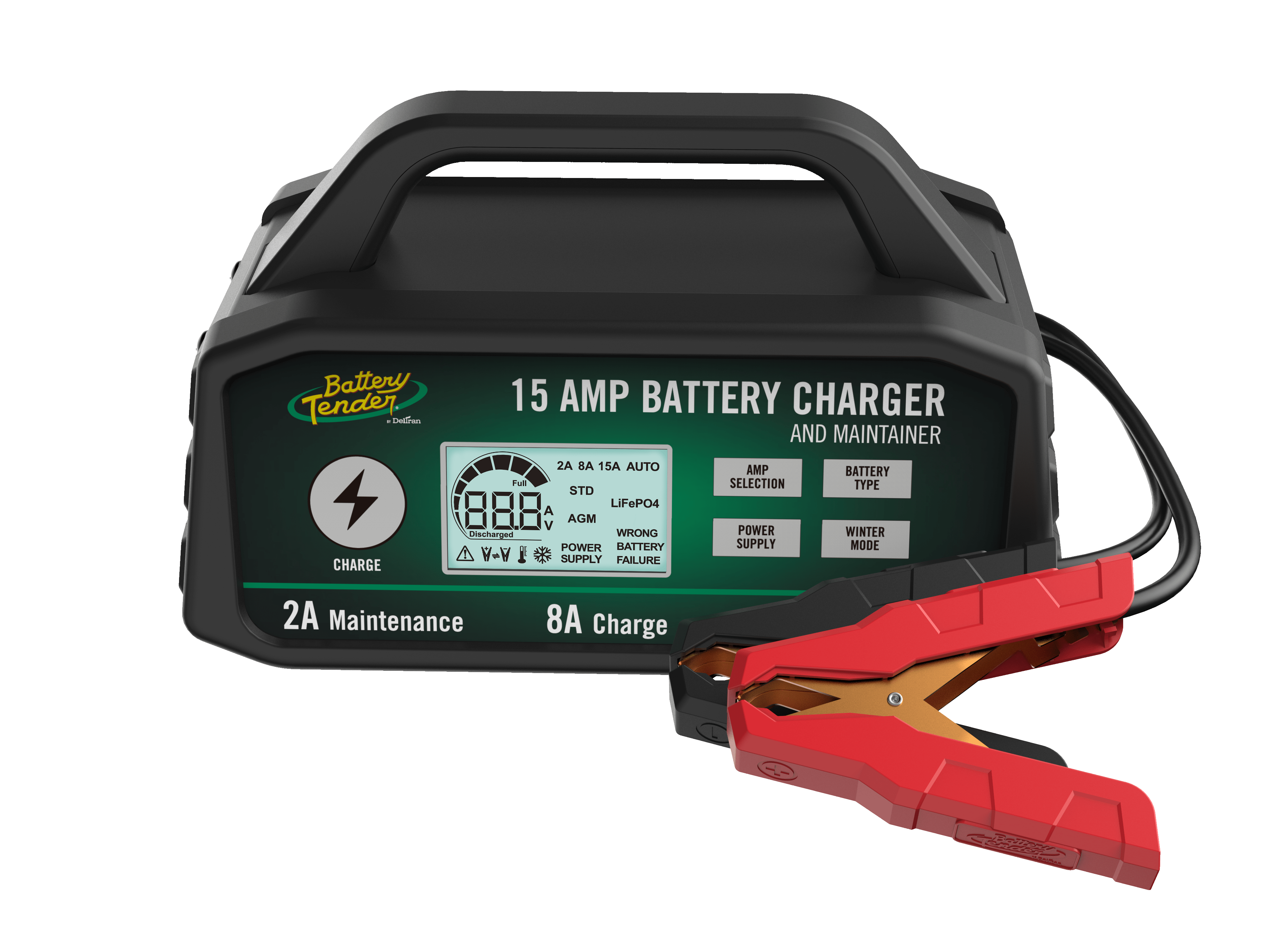
Battery Tender's Power Tender 15/8/2 is the 022-0234-DL-WH, a portable charger with one battery output. Its SKU-matched manual 392-0430-RB names P/N 022-0234 and documents three fixed charge-rate selections—2 A, 8 A and 15 A—plus an automatic-rate mode. The product page also calls it a 12 V charger. These modes make the unit more flexible than a fixed-rate tender, but they are not a prediction that the top setting is right for every battery. The battery manufacturer must approve the charging voltage, chemistry and current.
The LCD reports charge status, current, voltage, battery type and error information, while the physical controls separate rate, chemistry, charge, winter and power-supply functions. That visibility can help someone distinguish an active charge from the automatic maintenance phase without relying only on indicator lights. The manual states that a full battery transitions to maintenance and describes automatic rate selection. It also gives a 30 Ah/2 A time example, but it does not establish an exact charging time for a different battery or an overall capacity ceiling.
Supported battery modes and the unanswered BMS question
The exact manual permits six-cell lead-acid and four-cell lithium batteries and its selection button lists STD, AGM and LiFePO4. The product page lists flooded lead-acid, AGM, gel, sealed maintenance-free and lithium types. Those supportable distinctions map to a 12 V lead-acid plan and a 12 V LiFePO4 plan. The manual does not say whether a LiFePO4 battery needs a built-in BMS, so the finder does not count this unit for either explicit BMS condition. Use the battery maker's instructions and verify the precise battery subtype rather than treating “lithium” as a universal profile.
The manual's separate Winter Mode raises the bulk-charge voltage slightly for cold conditions. That is not a permission to charge a frozen battery: the manual's safety instructions say never to charge one. Winter mode is a selectable procedure, not environmental protection for the charger. The same exact manual says not to expose the case to rain or snow, so this remains a dry-use portable unit in this assessment. The page has no documented enclosure rating that would override that direction.
Why the Ah range remains unresolved
The page contains two incompatible battery-size statements: a general section says 14–250 Ah, while its 15 A FAQ says the top mode is optimally sized for 50–300 Ah. The manual has a 30 Ah example at 2 A but no maximum. Those claims cannot be merged into one trustworthy ceiling. The 022-0234 therefore remains unmatched when a shopper enters a numeric battery-capacity request; that is a deliberate limit in the evidence record, not proof the unit cannot charge a battery outside either marketing range. Check the exact documentation and get model-specific guidance before relying on a capacity number.
The fixed 15 A top selection is also not the per-battery rating of a multi-bank device. This is a single-output portable unit, so its one output can satisfy a one-bank minimum only. The 15 A number may matter for a larger battery when the battery maker approves the rate, while 2 A may be relevant to a lower-current maintenance plan. It does not create separate connections for a starting and house battery; an independently controlled bank charger would be a different operating layout.
Memory backup is not a general-purpose supply
The 022-0234 has a mode explicitly called Power Supply. The manual describes it for keeping vehicle settings while the vehicle battery is removed and says it can supply up to 10 A. Unlike the exact 022-0229 manual, this text does not state the supply voltage. For that reason, this assessment records the memory-support function but does not claim a generic 12 V accessory output or match any voltage requirement for the supply mode. Treat this function as separate from battery charging and verify that the vehicle procedure is compatible. The public finder’s device-power choice is a broad starting point, not confirmation that a specific accessory can use the 022-0234.
Practical fit and checks
This model may suit a dry garage or workshop where a portable 120 V AC charger, selectable current, explicit battery chemistry choices, an LCD and a vehicle-memory backup function are useful. A five-year limited warranty is stated by the manufacturer; warranty eligibility and seller terms still depend on the offer. The case has a fan and the manual describes current reduction or shutdown at high temperatures; keep its ventilation openings clear and follow the manual rather than enclosing the charger.
Before selecting an offer, check that the label is 022-0234, not the similarly described 022-0229 or another Power Tender. Verify the chosen rate and chemistry, clip condition and the package, confirm the battery maker permits the mode, resolve the applicable capacity range, and identify a dry, ventilated place. The source pages say the model is sold out at the time captured; this assessment makes no claim about current availability, price or third-party stock. It is desk research from an exact page and matching manual—not a hands-on test or ownership account.
Assessment basis
The facts here come from Battery Tender's exact 022-0234 product page and the 392-0430-RB manual that names the SKU, plus the manufacturer's charger collection. This review keeps the page's contradictory Ah claims visible, uses the manual for dry-use and battery-mode limits, and does not transfer generic power-supply or wet-location assumptions to the product.
Key specifications
Key details at a glance
| Output battery voltages | 12 V |
|---|---|
| Supported chemistries | Lead-acid / Lithium-ion |
| Rated DC charging current | 15 A |
| Independent battery outputs | 1 |
| Arrangement | Portable plug-in charger |
| Included connection | The exact product page lists hardwired alligator clips and the charger; verify whether an individual offer also includes any leads or accessories not in that list. |
Use the exact model’s instructions for operating limits, supplied equipment and version differences.
Sources for this review
Sources for this assessment
Keep the next step evidence-led
Use the finder to combine voltage, battery chemistry, charging job and setup requirements; then check the exact model and its manual.