
Your needs, this model
Does it fit your priorities?
Does the 022-0200 manual document a 6 V AGM mode?
Yes. The available shared manual identifies P/N 022-0200 and describes selecting 6 V lead-acid/AGM before connecting the battery. The current retail page and image call this SKU 2 A, while that manual says base P/N 022-0200 is 1.25 A, so confirm the manual supplied with the exact unit before relying on its current rating.
Explore this need in the finder →What lithium mode does the shared 022-0200 manual describe?
The manual identifies a 12 V LiFePO4 mode and does not document 6 V lithium. It does not state whether the lithium battery must have a BMS, so that condition remains unknown; verify the battery’s protection and the exact current manual.
Explore this need in the finder →Can I rely on a 2 A minimum for this current 022-0200 listing?
The current product page and product image identify 2 A, but the available instruction manual for base P/N 022-0200 states 1.25 A. The questionnaire reflects the current page rating, not a reconciled manual revision. If two amps is essential, do not assume compatibility from the page alone; confirm the exact device label and supplied instructions with the manufacturer.
Explore this need in the finder →A newly presented dual-voltage Plus, with a manual conflict to resolve
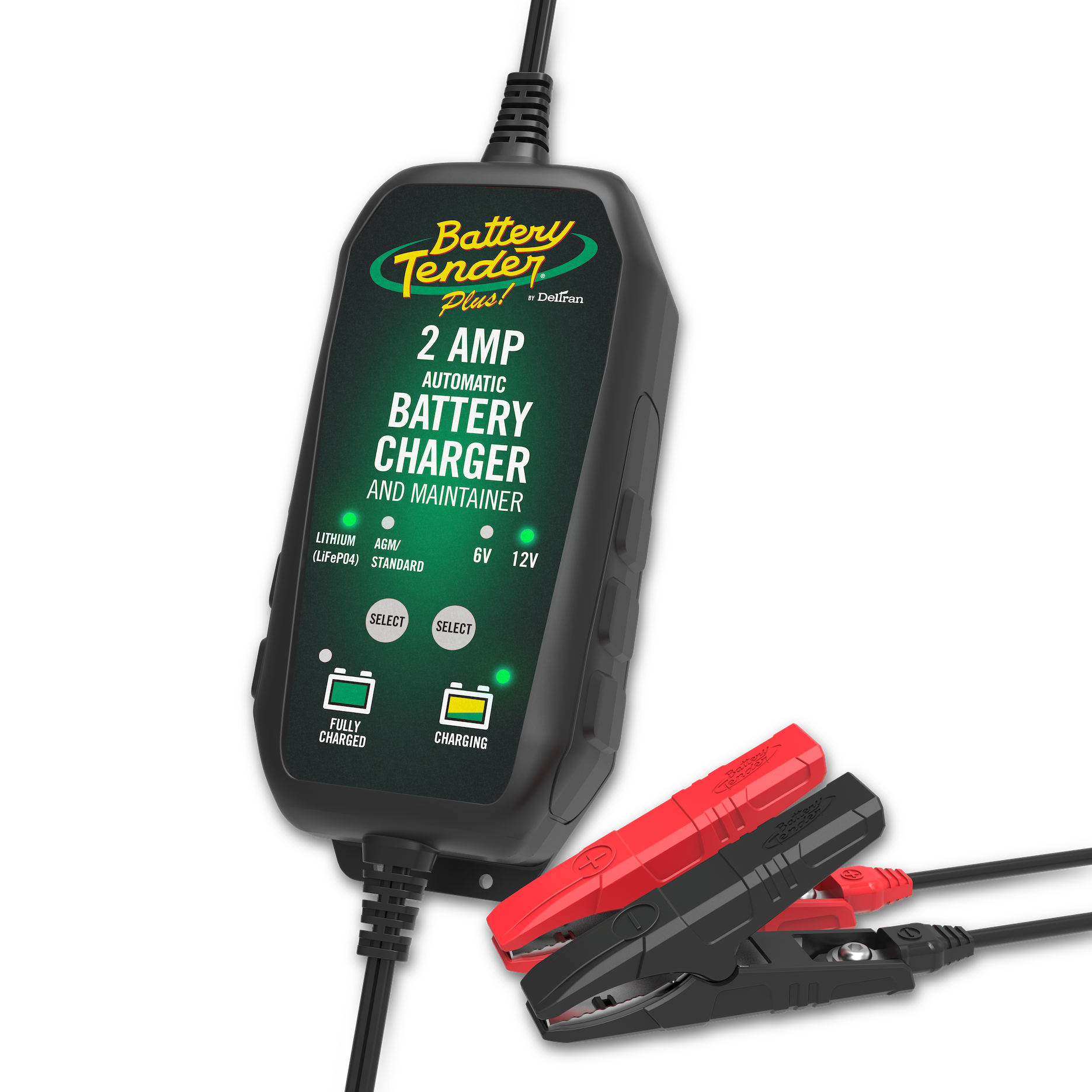
Battery Tender’s current exact product page identifies SKU 022-0200-DL-WH as a Plus 6 V/12 V charger rated at 2 A. The product image is even more explicit: it labels the body “2 AMP” and shows separate 6 V/12 V and AGM/Standard/Lithium (LiFePO₄) selectors. This is a different listing from the fixed 12 V, 1.25 A Plus 021-0128 and the selectable 1.25 A Plus 022-0211.
There is an important source bridge to keep visible. The manufacturer’s current product page and exact image say 2 A, but an instruction manual that names base part number 022-0200 states that P/N 022-0200 charges at 1.25 A. The manual also covers 022-0209 at 4 A. Because the product page now presents a 2 A retail SKU while the available manual for the same base part number documents 1.25 A, the exact revision and matching manual have not been reconciled. The assessment records the current-page 2 A claim but does not treat that conflict as settled; confirm the label and the instructions supplied with the exact package before relying on a two-amp rate.
Two battery voltages require a deliberate setting
The product page describes a manual voltage selector and separate charge profiles for 6 V and 12 V. The available 392-0327 manual likewise identifies the 022-0200 family and says to select the voltage before connecting the battery. It describes 6 V lead-acid/AGM and 12 V lead-acid/AGM or LiFePO₄. Its lithium mode is 12 V only; a 6 V LiFePO₄ arrangement is not documented. The manual says a connected charger’s voltage mode cannot be changed until the battery is disconnected, so this is not a device to set casually after attaching the leads.
The exact-model page states a 14–80 Ah range for lead-acid batteries at either voltage. That is a page claim, not a charge-rate guarantee for every battery in the range. The manual’s separate “foreign compliance” capacity wording is not adopted as a North American capacity range. The matcher screens the published 80 Ah upper value for the documented lead-acid plans, but it does not enforce the page’s 14 Ah lower edge. For lithium, the exact current page does not publish an Ah range, so an entered capacity cannot be treated as confirmed for that plan.
Small-battery use and storage maintenance
The page describes a four-stage process with initialization, bulk charge, absorption and float maintenance, and says the charger can remain connected after reaching full charge. Those are useful design claims for a car that spends time parked or for a vintage 6 V vehicle that is not driven often. Maintenance and recovery are different jobs: the product page’s capacity range is about charging, while a maintenance mode is intended to support an already charged battery against self-discharge. Neither claim establishes that an old, damaged or deeply discharged battery is healthy.
For a modest, single-battery job, a selectable 6 V/12 V charger can avoid keeping two fixed-voltage devices. But 2 A is still not a high-output recovery charger, even if the current retail page’s rating is correct. Compare it with the manual-backed 4 A Power Tender 022-0209 only after checking the battery maker’s permitted rate; see the 022-0209 assessment for that model’s separate manual and capacity conflicts.
Weather, installation and warranty language do not fully agree
The current product page advertises IP65 and describes permanent mounting in an engine bay or storage structure. The available manual that identifies P/N 022-0200 says not to expose the charger to rain or snow. The manual is the more conservative use instruction until Battery Tender reconciles the difference; this assessment does not recommend rain or exposed outdoor use from the page’s IP claim. The unit is an AC plug-in single-output charger, not a marine on-board charger. The ring-terminal harness may simplify repeated connections, but a hard-mounted maintainer still needs an appropriate AC supply, ventilation and safe cable routing.
The same page is inconsistent about warranty length: its opening description says five years while the specification block and FAQ say seven. The assessment does not choose between those statements. Verify the current written warranty and package terms if they influence the purchase.
Connections, safety and what to check
The product page lists a two-in-one alligator-clip/ring-terminal lead, an instruction manual and 120 V AC input. The available manual warns about explosive battery gases, calls for ventilation, says not to charge a frozen battery, and gives vehicle-connection procedures. It also says the device is not intended to supply power to a low-voltage electrical system; the separate “power supply” questionnaire option is not a battery-charging mode for this model. Confirm the exact connector cable, output cord reach, voltage switch, chemistry selector and model revision before use.
Who should shortlist this model
Consider the current 022-0200-DL-WH listing when selectable 6 V/12 V lead-acid support, a one-battery arrangement and a modest charger are relevant—and only after checking which current revision and manual are actually supplied. The manufacturer currently markets the exact page and image as 2 A, while the available manual identifies 022-0200 at 1.25 A. That is a material distinction for any minimum-current decision. The BMS condition for the lithium mode is not established in the sources reviewed, and the IP65/rain and warranty statements also conflict. If any of those facts is essential, verify them with Battery Tender or select a better-documented exact model.
This is a source-based assessment, not a physical test. It does not establish charging time, battery health, actual installation safety, or seller package contents. Follow the current manufacturer manual and the vehicle and battery makers’ instructions.
Manufacturer references: the exact Battery Tender Plus 022-0200-DL-WH page, the manufacturer’s selectable 022-0200/022-0209 manual, and the official 2 A product image.

Key specifications
Key details at a glance
| Output battery voltages | 6 / 12 V |
|---|---|
| Supported chemistries | Lead-acid / Lithium-ion |
| Rated DC charging current | 2 A |
| Published charge capacity limit | 80 Ah |
| Independent battery outputs | 1 |
| Arrangement | Portable plug-in charger |
| Included connection | Current exact page lists a two-in-one alligator-clip/ring-terminal cable, instruction manual and 120 V AC input; verify the exact revision and package. |
Use the exact model’s instructions for operating limits, supplied equipment and version differences.
Sources for this review
Sources for this assessment
Keep the next step evidence-led
Use the finder to combine voltage, battery chemistry, charging job and setup requirements; then check the exact model and its manual.