
Your needs, this model
Does it fit your priorities?
What is the documented output of the Power Tender 4 A model 022-0209?
The manual identifies P/N 022-0209 and states a 4 A charge rate. That is the rated charger output, not a promised charging time: the charger changes stages and actual progress depends on the battery. Confirm that its manufacturer allows the 4 A rate.
Explore this need in the finder →Can model 022-0209 charge a 6 V flooded battery?
The shared 022-0200/022-0209 manual describes a selectable 6 V AGM/flooded profile. Check the selector before connecting, because the setting cannot be changed once the battery is attached, and verify the battery maker's rate and instructions.
Explore this need in the finder →Does model 022-0209 support 12 V LiFePO₄?
The manual documents a 12 V-only LiFePO₄ chemistry selection. It does not establish the BMS condition, and lithium is not documented in the 6 V profile. Verify the battery's protection system and approved charging profile before use.
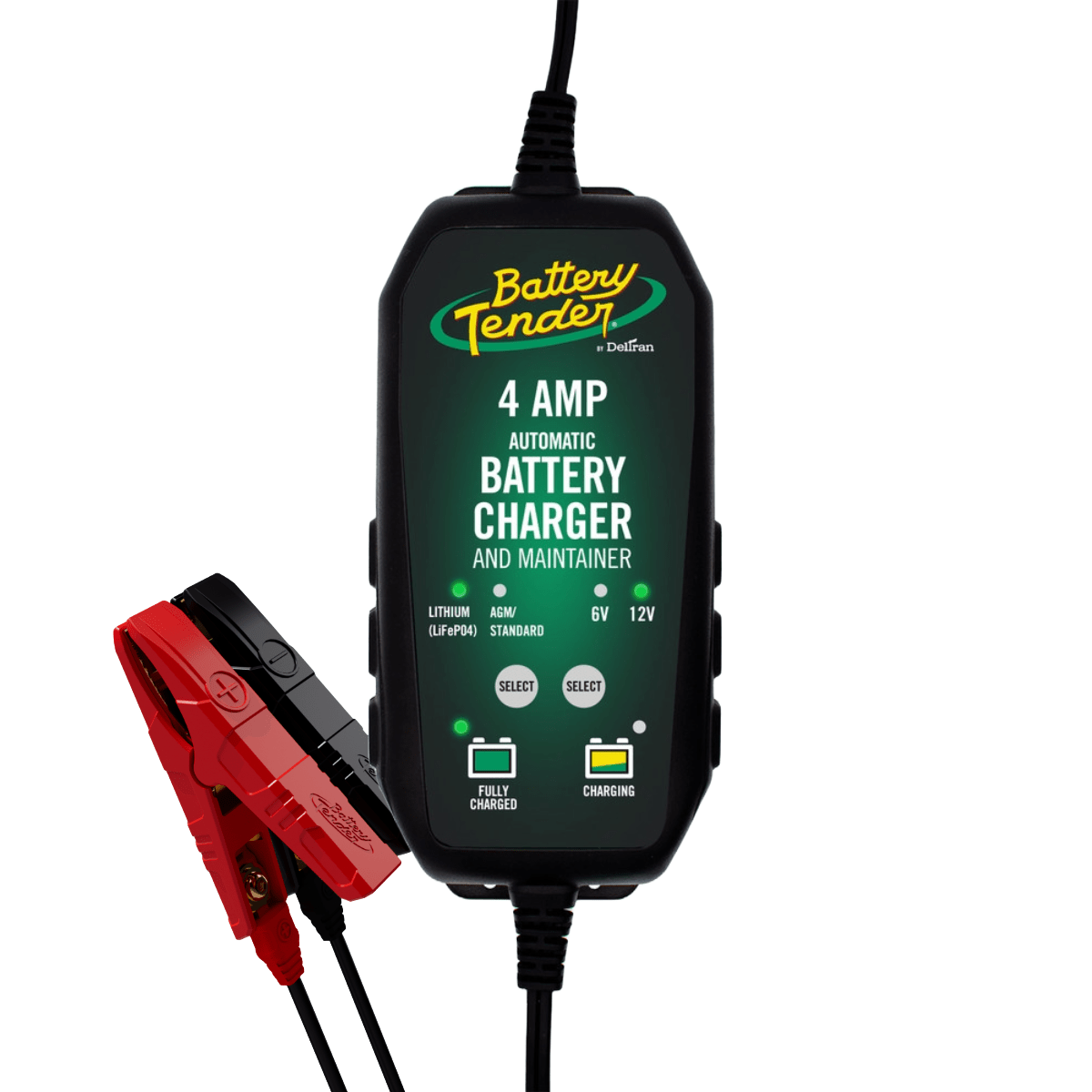
Explore this need in the finder →The Battery Tender Power Tender 4 A 12V/6V, retail SKU 022-0209-BT-WH, occupies the middle output position among this family's single-output 3 A, 4 A and 5 A models. The manufacturer page identifies the retail SKU, and its linked instruction manual names P/N 022-0209 in a shared document that also covers the 1.25 A model P/N 022-0200. The manual confirms the 4 A rate and selectable voltage and chemistry modes. This is a document-based assessment, not a test of charging performance.
Walmart retail SKU 022-0209-WAL
Battery Tender also lists a Walmart-specific 4 A 6 V/12 V charger as SKU 022-0209-WAL. Its exact manufacturer page and product image identify that separate retail suffix, while the shared selectable-charger manual names the same functional charger part number, P/N 022-0209, and specifies its 4 A rate. The available sources establish the same charger base and operating modes, so this review covers both documented retail identities rather than creating a second assessment with no supported technical difference. They do not establish whether the box contents, included leads or seller package are identical. Match the exact suffix and verify the cable kit you need before purchase; do not infer package equivalence from the shared charger number.
One output with two selectable battery voltages
The unit is a portable AC charger/maintainer with one battery connection path. Battery Tender lists a 120 V AC input, a two-in-one alligator-clip/ring-terminal lead and a 4 A output. The manual describes qualification, bulk, absorption and storage/float maintenance. It says the output depends on the state of the battery, so 4 A is a rating for the bulk phase, not a guaranteed charge rate at every point or a promise about how quickly a real battery will recover.
For lead-acid, the manual documents selectable 6 V and 12 V flooded/AGM profiles. A separate 12 V LiFePO₄ profile is described; lithium is not documented in the 6 V mode. The current product page's broad application text also describes lithium at 6 V, so the page and manual do not agree on that mode; this assessment follows the exact manual and does not count 6 V LiFePO₄ without a manufacturer clarification. The page also lists additional lead-acid types, but I do not tag gel, EFB, calcium or maintenance-free support because the exact instruction manual does not name those profiles.
Set both switches before connecting
The manual says to select voltage and chemistry after AC power is applied but before connecting the battery. Once the unit is connected to the battery, a setting cannot be changed until the battery and AC are disconnected and the charger is reset. Confirm the battery's nominal voltage and exact chemistry from its label and instructions; a visually familiar battery or a vehicle's model year is not a safe substitute. For LiFePO₄, the manual describes a 12 V mode but does not establish whether a built-in BMS is required. Check the battery maker's documentation before choosing that profile.
The manual's automatic float stage can maintain a charged battery, but a maintainer is not a battery-health test and cannot turn a damaged or frozen battery into a serviceable one. It also does not mean the charger's output should be left unmonitored in every installation. Follow the exact manual, keep the battery area ventilated, and verify polarity and cable routing.
The capacity ceiling is unresolved
On the current product page, the main compatibility statement gives a 14–100 Ah range, while a later FAQ describes a 20–200 Ah range. The linked 022-0209 manual does not state either as a maximum; its example of a 15 Ah battery reaching 80% after about three hours is a timing illustration, not evidence for an upper capacity boundary. Because these are conflicting claims on the same page and the manual does not reconcile them, I do not assign a maximum Ah value in the facts or include this model as a confirmed fit for a numeric capacity request. Request a current, SKU-specific clarification if capacity is a deciding requirement.
Weather statement versus operating instructions
The product page lists IP65, but the linked manual says not to expose the charger to rain or snow. Those statements do not resolve the permissible environment, so this review does not interpret the rating as approval for wet or outdoor use. Keep the charger dry unless Battery Tender provides updated instructions for this exact version. The manual also warns not to charge frozen batteries and requires ventilation around the battery. It says marine batteries must be removed and charged ashore unless the equipment is specifically designed for on-board marine charging; the ordinary portable unit should not be treated as an installed marine charger.
How 4 A differs from 3 A and 5 A
The main practical distinction in this small Power Tender family is rated output: the matching manuals identify 3 A for P/N 022-0202, 4 A for P/N 022-0209, and 5 A for P/N 022-0186G. All are single-output selectable 6 V/12 V products, and all document 12 V LiFePO₄ separately from 6 V flooded/AGM. The extra amp over the 3 A version or the one-amp step below the 5 A version is not a standalone speed test; charging behavior also depends on battery size, condition, state of charge and the maker-approved rate. Don't infer a larger capacity limit from the nameplate or from another model's product page.
Compared with the Battery Tender Plus 1.25 A 12 V model, the Power Tender offers a 6 V option and higher nominal output, but the Plus has clearer published capacity evidence for its specific 12 V model. Which matters more depends on the battery and job: a known 12 V battery capacity may favor the documented range, while a 6 V system calls for a model whose manual actually includes that mode.
Who should shortlist it
The 022-0209 is worth comparing when a single portable output, selectable 6 V/12 V lead-acid support or 12 V LiFePO₄ mode, and a 4 A rating fit the battery maker's instructions. It is not an on-board unit, not a multi-bank charger, not a 6 V lithium solution, and not a verified outdoor choice on the present documentation. Before purchase confirm the 022-0209 SKU, exact manual, supplied leads and battery-approved rate; ask Battery Tender to reconcile the two Ah claims if a capacity boundary is necessary. No physical use, measured performance or customer experience is claimed here.
Manufacturer references: the Power Tender 4 A product page, the exact Walmart 022-0209-WAL page, the selectable 1.25/4 A instruction manual, and the Battery Tender charger collection.
Key specifications
Key details at a glance
| Output battery voltages | 6 / 12 V |
|---|---|
| Supported chemistries | Lead-acid / Lithium-ion |
| Rated DC charging current | 4 A |
| Independent battery outputs | 1 |
| Arrangement | Portable plug-in charger |
| Included connection | Product page lists a two-in-one alligator-clip and ring-terminal lead; confirm exact package contents. |
Use the exact model’s instructions for operating limits, supplied equipment and version differences.
Sources for this review
Sources for this assessment
Keep the next step evidence-led
Use the finder to combine voltage, battery chemistry, charging job and setup requirements; then check the exact model and its manual.