
Your needs, this model
Does it fit your priorities?
Can the 022-0197 maintain one 8 V battery in a 48 V golf-cart pack?
Battery Tender's exact page identifies a fixed 8 V, 1.25 A charger and discusses individually maintaining 8 V batteries in a 48 V series system. It has one output; the pack itself remains a 48 V system, so this is not a 48 V charger. Confirm the golf-cart maker's disconnect and storage instructions before charging an individual battery.
Explore this need in the finder →Is the 8 V model a fit for a normal 12 V car battery?
No. The product page and linked manual describe an 8 V-only lead-acid output. A 12 V battery needs a documented 12 V plan; do not infer fit from the Plus name or the general no-preference voltage option.
Explore this need in the finder →What battery capacity can the linked 8 V product page support?
The page conflicts: its primary compatibility text ends at 80 Ah, but an FAQ says approximately 10–150 Ah and then describes typical 150–200 Ah golf-cart batteries. The linked manual names no capacity range, so this assessment does not claim an Ah ceiling or certify a match by size.
Explore this need in the finder →A specialist 8 V output, not a general car charger
Battery Tender lists SKU 022-0197 as a fixed 8 V, 1.25 A Plus charger and maintainer. That rating puts it outside the usual 12 V passenger-car job. It may be relevant when the actual battery is an individual 8 V lead-acid unit—for example, one battery in a higher-voltage golf-cart pack—but it is not a charger for the full 36 V or 48 V series pack. Before making that distinction, check the equipment and battery labels: a pack's overall voltage and the nominal voltage of one battery in it are different things.
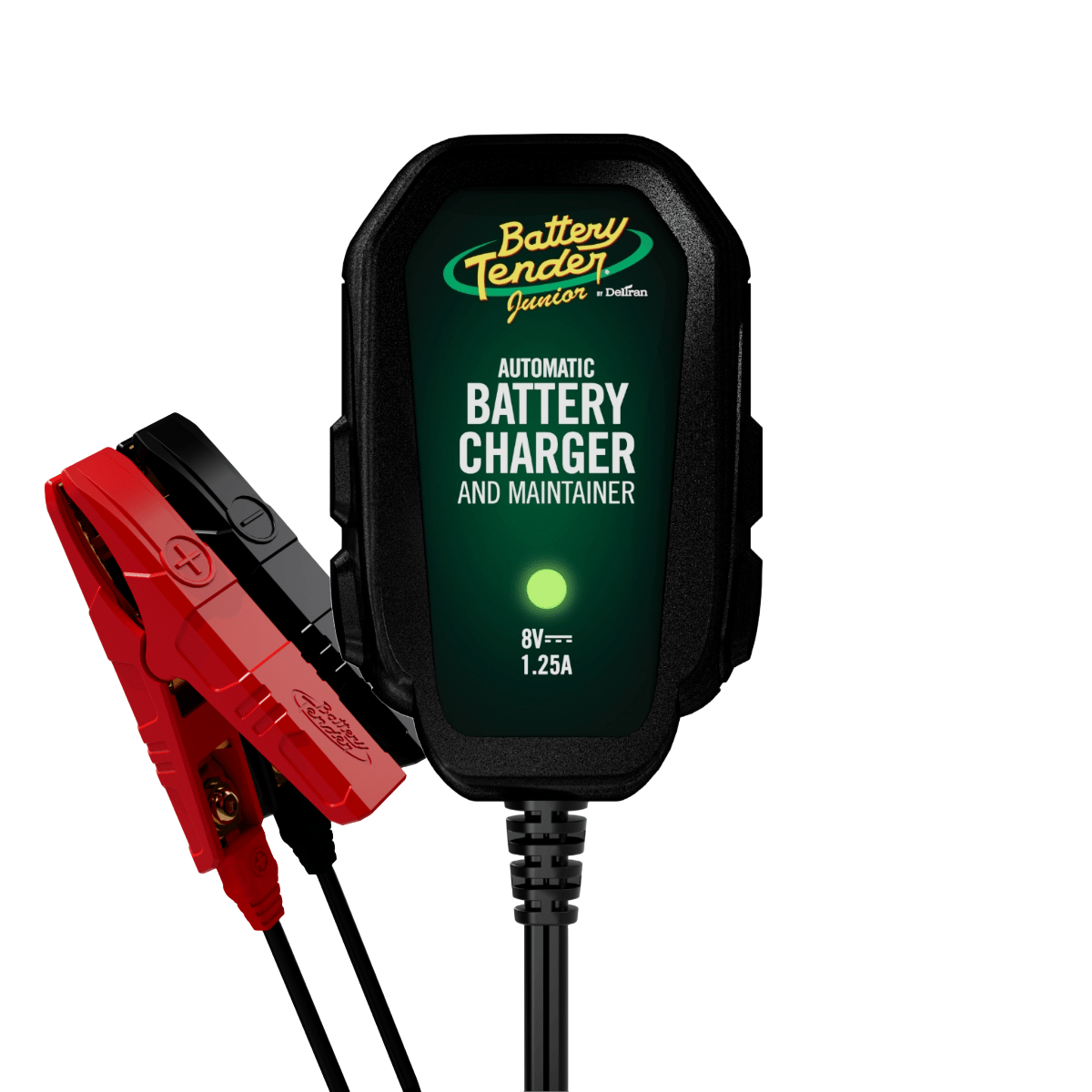
The product image on the exact-SKU page shows the charger face marked “Junior,” 8 V and 1.25 A, while the page title calls it a Plus. Its linked manual is similarly titled for an 8 V Junior and does not identify SKU 022-0197. Voltage and current agree, but the family label and exact manual-to-SKU link do not. The page does identify SKU 022-0197, and this review keeps the product as an observed model while making that source discrepancy clear. Check the exact label and instructions supplied with any specific unit; do not assume that a retailer's Plus name alone settles the edition.
Confirm the battery arrangement before choosing
A charger with one 8 V output is for a matching 8 V battery. In a series-connected bank, the charger is not supplying 8 V to the entire 48 V string. Battery Tender's product page discusses maintaining individual 8 V golf-cart batteries, but the cart manufacturer's instructions still determine how the battery should be isolated or serviced. A finder choice of 12 V will correctly exclude this unit. The public questionnaire does not offer an 8 V option, so the 022-0197 can appear only when the voltage filter is left open. A no-preference result is not confirmation that an 8 V charger fits a typical 12 V car.
At 1.25 A this is a modest-current unit, not an efficient way to quickly restore a large traction battery. Whether that current is acceptable depends on the battery maker's charging instructions and the battery's state. Do not translate the model's current into an assumed charge time or infer a safe rate from the fact that it can maintain a battery after charging.
The published Ah range is internally inconsistent
The main compatibility copy on the 022-0197 page says 14–80 Ah. A later FAQ instead says approximately 10–150 Ah, then describes common golf-cart batteries as 150–200 Ah. The linked manual does not establish a battery-capacity ceiling. Those statements cannot all be used as one reliable sizing rule. The fact record and matcher therefore leave the Ah limit unknown: a search that enters a battery capacity will not treat this model as an established fit by size. That conservative treatment is deliberate, not a claim that the charger is incapable of charging any battery in that range.
If capacity matters, seek clarification for the exact 022-0197 and the relevant battery, and follow the battery maker's allowed current. Do not take the highest number in an FAQ, and do not borrow the range from a 6 V or 12 V model. The page also lists 8 V use and lead-acid types; that does not resolve the Ah conflict.
Lead-acid, float maintenance and dry placement
The exact product page lists flooded, AGM, gel and sealed lead-acid compatibility. The linked instructions say to use the charger for lead-acid batteries only, so this assessment does not assign it lithium or LiFePO₄ capability. They describe an automatic charge sequence and a storage/float-maintenance stage, which is useful for a healthy compatible battery being stored. That function is not proof that a damaged, frozen or deeply discharged battery can be recovered.
The manual's precautions also constrain setup: it says not to expose the charger to rain or snow, never to charge a frozen battery, to keep the area ventilated and to follow the correct polarity and disconnect sequence. It says an in-vehicle connection needs care around moving engine parts and that a boat battery must be removed for charging unless the charger is specifically designed for onboard use. Treat this as an indoor, portable device—not an installed marine charger.
Comparisons and purchase checks
The 022-0196 is the separate fixed 6 V model; the earlier 022-0211 switches between 6 V and 12 V but not 8 V. A 12 V battery should be matched to a documented 12 V plan, such as the fixed Plus 021-0128, not this 8 V unit. The small output and unresolved Ah claim distinguish all these maintainers from higher-current options.
Before ordering, confirm the model is SKU 022-0197, inspect the charger label for 8 V and 1.25 A, verify that the battery itself is an 8 V lead-acid battery, and make sure the exact supplied leads reach safely. The product page lists a clip/ring-terminal lead; check the retailer's package. Request the current manual for that SKU and obtain the maker's capacity clarification if the Ah rating affects your decision. The available source page is not a substitute for a specific seller's contents or present stock.
Key specifications
Key details at a glance
| Output battery voltages | 8 V |
|---|---|
| Supported chemistries | Lead-acid |
| Rated DC charging current | 1.25 A |
| Maintenance claim | No |
| Independent battery outputs | 1 |
| Arrangement | Portable plug-in charger |
| Included connection | The exact-SKU page lists a two-in-one alligator-clip and ring-terminal lead; verify the exact retail package and lead set. |
Use the exact model’s instructions for operating limits, supplied equipment and version differences.
Sources for this review
Sources for this assessment
Keep the next step evidence-led
Use the finder to combine voltage, battery chemistry, charging job and setup requirements; then check the exact model and its manual.