
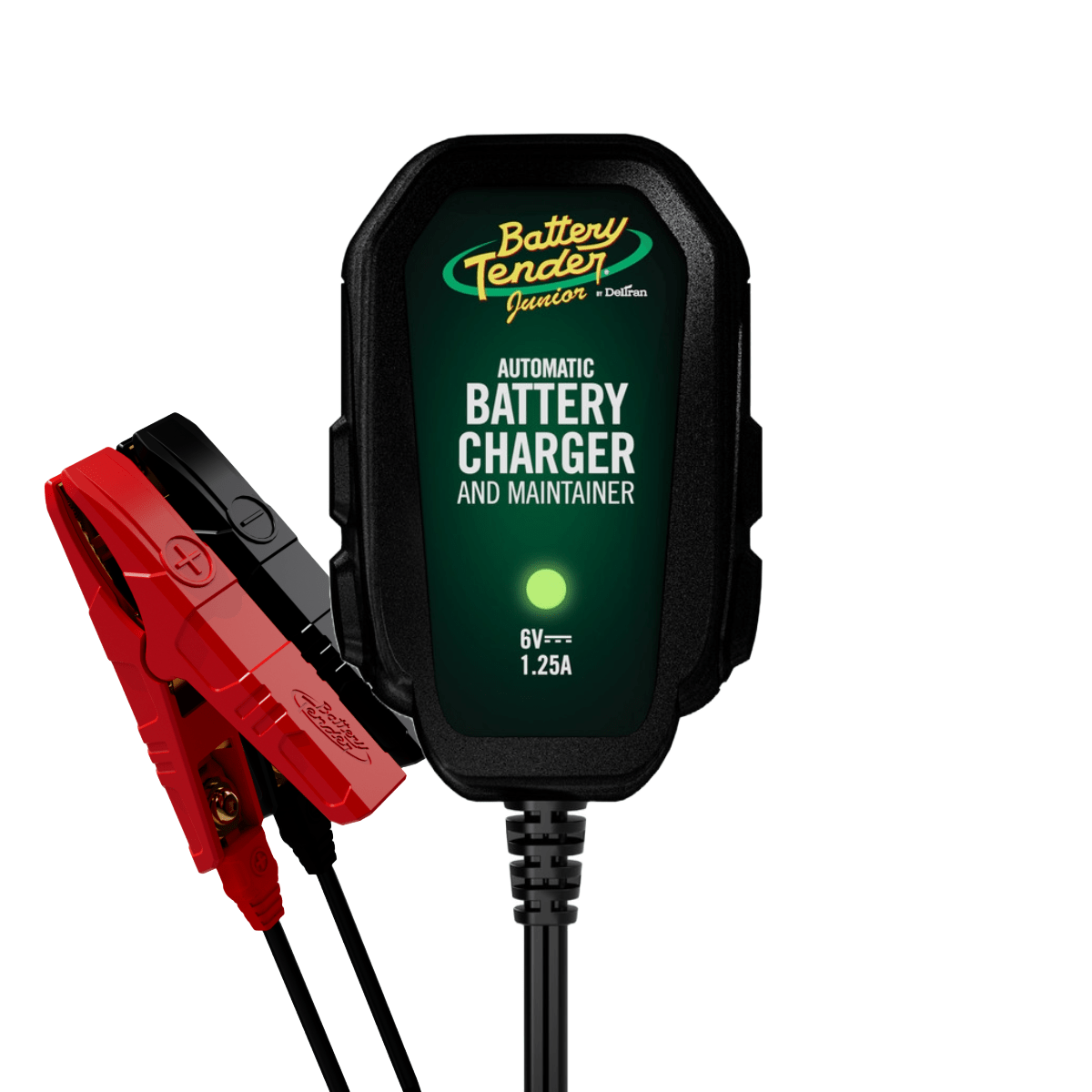
Your needs, this model
Does it fit your priorities?
Is the Plus 022-0196 suitable for a 6 V AGM battery?
Battery Tender's exact-SKU page lists a fixed 6 V, 1.25 A output and AGM among the listed lead-acid types. The linked 6 V manual supports lead-acid charging and float maintenance, but it is titled for a Junior and does not identify SKU 022-0196. Confirm the model label and use the battery maker's charging-rate instructions.
Explore this need in the finder →Can the 022-0196 be matched to an 80 Ah or 100 Ah battery?
Not confidently by capacity from the available manufacturer page. Its main description says 14–80 Ah, while the FAQ says approximately 14–100 Ah; the linked manual provides no Ah limit. The matcher therefore treats the capacity ceiling as unknown, and the battery maker's instructions plus written manufacturer clarification should govern.
Explore this need in the finder →Can this fixed 6 V charger maintain a charged 6 V flooded battery?
The product page lists flooded lead-acid batteries and the linked manual describes automatic transition to a storage/float-maintenance mode. Its safety instructions still require the correct nominal voltage, ventilation, careful connections and a dry location; maintenance mode is not a repair for a defective battery.
Explore this need in the finder →What SKU 022-0196 actually offers
The Battery Tender Plus 022-0196 is the fixed 6 V member of this small-output family. Battery Tender's exact-SKU product page lists a 6 V, 1.25 A charger, a 120 V AC input and one set of battery leads. That is a narrow but real job: charge or maintain one 6 V lead-acid battery when its own maker permits the charger's modest rate. It is not a 12 V car-battery charger merely because it carries the Plus name. Check the battery label and vehicle documentation before connecting it.
There is a meaningful naming wrinkle. The page title calls SKU 022-0196 a Plus, while its linked manual is titled for a “High Efficiency BT Junior 6V 1.25A” and does not identify this SKU. The official product image displayed with the exact 022-0196 page shows the charger face marked Junior, 6 V and 1.25 A. Those page, image and manual details agree on the voltage and current but not on the family name or exact manual-to-SKU bridge. This assessment preserves that discrepancy rather than treating the generic Junior manual as a serial-specific document. Before purchase or use, verify the exact unit label, included manual and connector package for SKU 022-0196.
Where a 6 V charger makes sense
Some older cars and equipment use a 6 V electrical system, while most contemporary passenger cars are 12 V. Battery Tender describes this model for 6 V batteries; the manuals for its chargers warn that the battery voltage must match the charger output. That makes voltage identification the first gate, not vehicle age, brand or the “classic car” label. If the car has been converted, its present battery and charging system—not its original year—control the choice.
At 1.25 A, the 022-0196 is better understood as a low-current charger and storage maintainer than a quick recovery tool. The exact page describes automatic charging and float maintenance, and the linked 6 V instructions explain an automatic transition into storage/maintenance mode after charging. Charge time will depend on starting state, battery condition and its allowed rate; the listed current is not a promise of a particular recovery time. If a battery maker calls for a higher rate or the battery needs a rapid return to service, look for a genuinely higher-output 6 V model rather than assuming this small unit can do the same job.
Capacity claims do not agree
Battery Tender's 022-0196 page gives 14–80 Ah in the main compatibility description, but an FAQ on that same page says approximately 14–100 Ah. The linked manual supplies no corresponding capacity range and does not name the SKU. That is too large a difference to smooth over with an average or to borrow from a nearby 12 V model. The authored matcher therefore does not treat any Ah ceiling as established for this SKU; a capacity-filtered search will not include it. Ask the manufacturer to reconcile the specific edition and check the battery's own charge-rate requirements before using it for a large battery.
This is also why its result should not be read as an unconditional “fits” badge. A broad 6 V or AGM result can show a product plan while leaving the exact battery capacity unknown. If your battery's amp-hour rating is material, do not rely on the higher of the product page's two statements. Confirm the exact manual for the device in hand.
Lead-acid only, with ordinary connection precautions
The exact page lists flooded, AGM, gel and sealed lead-acid types. Its linked manual says the charger is for lead-acid batteries only; there is no documented lithium mode. Do not substitute a lithium profile based on another Battery Tender model or a shared product-family name. The manual also says not to expose the charger to rain or snow, never to charge a frozen battery, and to keep the charging area ventilated. It gives polarity and vehicle-connection instructions, including keeping cables clear of moving engine parts. Those steps matter for a small maintainer just as much as for a larger charger.
The page lists a two-in-one clip and ring-terminal lead. Verify that the actual package includes the connector you need, that it reaches safely from the outlet, and that the battery maker permits the charging current. Do not assume the product image proves the included accessory set.
How it differs from nearby Plus models
The 022-0196 is fixed at 6 V. The already reviewed Plus 021-0128 is a fixed 12 V 1.25 A charger, so the two are not interchangeable. The distinct Plus 022-0197 is fixed at 8 V, while the earlier selectable 022-0211 offers a manual 6/12 V switch and the same nominal 1.25 A rating. Selection adds flexibility but also makes correct switch position essential; it does not create separate simultaneous outputs.
Choose the 022-0196 only when the battery is confirmed as 6 V, lead-acid and compatible with a 1.25 A rate, and only after resolving the capacity/manual discrepancy for the exact item. For a 12 V system, compare a 12 V model; for an 8 V battery, use an 8 V-specific assessment. Check the SKU and current instructions rather than treating these similarly named chargers as variants with interchangeable settings.
Key specifications
Key details at a glance
| Output battery voltages | 6 V |
|---|---|
| Supported chemistries | Lead-acid |
| Rated DC charging current | 1.25 A |
| Maintenance claim | No |
| Independent battery outputs | 1 |
| Arrangement | Portable plug-in charger |
| Included connection | The exact-SKU page lists a two-in-one alligator-clip and ring-terminal lead; verify the exact retail package and lead set. |
Use the exact model’s instructions for operating limits, supplied equipment and version differences.
Sources for this review
Sources for this assessment
Keep the next step evidence-led
Use the finder to combine voltage, battery chemistry, charging job and setup requirements; then check the exact model and its manual.