
Your needs, this model
Does it fit your priorities?
Can the SP1297 charge a 12 V LiFePO₄ battery?
Yes, the exact manual says it is for 12 V lead-acid or LiFePO₄ batteries and has a separate lithium selection. It does not say whether the battery must have a built-in BMS, so check the battery maker’s instructions rather than assuming either condition.
Explore this need in the finder →Is the SP1297 suitable for maintaining an already charged 12 V car battery?
Schumacher says the SP1297 changes to maintain mode after charging completes and can maintain small and large 12 V batteries. The manual calls for occasional monitoring and says to remove loads or investigate a weak battery if the charger has to provide maximum maintenance current continuously for 12 hours.
Explore this need in the finder →Should I use the SP1297 to recover a large, deeply depleted battery?
No. At 3 A, Schumacher’s manual lists larger car/truck and marine/deep-cycle examples as maintain-only and explicitly does not recommend charging a large depleted battery with this unit. The manual’s CCA and reserve-capacity figures are not Ah ratings; choose a higher-current charger using the battery maker’s approved limits.
Explore this need in the finder →Can the SP1297 stay outside while maintaining a battery?
No outdoor placement is documented. The manual says not to expose it to rain or snow, calls for a dry non-flammable location, and says to store it indoors in a cool, dry place. The exact page lists no IP rating.
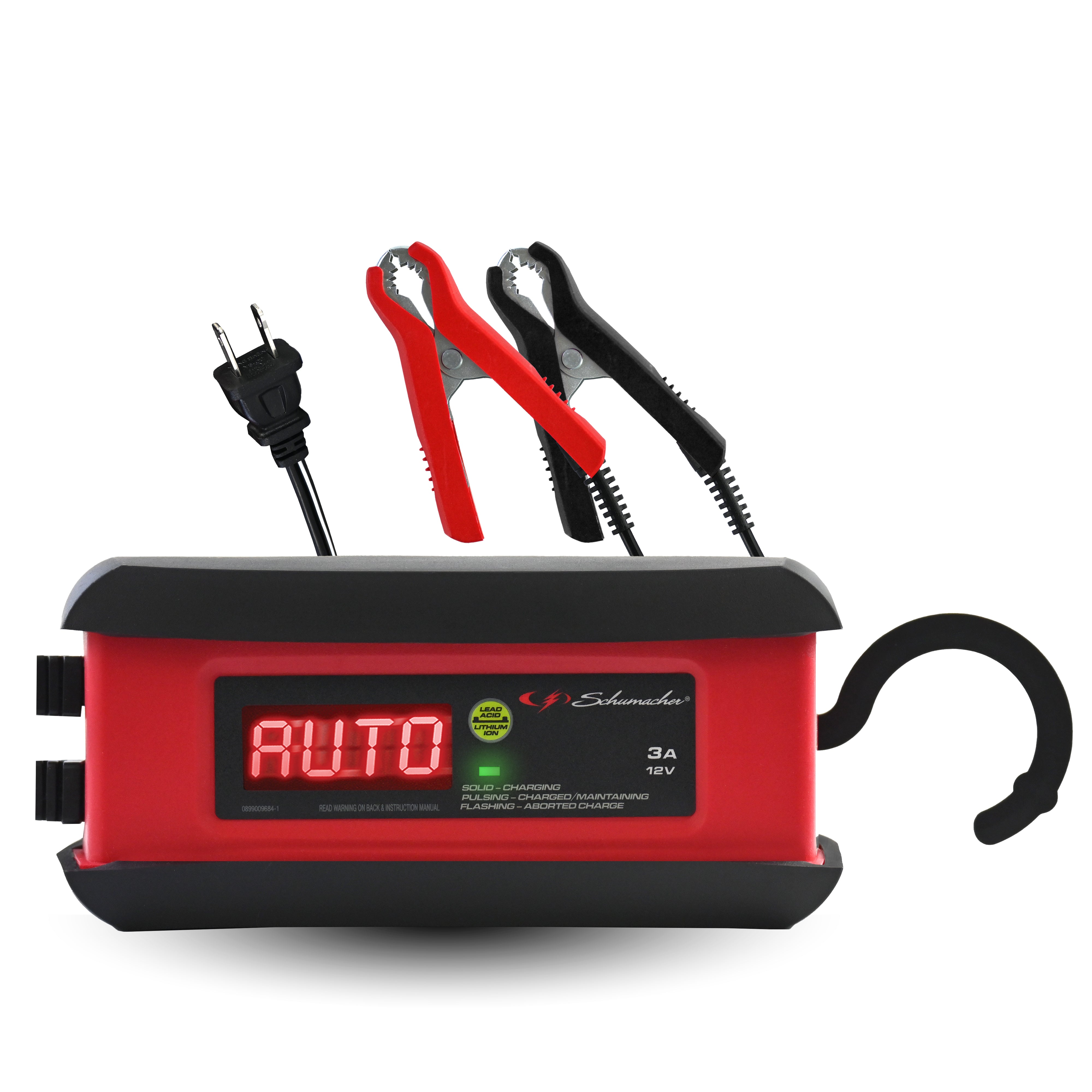
Explore this need in the finder →The Schumacher SP1297 is a portable, single-output 12 V charger/maintainer rated at 3 A. The current manufacturer page and its linked owner’s manual describe a compact AC-powered unit with automatic charging, selectable lead-acid or LiFePO₄ mode, and maintenance after a battery reaches full charge. This is a source-based assessment, not a hands-on test.
A modest 3 A role, not a fast recovery tool
Schumacher’s manual is unusually helpful about where a 3 A charger fits. Its time table lists charging examples for small batteries from 6–12 Ah and 12–32 Ah. For car and truck batteries, it changes to cold-cranking-amp and reserve-capacity bands; the largest listed band is marked “maintain only.” The manual similarly marks several larger marine/deep-cycle examples as “maintain only,” and expressly advises against charging a large, not-fully-charged battery with this unit because some battery capacity could be lost.
That means the SP1297 should not be chosen for a quick recovery of a large, deeply discharged starter or deep-cycle battery. A 3 A rating alone does not reveal a universal Ah limit, and the manual’s CCA and reserve-capacity figures cannot be converted into amp-hours without outside assumptions. Its supported capacity field therefore remains unresolved rather than turning the small-battery time examples into a blanket ceiling. Read the actual battery’s recommended rate and condition before charging.
Lead-acid and LiFePO₄ have separate selections
The current exact-model page names standard, AGM, gel and LiFePO₄ batteries, while the linked manual identifies the supported chemistries more broadly as 12 V lead-acid or LiFePO₄ and provides a battery-type button to select between those two modes. Schumacher describes a microprocessor that adjusts the amperage during charging and a float-monitoring mode after full charge. It is not a 6 V or 24 V model, and the manual says it is not intended to act as a general-purpose low-voltage power supply.
The charger’s lithium feature is specific to LiFePO₄; it is not evidence that every lithium chemistry is supported. The manual does not say whether a LiFePO₄ battery must have a built-in battery management system. Check the battery maker’s instructions for the exact battery, including BMS requirements and charging limits, before using the lithium mode. An unknown BMS condition should not be read as either “required” or “not required.”
Maintenance works best with an occasional check
After automatic charging completes, the unit switches to maintain mode and the manual says it can maintain both small and large 12 V batteries. That makes it more useful for a fully charged vehicle battery sitting between uses than its low charging current might suggest. However, Schumacher still calls for occasional monitoring. If the charger supplies its maximum maintenance current continuously for 12 hours, it aborts; the manual tells the owner to check for a battery drain or a battery problem rather than treating that cutoff as routine, unattended operation.
For a large battery that is already full, maintenance is a different task from restoring a depleted battery. Keep those jobs separate when comparing options: a product can be suitable to maintain a charged battery and still be a poor choice for recharging that same battery from a low state. This distinction is especially important for larger car, truck and marine batteries, where Schumacher’s manual uses “maintain only” for some size bands.
Plan the connection and a dry location
The exact current product page lists a clamp quick-connect and a ring-terminal lead; the linked manual describes both assemblies. The ring connection can remain attached to a battery for easier later hookup, but its placement must still follow the vehicle and battery instructions. The manufacturer page describes a 6-foot AC cord and 5-foot output leads, while its specifications separately list 5.17 feet of cable reach. The manual does not give a lead length. Measure the route from a grounded outlet and check the actual package rather than relying on a single reach figure.
The manual calls for a grounded 120 V AC receptacle, a dry non-flammable surface and clear cable routing away from moving engine parts. It says not to expose the charger to rain or snow, and to store it indoors in a cool, dry place. The page lists no IP rating, so neither the hook nor the product photo suggests outdoor weather protection. For a marine battery, the manual says to remove it and charge on shore; onboard use requires equipment designed for that installation.
How it differs from nearby choices
The CHARGE IT! 4502 is another low-current compact charger, but its documented lead-acid configuration adds selectable 6 V operation and does not offer the SP1297’s LiFePO₄ mode. The Schumacher SP1297 stays at 12 V, offers the separate lithium selection, and provides 3 A rather than the 4502’s 2.5 A 12 V rate. That difference is useful only if the battery chemistry and voltage actually match; neither current number overrides the battery maker’s safe-rate guidance.
Who should shortlist it?
Consider the SP1297 for one 12 V battery when its lead-acid or LiFePO₄ mode is appropriate, 3 A is suitable for the battery’s condition, and a grounded indoor outlet is available. Its automatic changeover to maintenance can suit a fully charged battery stored between drives, provided the setup is checked from time to time. Skip it for a 6 V or 24 V battery, rapid charging of a large depleted battery, wet outdoor placement, multi-bank work, or a lithium setup whose BMS instructions are unknown.
Before buying, confirm the exact SP1297 model, the supplied clamp and ring leads, the outlet-to-battery route and the battery manufacturer’s charging instructions. Review the official Schumacher SP1297 product page and its linked owner’s manual for the final setup details.
Key specifications
Key details at a glance
| Output battery voltages | 12 V |
|---|---|
| Supported chemistries | Lead-acid / LiFePO4 |
| Rated DC charging current | 3 A |
| Independent battery outputs | 1 |
| Arrangement | Portable plug-in charger |
| Included connection | The current exact product page lists one battery-clamp quick-connect and one ring-terminal quick-connect; the linked manual identifies those two assemblies as the available output leads. Verify the exact seller package and connector condition. |
Use the exact model’s instructions for operating limits, supplied equipment and version differences.
Sources for this review
Sources for this assessment

Keep the next step evidence-led
Use the finder to combine voltage, battery chemistry, charging job and setup requirements; then check the exact model and its manual.