
Your needs, this model
Does it fit your priorities?
Does the SC1667 offer regular 6 V charging?
Its associated control image identifies 6 V / 25 A as Boost, not Charge. The exact page identifies ordinary Charge at 12 V / 10 A only, so do not treat the boost selector as a conventional 6 V charging or maintaining mode.
Explore this need in the finder →Can the SC1667 maintain an already-full battery?
No automatic float or post-charge maintenance mode is documented. Its 135-minute manual timer is not a set-and-forget maintenance feature.
Explore this need in the finder →Is the SC1667 documented for lithium iron phosphate?
No. The exact current page lists standard, AGM and gel battery compatibility, not lithium. No LiFePO4 mode or BMS condition is verified, so this model is excluded from lithium matching.
Explore this need in the finder →Schumacher’s current U.S. catalogue identifies SC1667 as a 6 V/12 V manual timer-controlled charger and engine starter. The exact product page and its associated image show a single portable AC-powered unit with a charge-rate selector, timer and clamp leads. This assessment is based on those manufacturer records and the page-linked PDF, not hands-on use. The first distinction matters: the page identifies a 10 A 12 V Charge setting, while its other published outputs are Boost or Engine Start modes—not interchangeable charging-current ratings.
Separate the 12 V charge setting from boost and engine start
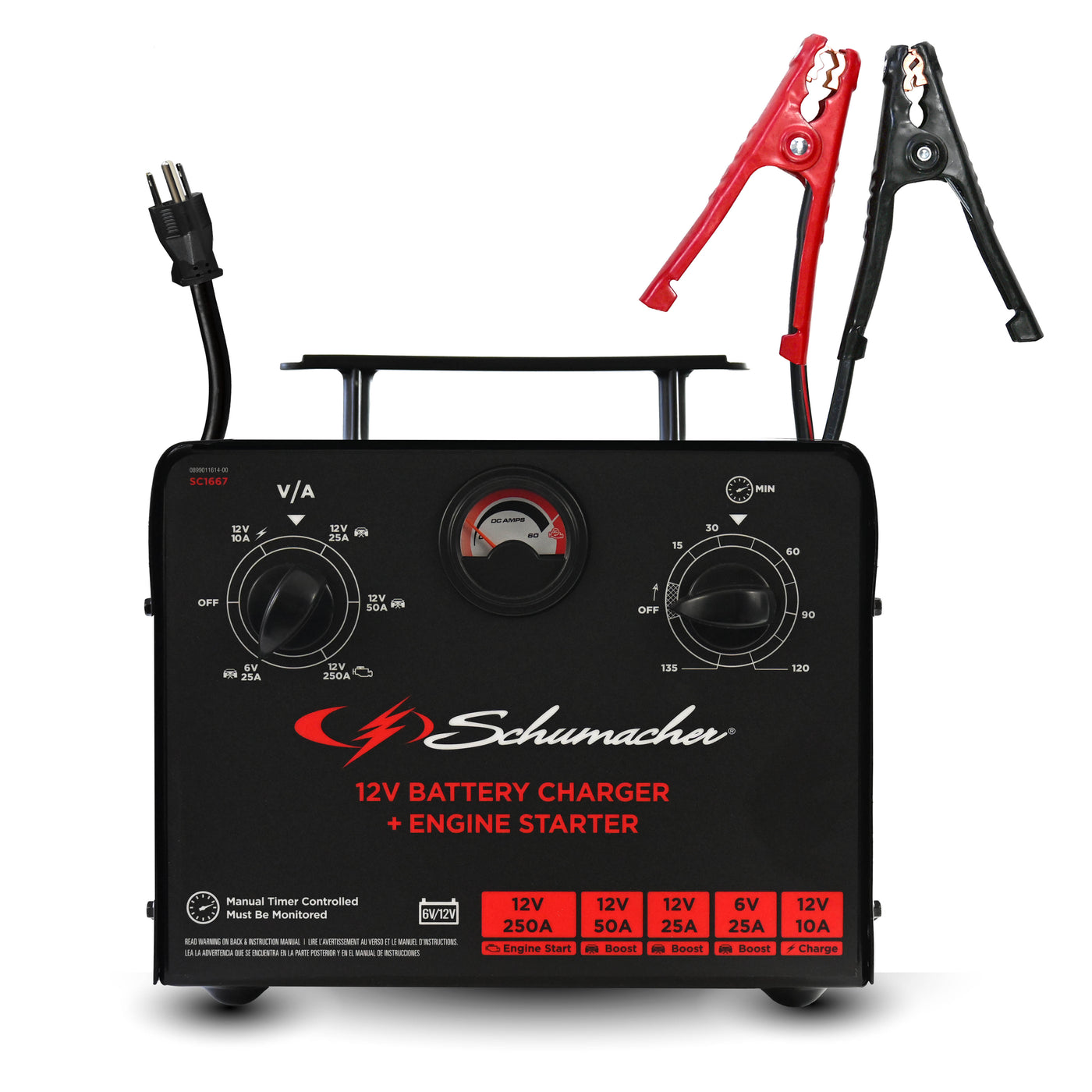
Schumacher’s page describes one 10 A 12 V Charge mode, three Boost choices (25 A at 6 V, 25 A at 12 V, and 50 A at 12 V), and a separate 250 A 12 V Engine Start selection. The exact page-associated product image labels these same selector settings. Treat each as a different job: the manufacturer describes Boost as adding energy before engine starting, and Engine Start as extra cranking current. Neither the 25/50 A boost numbers nor the 250 A start rating establishes the current available in the ordinary Charge mode. For a current-screen comparison, the clearly identified regular setting is 10 A at 12 V.
The image and page do not identify a regular 6 V Charge setting; the pictured 6 V selector position is 25 A Boost. That may be relevant when the intended task is the manufacturer-described pre-start boost, but it is not evidence of a 6 V float charger or routine low-rate maintainer. The product page’s summary also says “output current: 10/25/50/250 A” without assigning every number to a voltage and function, so the selector labels and descriptive mode text are the more useful context. This review does not turn the 6 V Boost rating into a numeric ordinary-charge-current match.
A manual timer calls for attention, not unattended maintenance
The page gives a 135-minute timer and calls the operation manual. The product image’s timer dial is marked through 135 minutes. This is a timed, manually selected charger—not an automatic maintainer that can be left connected to preserve a full battery indefinitely. The page does not document an automatic float or post-charge maintenance mode. The linked PDF likewise warns that manual operation must be monitored and says the timer stops charging when its selected interval expires. Owners need to follow the battery maker’s charging instructions, make a suitable time selection and check the charger and battery; the timed feature is not a substitute for observing an active charge.
There is a notable document limitation: the exact product page links manual 0099002475-R0, but the archived PDF cover lists models 105-20 and 105-21 rather than SC1667. It contains generic selector and rate-chart language—including a 2 A setting—that does not reconcile with SC1667’s exact page and image, which show 10 A Charge and the three specified Boost settings. I therefore do not transfer the PDF’s generic rates, charge-time table or capacity examples to SC1667. Before relying on detailed wiring or operating procedures, confirm that the manual supplied with the actual unit is the correct SC1667 revision.
Lead-acid only; do not infer lithium or every subtype
The exact product page states compatibility with standard, AGM and gel batteries. It does not list lithium or a LiFePO₄ mode, and the page-linked manual is not identified on its cover as an SC1667 manual. This assessment therefore matches only lead-acid use. AGM and gel are explicitly named subtypes; “standard” is not silently converted into a claim for flooded, EFB, maintenance-free or calcium batteries. Schumacher’s product page is the basis for the stated chemistry compatibility, but the exact battery maker’s instructions still govern the charge rate and selection. Do not use the 6 V or 12 V labels alone to assume the charger suits a lithium battery.
No exact SC1667-specific universal Ah charging range is established by the reviewed page and linked document. Because the manual’s model identity and rate chart do not bridge cleanly to the product’s current published settings, its generic charge-time examples are not treated as SC1667 capacity limits. The finder does not match a requested Ah value to this model. Check the battery’s rated capacity and permitted charge rate with its manufacturer before choosing any manual Charge or Boost setting.
Plan for a grounded outlet and a dry location
The manufacturer page lists 120 V AC input, 10 A continuous and 50 A intermittent input current, a six-foot power cord, 8.75-foot booster-cable reach, one year of limited warranty coverage, and no IP rating. These are maker-listed values, not measurements of a delivered item. The page’s current specification block and its official search-view excerpt disagree on the unit’s weight and body dimensions, so those figures are omitted rather than chosen arbitrarily. The associated photo shows an AC plug, red and black clamps, a handle and the SC1667 face labels; it does not independently establish carton contents, dimensions, weight or performance.
The page-linked PDF calls for a nominal 120 V grounded receptacle, says not to expose the charger to rain or snow and directs that a marine battery be removed and charged ashore unless purpose-designed onboard equipment is used. Because the linked PDF cover does not identify SC1667, use these as safety cautions from the document supplied through the product page—not a substitute for a confirmed model-specific owner’s manual. Keep the connection dry, follow the actual battery and vehicle procedures, and do not treat this portable mains charger as an onboard marine installation.
Check the exact manual and the task before buying
SC1667 is a distinct exact-model listing; Schumacher’s catalogue also lists FR01666 as a separate manual variant, so do not substitute the similar-looking name or a search result for the requested configuration. The present product page supports a 12 V lead-acid AGM or gel charge at the stated 10 A setting, while the 6 V selector is identified as Boost. If the need is routine 6 V charging, automatic maintenance, lithium charging, a multi-bank installation or unattended storage care, this is not a documented fit.
Before ordering, confirm that the seller’s box is labelled SC1667 and includes an owner’s manual that actually covers that model; verify the battery voltage, chemistry and manufacturer-permitted charging rate; and plan to monitor the manual timer. Confirm a properly grounded 120 V outlet and a dry charging location. The manufacturer page’s warranty statement does not establish the seller’s return terms or the condition of a particular offer. This is a source-based capability assessment, not a test report or a promise of charging speed.
Key specifications
Key details at a glance
| Output battery voltages | 6 / 12 V |
|---|---|
| Supported chemistries | Lead-acid |
| Rated DC charging current | 10 A |
| Maintenance claim | No |
| Independent battery outputs | 1 |
| Arrangement | Portable plug-in charger |
| Included connection | Single red/black clamp leads shown in the page-associated image; verify package contents and lead condition with the seller. |
Use the exact model’s instructions for operating limits, supplied equipment and version differences.
Sources for this review
Sources for this assessment
- Schumacher Electric dated U.S. Battery Chargers collection snapshot
- Schumacher Electric SC1667 current U.S. product page
- PDF linked from SC1667 page, manual label 0099002475-R0
- Official Schumacher search-view excerpt for the SC1667 product page
- Official image associated with the current SC1667 product page

Keep the next step evidence-led
Use the finder to combine voltage, battery chemistry, charging job and setup requirements; then check the exact model and its manual.