
Your needs, this model
Does it fit your priorities?
Can the SC1644 charge two 12 V AGM batteries through separate installed leads?
The exact SC1644 page and image show two banks, while the linked manual says multi-bank units charge one bank at a time for 15 minutes per bank. The manual names AGM and 12 V use and transitions a fully charged battery to Maintain mode. The 15 A output is not delivered to both batteries simultaneously, and there is no stated universal Ah limit.
Explore this need in the finder →Does its LiFePO₄ mode document a built-in BMS requirement?
The current exact page names LiFePO₄ and the manual has a LITH mode, so the basic lithium chemistry choice is documented. Neither source states whether a built-in BMS is required; a required-BMS or no-BMS finder choice therefore does not count as a known match. Confirm the battery and charger instructions together before use.
Explore this need in the finder →Is the SC1644 a portable 6 V/12 V charger with a known amp-hour ceiling?
No. The product page identifies a 12 V on-board charger, not a 6 V or portable model, and its manual specifies two sequential battery banks. Neither page nor manual gives a universal Ah charging ceiling, so a numeric capacity request is not inferred from its 15 A output.
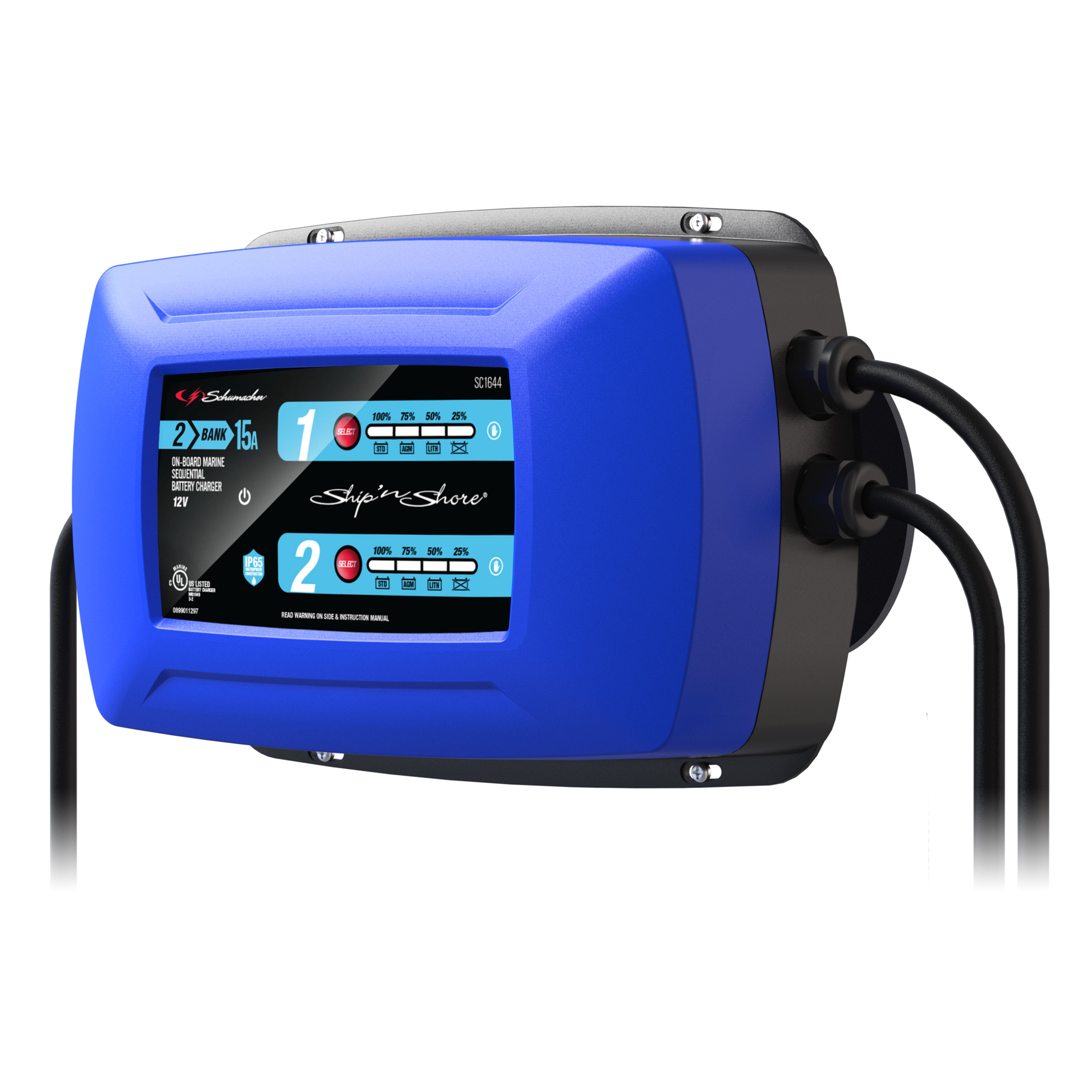
Explore this need in the finder →The Schumacher SC1644 is a fixed-installation, 12 V charger with two battery banks and a sequential charging routine. It is a different kind of choice from the portable clamp chargers elsewhere in this library: install it where both battery leads can reach, connect it to a grounded AC supply, and leave room for airflow. The maker’s exact searchable listing calls it a car-battery charger for automotive and marine use, but the current product-page headline and long description emphasize its Ship ’n Shore marine role. The assessment keeps that discrepancy visible rather than implying it is a portable garage charger.
Two banks, one active charging interval
Schumacher describes the SC1644 as a two-bank, 15 A sequential charger. Its linked manual says multi-bank units service one bank at a time, spending 15 minutes on each before returning to the previous battery. The rated 15 A output is therefore not a promise to deliver 15 A to both batteries simultaneously. The product image shows two separate status and selection controls, and the manual describes selecting battery type for a bank. For a pair of batteries, check the exact wiring and chemistry instructions for each one; do not assume the name “two-bank” means two independent 15 A power supplies.
This is most useful when a fixed vehicle, boat or similar installation has two 12 V batteries that need periodic charging and maintenance. It is not the right form factor for a driver who wants to move one lightweight charger between vehicles. The page says the unit can be mounted vertically or horizontally, while its manual provides flat and wall-mounted orientations and calls for open airflow. Check the clearance at the real installation site before choosing it.
12 V only, with AGM and LiFePO₄ modes
The current page identifies 12 V output and lists standard, AGM, deep-cycle and LiFePO₄ battery use. The linked manual offers STD, AGM and LITH selections, and tells the reader to consult the battery maker when deciding which type to use for a deep-cycle battery. That evidence supports an AGM lead-acid plan and a LiFePO₄ plan. It does not let us map “STD” to every narrower finder subtype, such as flooded, EFB, gel, maintenance-free or calcium.
For lithium, the page names LiFePO₄ and the manual’s LITH setting confirms a lithium mode, but neither source states whether the battery must have a built-in BMS. An open BMS question can leave that requirement out of the shortlist; a required-BMS or no-BMS choice is not a documented match. Check the charger and battery instructions together before use. No 6 V or 24 V battery arrangement is shown for this model.
Charging and maintenance, not a published Ah range
The official product page and manual specify a 15 A, 12 V output. The manual says a battery reaches Maintain mode when charging is complete, then receives a small current when needed. It does not state one universal amp-hour charging ceiling, a separate maintenance-current figure or an all-size maintenance claim. A 15 A rating alone does not tell you whether a particular battery’s capacity or permitted charge rate is suitable. Check the battery label and manufacturer’s charging guidance; when the Ah screen is used, the finder will not treat this model’s missing capacity limit as a match.
For two batteries, sequential operation affects elapsed time: each selected bank receives an alternating 15-minute charging window, rather than both being charged at once. The manufacturer does not give a single time-to-full promise for every bank, battery condition or installation. Treat the output rating as a capability boundary, not an estimate of when a particular pair will be ready.
Installation and connection checks
The manufacturer lists a 120 V AC input and 12 V DC output. The manual specifies nominal 120 V AC, 60 Hz, 3.7 A, with a properly grounded outlet. Its connection instructions use ring terminals on the battery posts, and the product page lists six-foot power and output cables with fused outputs. Measure the actual path from the proposed mounting point to both batteries and the AC outlet; six feet on a page is not a measured route around compartments, panels or moving parts.
The manual calls for at least four inches of unobstructed clearance on every side, ventilation beneath the unit, and a location away from fuel tanks and below-waterline positions. Its diagrams also warn against drilling into hidden wires or components. This is a permanent installation, not a charger to set on top of a battery. Follow the manual’s polarity and connection sequence, and confirm that the actual package contains the model and leads you expect.
Resolve the weather-language conflict conservatively
The page and the charger face identify IP65, and one manual installation passage calls the charger rainproof and suitable for a weather deck. But the same manual’s safety section says not to expose it to rain or snow. Those statements do not justify an unqualified claim that any outdoor mounting location is acceptable. Confirm the current model’s permitted exposure with Schumacher and use the complete instructions for the exact unit rather than inferring safe wet use from an IP label alone.
How it differs from a portable charger
Compared with a single-output portable charger, the SC1644’s appeal is its installed dual-bank wiring and automatic maintenance after charging. The tradeoff is a fixed location, AC wiring, two-bank sequencing and no published Ah ceiling. Its 4.4 lb weight and listed 11.78-inch width and 7.17-inch height give a starting point for a fit check, but the manual’s four-inch airflow clearance matters too. Compare it with portable models only when the install requirement is genuinely open; a portable charger is not a substitute for a properly wired on-board layout, and an on-board unit is not a convenient clip-on maintainer.
Bottom line
The SC1644 is worth considering for a fixed 12 V application needing two leads, AGM or LiFePO₄ mode, 15 A output and automatic post-charge maintenance. It does not offer the documented voltage range or portability of many garage chargers. The 15 A is shared through alternating bank intervals, the lithium BMS condition and universal capacity limit remain unknown, and the manual conflicts about weather exposure. Before buying, verify exact SC1644 identity, battery chemistry and rate, grounded power, cable reach, airflow clearance and the current exposure instructions. This is a source-based assessment of published documentation, not a hands-on installation or charging test.
Key specifications
Key details at a glance
| Output battery voltages | 12 V |
|---|---|
| Supported chemistries | Lead-acid / Lithium-ion |
| Rated DC charging current | 15 A |
| Independent battery outputs | 2 |
| Arrangement | On-board charger |
| Ingress rating | IP65 |
| Included connection | The official page lists a 6-foot AC power cord and 6-foot output cables; manual wiring diagrams describe ring terminals and inline fuses. Verify the exact package and that the fixed mounting location lets the leads reach without strain. |
Use the exact model’s instructions for operating limits, supplied equipment and version differences.
Sources for this review
Sources for this assessment
- Schumacher Electric current official SC1644 product page
- Schumacher Electric exact SC1644 public product record
- Schumacher Electric product-page-linked On-Board Marine Charger owner’s manual 0099002393-02
- Schumacher Electric dated current U.S. Battery Chargers collection snapshot
- SC1644 exact official product-page image

Keep the next step evidence-led
Use the finder to combine voltage, battery chemistry, charging job and setup requirements; then check the exact model and its manual.