
Your needs, this model
Does it fit your priorities?
Can this charger provide a 6 A charge to a 6 V AGM battery?
The exact SC1564L-titled U.S. page links the family manual that explicitly covers 6 V lead-acid use and an AGM battery-type setting. The manual lists a separate 6/2 A Charge selection; its 30 A Boost and 100 A Engine Start labels are not the normal charging rate. Six amperes is only a listed capability threshold, not a safe-rate recommendation for every battery. Follow the battery maker's instructions and check the actual SC1564L label/manual because the page form and one package field say SC1564.
Explore this need in the finder →What makes the SC1564L's 12 V LiFePO4 plan different from its 6 V lead-acid plans?
The page-linked manual allows 12 V LiFePO4 only when the battery pack includes its own battery-management system and all necessary protection; it does not document 6 V lithium. The 6/2 A setting is Charge, while Boost and Engine Start are separate modes. The manual has no universal Ah ceiling, so selecting the numeric capacity option cannot establish that an unknown battery size is supported. Verify the delivered model and the battery maker's allowed charge rate.
Explore this need in the finder →Can the SC1564L stay on a charged 12 V AGM battery as a maintainer?
The manual describes automatic post-charge Maintain for 6 V and 12 V batteries and a small current when needed, but gives no fixed float-current amount. It calls for occasional monitoring and says the charger aborts if its maximum maintain current is required continuously for 12 hours. Do not confuse this maintenance behavior with a universal depleted-battery Ah charging limit, and do not assume the manual provides a separate LiFePO4 maintenance plan.
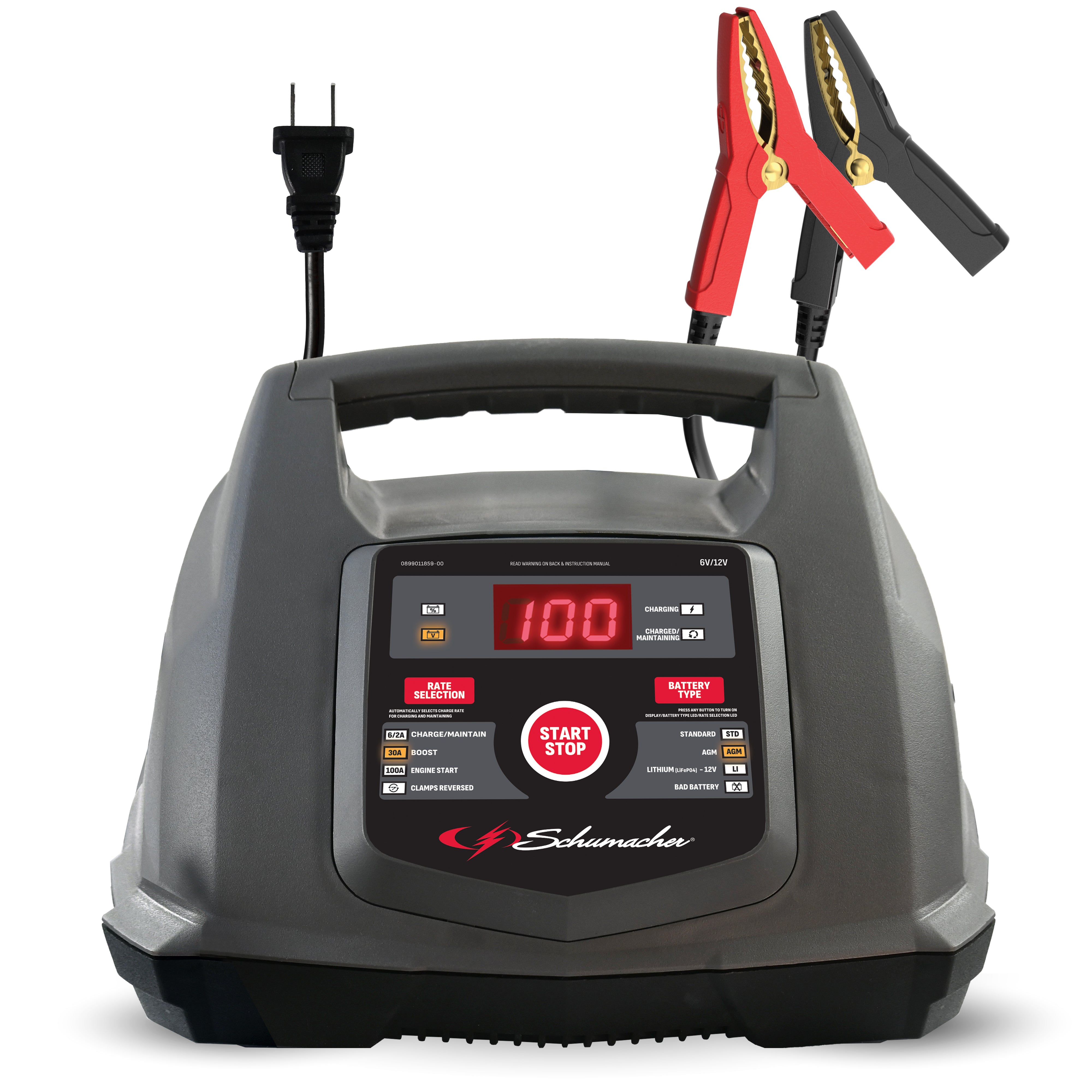
Explore this need in the finder →The Schumacher SC1564L reads like a small garage service station: it combines ordinary charging, automatic maintenance, a battery-voltage display and an alternator-check mode with separate Boost and Engine Start functions. The first buying check is model identity, not an amp number. Schumacher’s observed U.S. battery-charger card and current page title name SC1564L, but the page’s product-form field and one package line say SC1564. Its linked manual names SC1564L alongside SC1281L on the cover, which supports using that manual as a family reference; it does not erase the page conflict or guarantee that an outside seller will ship the exact suffix. This assessment keeps those versions distinct rather than treating the product as an interchangeable SC1564.
Use the 6/2 A Charge label for everyday charging—not the Boost number
The linked manual separates its 6/2 A Charge selection from Boost and Engine Start. Schumacher’s page lists a 12–30 A Boost range and 100 A Engine Start, while its output-current field bundles 2, 6, 30 and 100 A without explaining each mode in that field. The manual’s operating directions make the distinction clear: Boost is a separate pre-start function, and Engine Start is brief cranking assistance with cooldown steps. Neither higher figure is a substitute for a 30 A or 100 A ordinary charger. The automatic charge path transitions to maintenance after charging; the exact ordinary-charge capability used in the finder is 6 A, with the lower 2 A setting also documented.
The manual supports charging 6 V and 12 V lead-acid batteries, including its named AGM mode. It also lists Standard/STD and deep-cycle use, but Standard is not mapped here to a specific flooded/wet, EFB, maintenance-free or calcium subtype; deep-cycle describes a use class rather than a distinct chemistry. The web page’s feature copy mentions gel, but the directly linked manual does not establish a Gel selection, so a gel-specific match is not claimed. None of these output ratings is a safe-rate recommendation for an individual battery: compare the battery label and its maker’s charging limit before choosing a rate.
LiFePO₄ is a narrower, 12 V path
The family manual’s lithium instruction is specific: it permits 12 V LiFePO₄ only when the battery pack includes its own battery-management system and all required protection as part of the pack. It does not document 6 V lithium. The page’s broader chemistry marketing should not be read as universal approval for every lithium chemistry, voltage or battery without a BMS. The authored match plan therefore keeps lead-acid and lithium in separate operating arrangements and keeps LiFePO₄ maintenance unclaimed. If your battery lacks a built-in BMS, is a different lithium chemistry or is 6 V, this evidence does not establish a fit.
Maintenance and the built-in checks are useful but limited
After an automatic charge, the manual describes a Maintain state that supplies a small current when needed. It does not give a fixed float-current value. If the charger must deliver its maximum maintenance current continuously for 12 hours, it aborts, and Schumacher says the battery and process still need occasional monitoring. That makes the SC1564L more versatile than a simple manual timer, but not a reason to leave any battery unattended indefinitely. The manual also warns that surface charge can affect a displayed battery-voltage reading. Its alternator test is a screening procedure with an engine running; follow the vehicle maker’s guidance and do not treat a displayed number as a complete diagnosis.
There is no universal Ah charging ceiling in the linked manual. Its table gives selected charge-time examples under stated conditions, not a maximum battery size for the SC1564L. A numeric Ah requirement therefore cannot be used to qualify this model in the finder. That is an unknown limit, not proof that a particular battery cannot be charged; confirm the battery size and permissible rate with Schumacher and the battery maker before relying on it.
One portable, AC-fed output sets the installation boundary
This is a portable charger, not an installed on-board system. The manual requires nominal grounded 120 V AC, adequate ventilation and a dry location; it prohibits rain or snow and says not to charge a frozen battery. A boat battery must be removed and charged ashore. The exact gallery shows one clamp pair, so the page does not document separate simultaneous banks. The maker’s page lists a six-foot power cord and says the booster cables are six feet; its specifications collapse that to a general six-foot cable-reach field, so measure your actual setup and verify the delivered leads rather than treating those listings as our measurements.
The page also lists a 10 lb weight and a 10.57 × 7.12 × 10.87 in body. Those are manufacturer specifications, not independent measurements, and the page’s SC1564/SC1564L form/package conflict makes checking the actual unit especially important. The page lists no IP rating, which aligns with the manual’s dry-use warning rather than an outdoor-weather claim.
Who should shortlist it
The SC1564L is worth considering when you need one portable unit for a documented 6 V or 12 V lead-acid AGM charging task, want automatic post-charge maintenance, and value basic battery/alternator checks. A separate 12 V LiFePO₄ charge plan is documented only with the battery’s integrated BMS and protection. It is not a choice for a 24 V battery, an on-board installation, multiple isolated banks, a guaranteed high-current ordinary charge, a fixed float-current requirement or a specified Ah ceiling. Before ordering, confirm that the seller’s unit is labelled SC1564L rather than relying only on a page title, verify the actual box and manual, check available grounded power and lead reach, and follow the battery manufacturer’s charging instructions. This is document-based product analysis, not hands-on testing or a measured performance claim.
Key specifications
Key details at a glance
| Output battery voltages | 6 / 12 V |
|---|---|
| Supported chemistries | lead_acid / lithium_ion |
| Rated DC charging current | 6 A |
| Independent battery outputs | 1 |
| Arrangement | Portable plug-in charger |
Use the exact model’s instructions for operating limits, supplied equipment and version differences.
Sources for this review
Sources for this assessment
- Frozen Schumacher U.S. battery-chargers collection card naming SC1564L
- Current U.S. Schumacher product page titled SC1564L (browser-rendered text extract)
- Owner manual 0099002293-00 linked by the exact SC1564L page; family cover names SC1281L and SC1564L
- Official SC1564L collection-card gallery image, visually inspected

Keep the next step evidence-led
Use the finder to combine voltage, battery chemistry, charging job and setup requirements; then check the exact model and its manual.