
Your needs, this model
Does it fit your priorities?
Can the SC1446 charge a 12 V AGM battery when the listed 10 A capability is acceptable?
The current exact page names a 10 A 12 V Charge mode and the directly linked manual lists AGM lead-acid use. The charge is manual: select an appropriate timer, monitor the battery and stop when it is full. Ten amperes is a maker-listed capability, not a safe-rate recommendation for every AGM battery; follow the battery maker's instructions. The separate 20/40 A Boost and 200 A Engine Start settings are not routine charge current.
Explore this need in the finder →How should I interpret the SC1446's 6/12 V output label beside its 12 V Charge rating?
No 6 V ordinary Charge current is established by the exact current product page: its documented regular Charge setting is 10 A at 12 V, while the 6 V figure belongs to the separate 20 A Boost description. The page-linked manual requires mode and voltage selection, but its cover identifies a charger family rather than SC1446. Do not convert a 6 V Boost rating into ordinary charging capability; check the delivered label/manual and the battery maker's permitted rate.
Explore this need in the finder →What should I know when choosing the SC1446 for a timed 12 V Gel charge and considering leaving it connected?
Its manual names Gel lead-acid and the product page lists a 10 A 12 V Charge capability, so a supervised timed charge is documented when the battery maker allows it. The manual says to monitor charging and the timer stops the session; no automatic float-maintenance mode or fixed maintenance current is stated. Choose a maintainer instead if the actual need is unattended storage care. The manual's table also marks its small 6–32 Ah categories not recommended at the listed settings.
Explore this need in the finder →This is a source-based assessment of Schumacher Electric’s current U.S. SC1446 page, the owner’s manual linked from that page, and the associated official product image—not a hands-on test. The SC1446 is a wheeled, plug-in manual charger with one output. It is most relevant when the user wants to control and monitor a timed 12 V lead-acid charging session; it is not an automatic storage maintainer or a cordless jump starter.
The exact page identifies the SC1446; its manual is family-coded
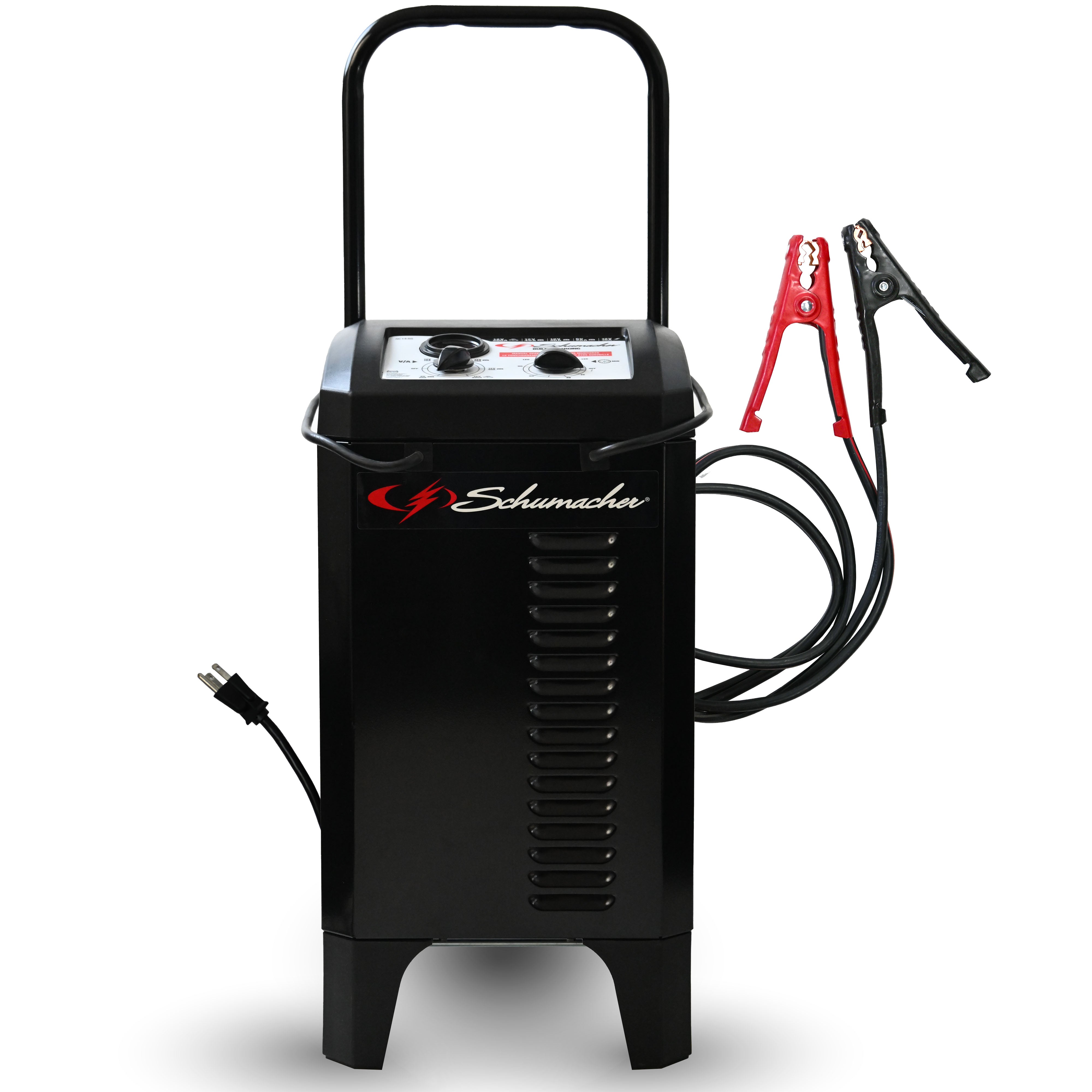
The frozen U.S. charger collection listed SC1446; the current exact page title, form and embedded record identify SKU SC1446. That page links owner manual 0099002195-04 and associates the image shown here. The manual cover prints family codes 105-4/105-5/105-9/105-12/105-13 rather than SC1446, so the exact page is the model bridge—not the cover itself.
The page describes 10 A 12 V Charge, separate 20 A 6/12 V and 40 A 12 V Boost, and 200 A 12 V Engine Start. Its Output Current field aggregates 10/20/40/200 A; those are not one charge rate. The linked manual also has a generic 50 A time-chart column, but the exact page does not assign it to SC1446. This assessment uses only its explicit 10 A 12 V Charge capability.
Charge, Boost and Engine Start are different jobs
For ordinary charging, the page states 10 A at 12 V. The 20 A 6/12 V and 40 A 12 V Boost settings add energy before starting; they are not ordinary Charge rates. The 200 A Engine Start figure is brief cranking assistance, not battery charging or a cordless jump pack. The manual requires a vehicle battery, limits each crank to five seconds and calls for a three-minute pause before another attempt. If a charged battery still will not start the engine, have the battery checked instead of continuing to use Engine Start.
Although the product page lists 6/12 V output, it specifically identifies the regular 10 A Charge mode as 12 V. The 6 V evidence reviewed here is for Boost, not ordinary 6 V charging. Do not treat the product’s 6/12 V headline or a 6 V Boost label as proof of an ordinary 6 V Charge current. If 6 V routine charging is essential, verify that exact function in the delivered instructions or choose a model whose maker explicitly assigns an ordinary 6 V charging rate.
Lead-acid only, with an important small-battery warning
The linked manual limits use to lead-acid Standard (STD), AGM, Gel or deep-cycle batteries. Only AGM and Gel map to the finder’s named subtypes: Standard is not defined as flooded/wet, EFB, calcium or maintenance-free, and deep-cycle is a use class. No lithium mode or BMS condition is documented; check the actual battery label and instructions.
No universal SC1446 Ah maximum is published. The manual uses battery size, state of charge and reserve capacity to guide timing, but its examples are not a capacity limit. It does mark 6–12 Ah and 12–32 Ah small-battery rows not recommended at listed settings—a caution for small powersport batteries, not a general minimum/maximum for every battery. The finder therefore does not count an unknown Ah ceiling as satisfying a numeric capacity request.
Manual timing means active supervision
The 135-minute timer stops the session when the selected interval ends. The manual requires monitoring and stopping when the battery is full; it does not describe automatic float maintenance, a fixed maintain current or unattended storage care. A timer is not a promise that the battery will be full when it expires, so this is a poor choice if you want to leave a battery connected for the device to manage the entire cycle.
The analog ammeter is a basic current indicator, not a diagnostic tool. Choose the voltage/mode and timer yourself, observe the session and disconnect in the stated sequence.
A wheeled workshop unit still needs a grounded outlet
The page lists 120 V AC and 8 A continuous/43 A intermittent input; the manual requires a grounded nominal 120 V circuit. The wheeled unit must stay plugged in and has no internal battery. One clamp pair means one battery at a time, not multiple independent banks.
The page names a 6-foot power cord and separately says “Cable Reach: 6 ft” without clearly assigning that value to the DC lead or total reach. Do not assume 12 feet combined. It lists 26.9 lb and 11.8 x 23 x 11 inches, not independently measured; leave clearance for the handle and airflow.
No IP rating is supplied, and the manual forbids rain/snow exposure, charging a frozen battery, and onboard marine charging without marine-specific equipment. Use a dry ventilated area and standard lead-acid precautions. Before buying, verify the SC1446 label, seller condition, manual and return terms; the maker’s one-unit/manual description may not define every retailer carton.
Who should consider it
Consider the SC1446 if a wheeled 120 V garage charger with a manually supervised 10 A 12 V charge fits the battery maker’s limit. Boost and Engine Start are separate functions. Skip it for unattended maintenance, lithium, two-bank use, outdoor charging or a verified 6 V ordinary-charge need. Its small-battery chart warning also deserves care for motorcycle, lawn-tractor and similar batteries.
Key specifications
Key details at a glance
| Output battery voltages | 12 V |
|---|---|
| Supported chemistries | Lead-acid |
| Rated DC charging current | 10 A |
| Independent battery outputs | 1 |
| Arrangement | Portable plug-in charger |
| Included connection | The current product page says the box includes one SC1446 manual timer-controlled wheeled charger/engine starter and one user manual. The page-associated image shows one clamp pair and AC plug; check exact seller package and delivered label. |
Use the exact model’s instructions for operating limits, supplied equipment and version differences.
Sources for this review
Sources for this assessment
- Frozen Schumacher U.S. battery-charger collection observation for SC1446
- Current U.S. Schumacher SC1446 product page
- Owner manual 0099002195-04 directly linked from the exact SC1446 product page
- Official image associated with the exact Schumacher SC1446 product page
- CPSC Schumacher manufacturer index checked for SC1446

Keep the next step evidence-led
Use the finder to combine voltage, battery chemistry, charging job and setup requirements; then check the exact model and its manual.