
Your needs, this model
Does it fit your priorities?
Can the SC1445 charge a 12 V AGM battery at 10 A?
The current exact manufacturer page describes a 10 A ordinary Charge setting for 12 V and names AGM compatibility; the page-linked manual covers lead-acid AGM and requires a timed, monitored session. This is a documented charger capability, not a recommendation that 10 A is right for every AGM battery. Follow the battery maker’s rate guidance.
Explore this need in the finder →What ordinary charge current is documented for a 6 V SC1445 battery?
The exact page and current manual support 6 V lead-acid use, but they do not state a separate ordinary 6 V Charge current. The 25 A 6 V Boost rating is a distinct mode, not proof of ordinary 6 V charge output. The finder therefore does not count SC1445 for a numeric 6 V minimum-current request; check the delivered instructions and battery maker.
Explore this need in the finder →Can the SC1445 maintain a charged battery unattended?
No documented maintenance mode is established. Manual 0099002630-00 says the charger stops when the timer expires and tells the operator to monitor the battery and charger. The SC1445 is not matched for an unattended float-storage task.
Explore this need in the finder →This is a source-based assessment of Schumacher Electric’s current U.S. SC1445 product page, the owner’s manual linked from that page, and the associated official image—not a hands-on test. The SC1445 is a 120 V AC, single-output, wheeled manual charger with separate Boost and Engine Start positions. It is relevant when a lead-acid battery needs a supervised charging session; the manual operation and timer make it a poor stand-in for an unattended storage maintainer.
An exact product page and an exact-model manual
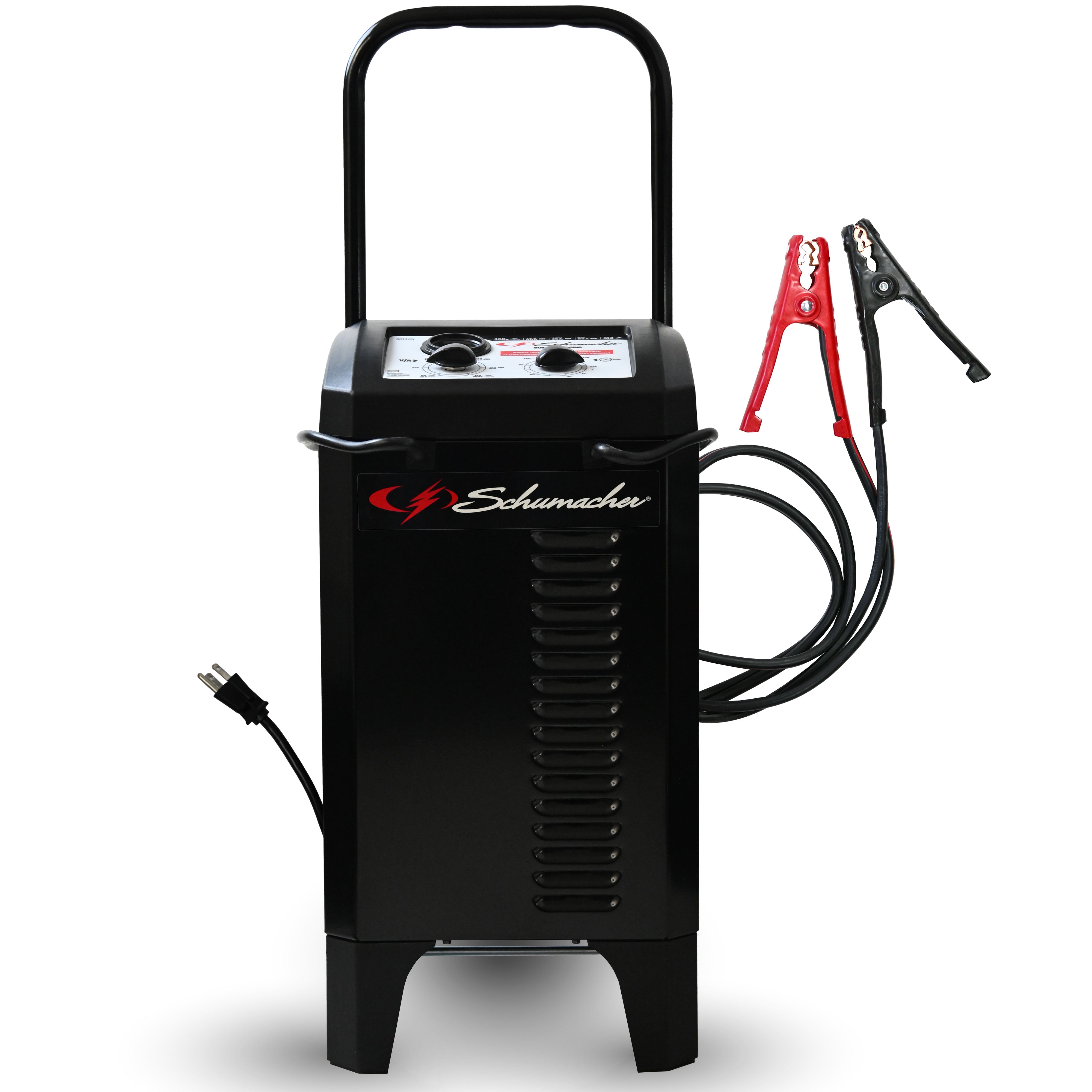
The U.S. charger collection lists SC1445, and the current exact product page identifies the form SKU as SC1445 and supplies GTIN-8 00026666814454. That page links manual 0099002630-00, whose cover also identifies SC1445. The manufacturer page associates the image shown here with the same product record. This is a stronger identity bridge than relying on a family manual or a retailer’s short title, though the image is only an official visual reference, not proof of hidden specifications or delivery contents.
Some older indexed renderings of the same maker route expose different dimensions, manuals, or cable-reach descriptions than the current page. This assessment uses the current live page and its currently linked manual for the operating plan and leaves conflicting physical details unresolved. If a tight fit, exact reach, or a manual revision matters, verify the label and instructions supplied with the actual item rather than treating a cached page extract as a measurement.
Keep Charge, Boost, and Engine Start separate
For an ordinary 12 V charge, Schumacher describes a 10 A Charge setting. The exact product information also supports 6 V and 12 V use, but it does not assign a distinct ordinary Charge current to the 6 V plan. The 6 V arrangement is therefore a documented charging capability here, not a numeric 6 V current claim. The maker separately lists 25 A Boost for 6 V and 12 V, 50 A Boost for 12 V, and a 250 A 12 V Engine Start setting. Those are different operating modes; none raises the ordinary 10 A 12 V Charge figure. A displayed capability is not a battery-specific safe-rate recommendation.
The linked manual calls for the user to select the rate, set a time, and monitor both charger and battery. The timer stops charging when its interval expires; the meter indicates current being drawn by the battery. This is direct control for someone prepared to supervise and stop the session, not an automatic charge-and-float cycle. A timer does not establish a universal amp-hour ceiling: the manual asks the operator to consider battery capacity and state of charge, and its general time examples are not a model-specific maximum rating.
Lead-acid profiles, not a universal chemistry claim
The maker names Standard, AGM, gel, and deep-cycle batteries. Its manual explicitly limits the charger to rechargeable lead-acid batteries and says it is not intended as a general low-voltage device supply except for a starter-motor application. “Deep-cycle” is a battery use class, not an extra chemistry subtype. The manufacturer does not define its Standard label as flooded/wet, EFB, calcium, or every maintenance-free battery, so those finder categories are not inferred. The current linked manual supplies no lithium profile and says nothing about a lithium pack’s BMS; neither LiFePO₄ support nor a BMS condition is established.
Choose by the exact battery label and its manufacturer’s charging instructions. The charger’s 10 A 12 V capability does not mean every AGM or gel battery should be charged at that rate. For a 6 V battery, confirm the permitted profile and rate from the battery maker and delivered instructions; the sources reviewed here do not document a separate 6 V ordinary-current figure.
A grounded outlet, dry location, and one battery output
The manual specifies a nominal grounded 120 V AC circuit, warns not to expose the charger to rain or snow, and requires monitoring during charging. A marine battery must be removed and charged ashore unless the equipment is specifically designed for onboard marine use. The manual also warns against using the unit as a general low-voltage supply. This is a plug-in garage/driveway charger, not a mains-free jump starter or a permanently installed onboard charger.
The manufacturer describes a wheeled cabinet, retractable handle, front-mounted clamps, and a six-foot power cord. Its current specifications list a six-foot “Cable Reach,” but do not separate AC-cord reach from the DC lead length; plan for the actual outlet and battery positions rather than assuming a longer combined reach. The page publishes a 30.3 lb weight. These are maker specifications, not independent measurements. The official image shows the cabinet, controls, a red/black clamp pair, and AC cord; it does not verify the unseen side of the unit, wheel hardware, lead length, or ratings.
Where this manual unit fits—and where it does not
The SC1445 fits a narrow task: one portable 12 V lead-acid AGM or gel battery, a grounded outlet, a battery-maker-approved charging rate, and an operator willing to set and watch the timer. It also documents 6 V lead-acid use, but without a voltage-specific ordinary Charge current in the current product page. A buyer prioritizing an unattended maintenance stage should compare an actual automatic maintainer, not treat the SC1445 timer or 250 A starting rating as that function. For a smaller manual 12 V session, the SC1437 is a separate six-amp model with its own timer and limitations; it is not a substitute for SC1445’s documented 6 V capability.
Before ordering, confirm the exact SC1445 label and seller package; check the battery’s voltage, chemistry subtype, and allowed rate; ensure a properly grounded 120 V outlet and safe lead reach; and read the current 0099002630-00 instructions. Do not plan on unattended float maintenance, a general device-power mode, onboard boat charging, wet-weather exposure, lithium compatibility, or a numeric 6 V Charge rate from this evidence. The manufacturer’s SC1445 product page and its linked owner’s manual are the primary checks for the delivered model and operating instructions.
Key specifications
Key details at a glance
| Output battery voltages | 6 / 12 V |
|---|---|
| Supported chemistries | Lead-acid |
| Rated DC charging current | 10 A |
| Maintenance claim | No |
| Independent battery outputs | 1 |
| Arrangement | Portable plug-in charger |
| Ingress rating | No Rating |
| Included connection | One clamp pair and a nominal 6 ft AC power cord are shown/described; the exact product page package lists charger and manual. Current DC lead length is not separately verified; confirm parts and reach with the seller. |
Use the exact model’s instructions for operating limits, supplied equipment and version differences.
Sources for this review
Sources for this assessment
- Schumacher U.S. Battery Chargers collection product record, frozen page-one enumeration
- Schumacher Electric current U.S. SC1445 product-page capture
- Schumacher Electric SC1445 manual timer-controlled charger owner manual 0099002630-00
- Official image associated with the exact current SC1445 product page
- Earlier official-page search-index extract retained as a conflict record

Keep the next step evidence-led
Use the finder to combine voltage, battery chemistry, charging job and setup requirements; then check the exact model and its manual.