
Your needs, this model
Does it fit your priorities?
Can the SC1364 charge a 12 V AGM battery at a documented 6 A setting?
The manufacturer page and its linked instructions list a 6 A/2 A Charge/Maintain selection for the 12 V lead-acid model. Six amperes is a selectable capability, not guaranteed continuous current or a safe-rate recommendation; compare it with the battery maker's limit and verify the delivered panel/manual because the page-linked manual is a family manual and the page has a mismatched package bullet.
Explore this need in the finder →Can it maintain a charged 12 V AGM battery after charging?
Yes. The manual describes an automatic transition into maintain mode and a small current supplied as needed, with occasional monitoring. It does not specify a fixed float current, and the 2 A label is not presented as a continuous maintenance rate.
Explore this need in the finder →Is it suitable if I need a compact jump pack, 6 V charging or a lithium mode?
No. This is a wheeled AC-powered 12 V lead-acid charger with one clamp pair; Engine Start is a separate function that needs a battery installed in the vehicle and 120 V AC. Its page/manual do not document 6 V operation or a lithium profile. The 20 A Boost and 150 A Engine Start ratings do not turn it into a batteryless jump pack or a higher-current routine charger.
Explore this need in the finder →The Schumacher SC1364 is a wheeled, AC-powered 12 V charger with a separate engine-start mode. Its current U.S. product page identifies the retail model as SC1364 and describes a 6 A/2 A Charge/Maintain selection, a 20 A Boost mode and a 150 A Engine Start mode. These figures describe different jobs: the start and boost outputs do not raise the ordinary charging rate, and the 6 A selector should not be read as a continuous-current guarantee or as advice for a particular battery.
Read the output as three different tasks
For routine 12 V lead-acid charging, Schumacher lists a 6 A/2 A Charge/Maintain choice. The linked automatic-charger instructions describe a 6A<>2A selection and an automatic change into maintenance after charging. Another manufacturer output summary calls 6 A intermittent while listing 2 A and 20 A as continuous, so the exact duty and current mapping are not cleanly reconciled across the material. I treat 6 A as the maker-listed selectable charge capability for a minimum-current screen, not a sustained rating. Check the panel and battery maker's permitted rate before using it.
The 20 A Boost setting is described for adding charge before an engine-start attempt; the 150 A Engine Start figure is a short-duration starting function, not an ordinary battery-charging plan. The manual requires a battery to remain installed in the vehicle for engine start and limits repeated attempts with cooldown periods. The machine also must be plugged into nominal 120 V AC, so it is not a self-contained jump starter for roadside use without a suitable outlet.
One 12 V lead-acid arrangement
The directly linked manual says the charger is for 12 V lead-acid Standard and AGM batteries. AGM is explicit enough for the subtype filter; “Standard” is not automatically converted to flooded/wet, EFB, calcium or every maintenance-free label. No 6 V, lithium or battery-management-system profile is documented in the reviewed page/manual. The exact page names cars, trucks, SUVs, motorcycles and marine use, but the manual says marine batteries must be removed and charged ashore.
The manual's charge-time table gives examples for selected CCA and amp-hour sizes, using a stated 50-percent-discharge assumption. Those examples do not define a universal SC1364 capacity ceiling. The 800 CCA marketing line is also not an Ah limit. If a particular capacity is essential, compare the battery and charger instructions rather than interpreting the example table as a maximum specification.
Wheeled layout and installation checks
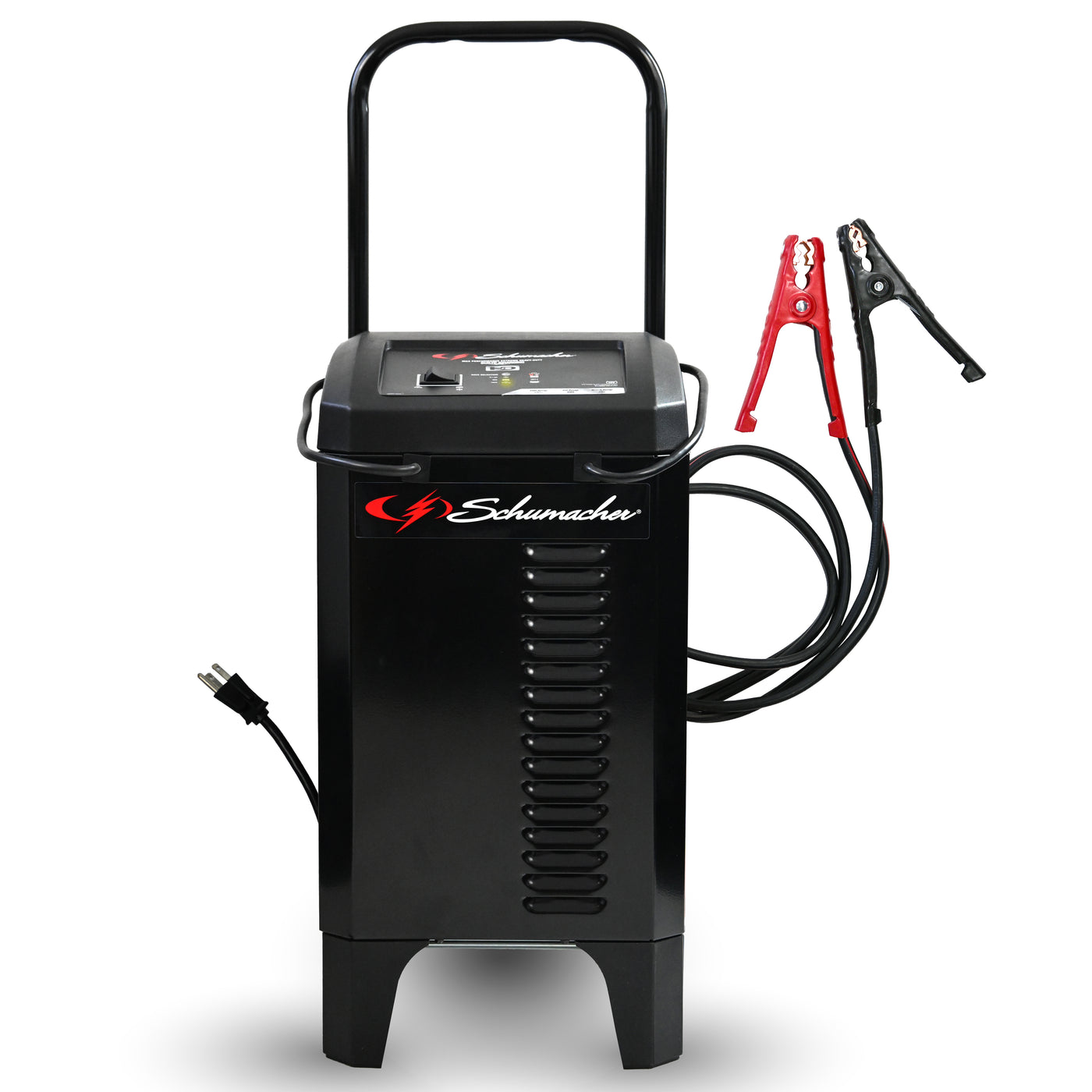
The official image associated with the exact SC1364 product page shows a tall steel-looking case, a raised handle, wheels, an AC cord and a single red/black clamp pair. It is a useful reference for the general layout, not a measurement of the footprint or proof of supplied accessories. The page states a six-foot power cord and six-foot booster cables; confirm usable lead reach at the intended vehicle, especially when the unit must sit away from battery gases and moving engine parts.
Keep the charger in a ventilated, dry location. The linked instructions say not to expose it to rain or snow, not to charge a frozen battery, and to follow the battery manufacturer's specific charging limits. Automatic maintenance supplies a small current when needed after charge completion, but the manual calls for occasional monitoring and does not establish a fixed continuous float current. This is not a weather-resistant unit or a reason to leave an unattended battery without checks.
Documentation limits worth checking
The current product page's model form, embedded SKU and GTIN identify SC1364, but one feature bullet mistakenly says that the package includes an SC1361L. A separate package line names SC1364 and the manual, so the conflicting phrase should be treated as a page error rather than a second configuration. The manual linked from the page is a family document whose cover lists 101-7/101-9 rather than printing SC1364; it helps explain operation and safety but is not an exact retail-model spec sheet. Maker page renditions also differ on size, weight and warranty duration. Verify the product label, included manual, actual dimensions and seller warranty rather than relying on those conflicting details.
Where it makes sense
Consider the SC1364 when a wheeled garage unit for one 12 V AGM battery suits the task and the 6 A/2 A charge-maintain selection, 20 A Boost and separate Engine Start capability are useful. It is not the right match for 6 V or lithium batteries, multiple simultaneous outputs, a self-powered jump-pack role, wet-weather operation, a known Ah ceiling or a need for verified physical clearances. The SC1280, for example, is a smaller portable 6 V/12 V charger with a higher page-stated 12 V charge figure but no corresponding engine-start output; the SC1364 trades compact portability and voltage flexibility for a wheeled shop format and separate starting modes. Follow the actual battery and equipment instructions. This assessment is based on manufacturer documents and an exact-page-associated image, not hands-on use or performance testing.
Sources: Schumacher's SC1364 product page, its linked Automatic Battery Charger manual, and the CPSC Schumacher recall index (a limited index check, not a safety clearance).
Key specifications
Key details at a glance
| Output battery voltages | 12 V |
|---|---|
| Supported chemistries | Lead-acid |
| Independent battery outputs | 1 |
| Arrangement | Portable plug-in charger |
Use the exact model’s instructions for operating limits, supplied equipment and version differences.
Sources for this review
Sources for this assessment
- Current Schumacher U.S. automotive charger collection card for SC1364
- Current Schumacher SC1364 product page and embedded U.S. product-form identity
- Automatic Battery Charger manual directly linked from the current SC1364 product page; cover model codes 101-7/101-9
- Official image associated with the exact Schumacher SC1364 product page
- CPSC Schumacher manufacturer recall index, scoped SC1364 name check

Keep the next step evidence-led
Use the finder to combine voltage, battery chemistry, charging job and setup requirements; then check the exact model and its manual.