
Your needs, this model
Does it fit your priorities?
What ordinary charge current does the SC1363 document at 6 V and 12 V?
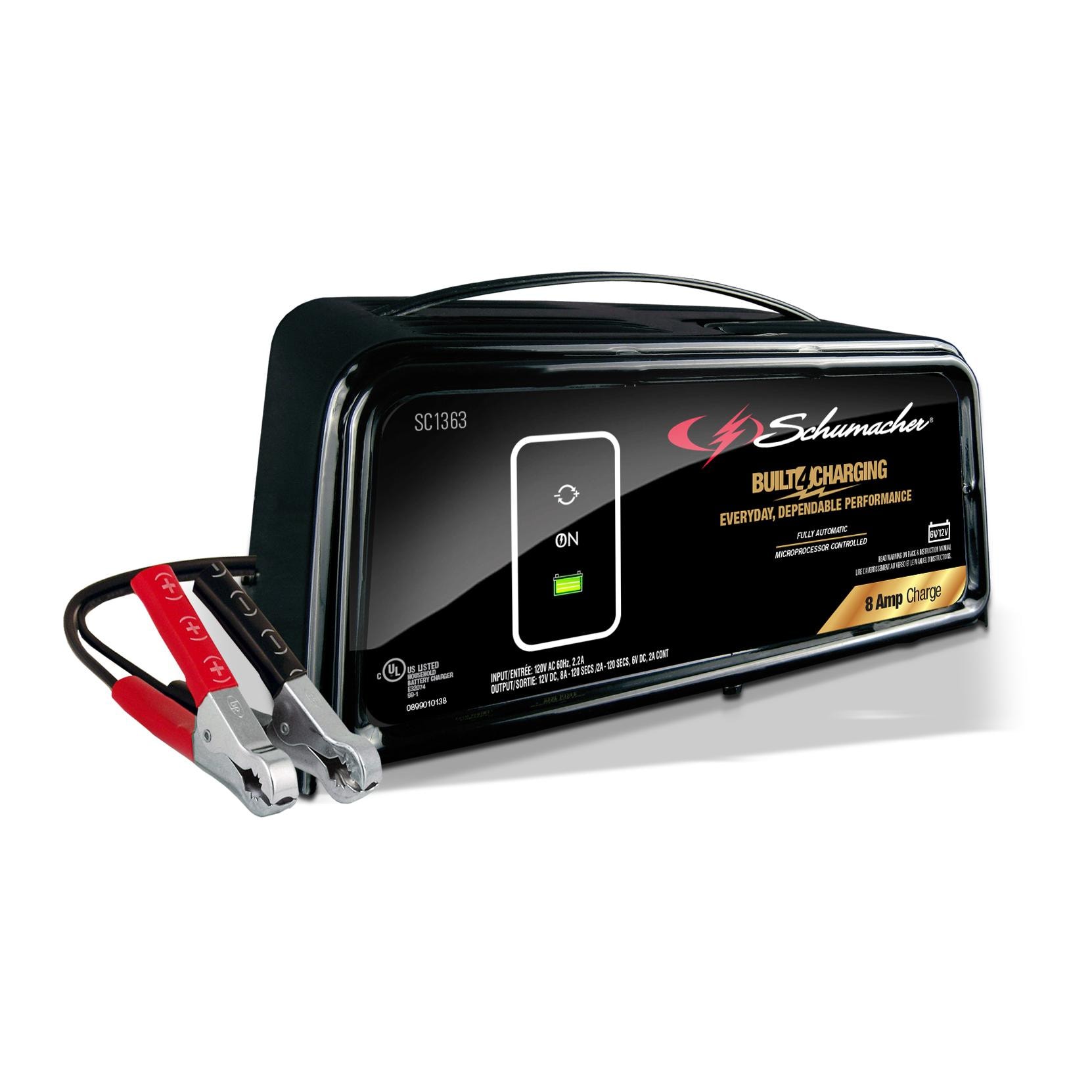
Schumacher lists 2/8 A at 6/12 V; the product page and exact-model image associate 2 A with 6 V and up to 8 A with 12 V. The manual says charging current adjusts with battery size and then switches to a small maintenance current when needed. The 8 A capability is not advice for a specific battery, and no fixed float current is stated.
Explore this need in the finder →Which lead-acid subtypes are mapped for the SC1363?
The current page and linked manual name Standard (STD) and AGM, but the manufacturer’s structured battery-type field lists AGM alone. AGM is the only named questionnaire subtype mapped. Standard is not assumed to mean flooded/wet, EFB, Gel, maintenance-free, or calcium; no lithium profile or BMS condition is documented.
Explore this need in the finder →Can the SC1363 stay aboard a boat or power vehicle electronics?
No on-board or general power-supply plan is documented. The unit is an AC-powered portable charger; its linked manual requires grounded 120 V AC and dry ventilation, says marine batteries must be removed and charged ashore, and says it is not intended to supply a low-voltage system except in a starter-motor application.
Explore this need in the finder →Does the SC1363 have a stated Ah ceiling or fixed float current?
No. The linked manual provides conditional charge-time examples, not a universal Ah limit; it says maintenance supplies a small current when necessary but gives no fixed value. Any entered Ah ceiling therefore fails closed in the finder rather than becoming a guessed fit.
Explore this need in the finder →This is a source-based assessment, not a hands-on test. I reviewed Schumacher’s current U.S. SC1363 page, the manual linked from that page, and a retailer listing whose product photo visibly identifies the SC1363. The manual cover is generic; Schumacher’s exact page lists its UL family model code and links to that manual.
A small plug-in charger with a distinct 6 V/12 V job
The SC1363 is a bench-style 120 V AC charger/maintainer for one battery connection at a time. Schumacher describes it as a basic charger in a steel housing, with LED status, automatic charging, maintenance monitoring and a desulfation mode. The current product page lists two DC output voltages and a 2/8 A output rating for 6/12 V. Its detailed text associates 2 A with 6 V and an 8-to-2 A charging/maintenance range with 12 V. Those are charger capability figures, not a safe-rate recommendation for every battery; follow the battery manufacturer’s permitted charge current.
That distinction matters when comparing an ordinary charger with a larger jump-start or shop charger. The SC1363 page does not describe Boost, Engine Start or a regulated 12 V power-supply mode. Its supported uses here are battery charging and post-charge maintaining, not cranking an engine or powering vehicle electronics. The current official source page does describe desulfation/reconditioning, but that feature is not a promise to recover a damaged battery; the manual says charging can abort when a battery will not accept normal charge.
Do not turn the 8 A headline into an Ah limit
The page and image identify the charger’s upper 12 V capability as 8 A; the manual says current adjusts automatically with battery size. The same manufacturer text identifies a 2 A 6 V path. After charge completion, the green indicator means the unit has changed to maintenance mode, where it supplies a small current when needed. Schumacher does not publish a fixed maintain current or a universal battery-capacity ceiling in the linked manual. Its example charge-time chart is conditional, not an Ah maximum. If your battery has a known capacity or charging limit, check its own label and instructions rather than treating an 8 A tool rating as proof of compatibility or speed.
The SC1363 can be screened for its stated 2 A 6 V or 8 A 12 V upper routine capability, but the finder’s current floor means only that the product page lists that output capability. It does not predict the current a given battery will accept at a particular state of charge. A request for more than 2 A at 6 V or more than 8 A at 12 V is outside the published output figures. A numeric Ah request is withheld from matching because the maker has not stated a universal maximum.
Lead-acid only; AGM is the explicit subtype
The page’s prose and the linked instructions name Standard (STD) and AGM lead-acid batteries. Its structured battery-type field lists AGM alone. I therefore map AGM as a supported named subtype, while leaving “Standard” unmapped to flooded/wet, EFB, Gel, maintenance-free or calcium. The 6 V and 12 V plans are lead-acid plans only; neither the product page nor this manual documents lithium chemistry or a BMS condition. A different Schumacher charger may have a separately documented lithium plan, but that does not transfer to the SC1363.
There is a voltage-handling wrinkle to verify: the page lists 6/12 V output, and the manual’s troubleshooting section says the unit uses automatic voltage detection. Earlier preparation instructions also tell the user to identify the battery voltage and set a selector if the model has one. Do not guess the battery voltage or assume the panel behaves like another charger. Read the instructions supplied with the exact unit, confirm the battery label and let the documented selector/detection process govern connection.
Grounded outlet, dry placement, and no onboard marine use
The SC1363 must stay plugged into nominal 120 V AC while charging. The manual calls for a grounded outlet and a dry, ventilated work area, warns against rain and snow exposure, and says not to charge a frozen battery. It directs users to remove a marine battery and charge it ashore; a boat-installed charger is a different kind of equipment. The charger’s automatic maintenance mode also requires occasional monitoring: if it must supply its maximum maintenance current for twelve continuous hours, the manual says it will abort, often because of a load or a bad battery.
The maker’s current product page describes one charger and manual, a six-foot power cord and booster cables. A retailer’s exact-model listing image shows the SC1363 name on the face, one clamp pair and the AC plug. The image confirms what is pictured, not a seller’s delivered package. The same retailer listing has contradictory minimum/maximum-current labels and differing dimensional data; Schumacher’s current page presentations also disagree on weight and size. Do not use these conflicting measurements to plan a close-fitting shelf, vehicle bay or installed space. Check the actual nameplate, delivered instructions, cable reach and return terms before purchase.
Who should compare it—and what to verify
The SC1363 is a candidate when you need a straightforward AC-powered unit for a single 6 V or 12 V lead-acid battery, with automatic charge adjustment and maintenance after a charge. Its particular distinction is the combination of 2 A at 6 V and up to 8 A at 12 V; it is not a multi-bank unit, an onboard installation, or an engine starter. A different charger may suit a higher current floor or several connected batteries, but compare only its documented ordinary-charge plans rather than Boost or starter ratings.
Before choosing this exact model, verify the battery voltage and chemistry, its permitted charging rate, the current manual for SC1363, grounded 120 V supply and dry ventilated location. If your decision depends on capacity, a fixed float-current value, a precise installation footprint, lithium support or boat-mounted charging, the evidence here does not answer that requirement. Schumacher lists a one-year warranty for the manufacturer-page offer; confirm what applies to the actual seller and package. No availability, third-party package, price or service outcome is inferred by this assessment.
Key specifications
Key details at a glance
| Output battery voltages | 6 / 12 V |
|---|---|
| Supported chemistries | Lead-acid |
| Rated DC charging current | 8 A |
| Independent battery outputs | 1 |
Use the exact model’s instructions for operating limits, supplied equipment and version differences.
Sources for this review
Sources for this assessment
- Schumacher Electric current U.S. Automotive Battery Chargers collection card for SC1363
- Current Schumacher Electric SC1363 U.S. product page and exact product form
- Manual 0099001939E-R3 directly linked from exact SC1363 page; generic Automatic Battery Charger booklet
- AutoZone exact SC1363 product listing and associated retailer photo
Keep the next step evidence-led
Use the finder to combine voltage, battery chemistry, charging job and setup requirements; then check the exact model and its manual.